John Kiely's highlight of another stellar year? The dramatic comeback against Tipp
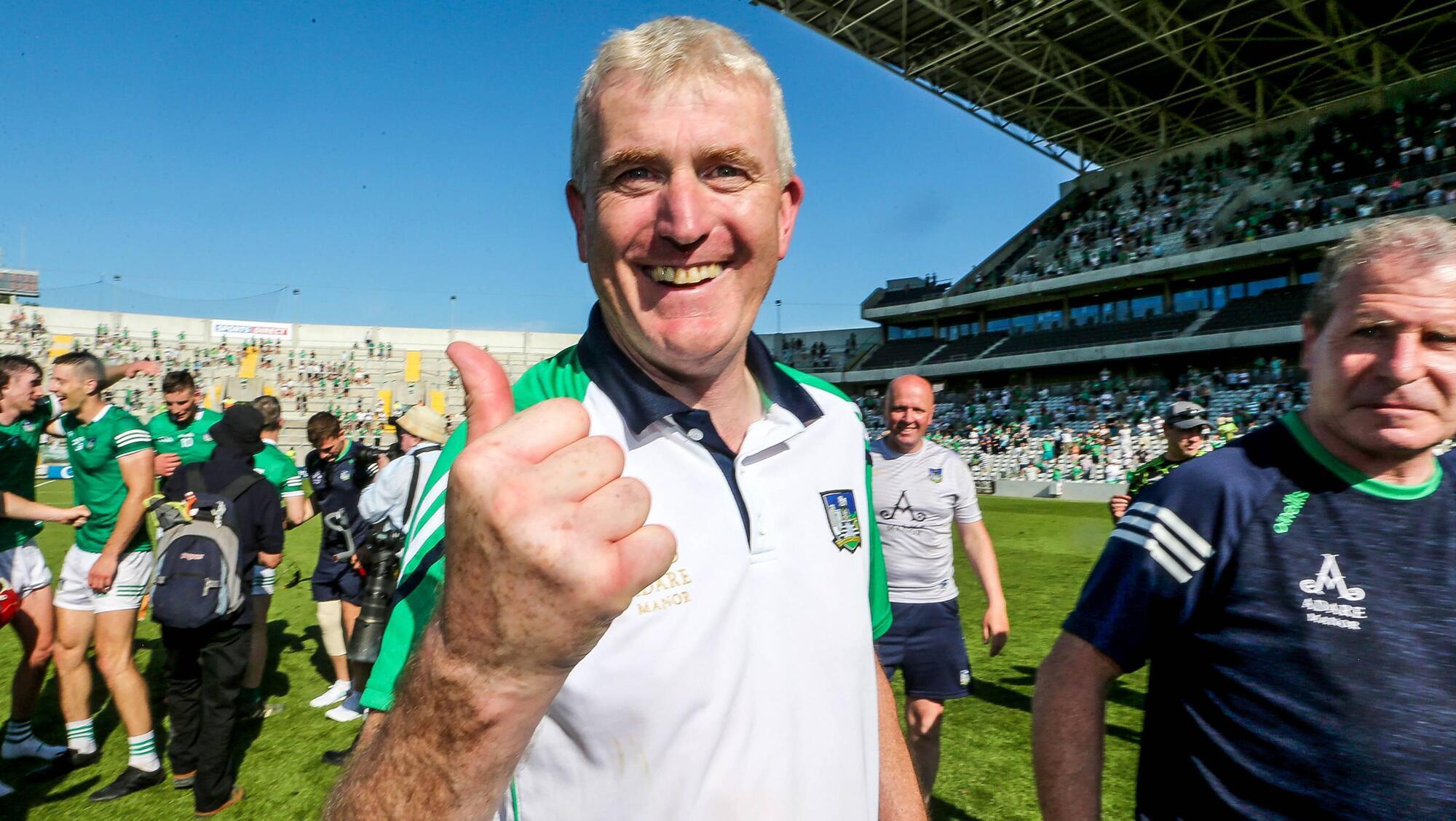
THUMBS UP: An elated John Kiely after Limerick overcame a 10-point half-time deficit to beat Tipperary by five points in the Munster SHC final at Páirc Uí Chaoimh.
2022 is around the corner, a light lining the horizon. Before consigning 2021 to history, though, a chat with the hurling manager who ruled the year.
John Kiely gives due consideration to the opening question, and his answer gives a glimpse of the process that gave Limerick a third All-Ireland title in four years. His highlight of the year?
“It’s an interesting one. Looking back on it, you could pick out individual performances that were exceptional, and individual moments of brilliance.
“But from a team perspective I think the first 15-20 minutes of the second half against Tipperary in the Munster final was a really significant passage, a really significant period in the game.
“If we had not responded in the way we did, the way the boys did, the game could have been gone from us very quickly. It was great to see the boys trusted themselves and trusted the work they’d done, and found the energy to grab the game by the scruff of the neck — to take control of it, and to convert that control into scores.
“Once we got that momentum — and Liam (Sheedy, Tipperary manager) said it on the day — it’s very hard to stop. We knew we had to gain that momentum because we felt we’d be very hard to stop if we did.
“That was a significant game, because obviously a loss at that stage sends you down a different route, a more difficult route. And the way the championship was structured last year, with two weeks between each game, was the most ideal schedule of matches you could possibly have.”
Still, Kiely and his backroom team are experienced enough now to deal with most of the surprises a championship can throw at you. Take Peter Casey’s red card in the All-Ireland semi-final.
“There were challenges,” says Kiely now. “There’s only one route in this game when there’s a challenge put in front of you, and that’s to take it on. And if that means a clip on the chin then you take a clip on the chin and you go with it.
“In Peter’s case we were absolutely certain from the evidence we had available to us that in his situation it was a complete and utter certainty that he wasn’t in the wrong. We had to respond in the way we did by challenging that decision, and that was vindicated by the subsequent decision to allow him to play in the final.
“So we were very pleased with that but it was difficult, and it was a distraction for a few days — but it was the right thing to do and the player deserved it, Peter Casey deserved us doing that for him and with him.
“I was very happy he got to play in the final and he repaid that trust by the performance he put in during the 28 minutes he was on the field. He was sublime in that period of time and really set us on our way with some of the scores he was able to take.
“It was a pity he got injured but there’s the challenge for him, to respond in the right way, and he has already.”
Limerick’s dominance of Cork in that All-Ireland final was the most powerful display in a decider since Kilkenny’s win in 2008. How confident was he ahead of time of a performance like that?
“Our performance levels throughout the season mirrored previous seasons where we were incrementally improving as we went along.
“Energy levels were really good and the players’ mentality going into the games was pitch-perfect in terms of their focus — how relaxed they were in one sense but also very focused on what they wanted to do.
“I thought they delivered on what they set out to do in the games and it was irrelevant who they were playing, to be honest. It was about ourselves, and implementing our performance and game plan, and taking the game to a level of intensity that we wanted to play at. And we were able to do that.
“You asked if it’s possible to comprehend that in the course of a game, and I’d say the focus of the players on the pitch was mirrored by us as coaches and backroom off the pitch.
“We stayed in the moment to the very last, to the final whistle — we didn’t let our intensity levels drop in terms of focus and concentration, in identifying when a change was necessary and getting the right subs on, tactical switches and analysis — we didn’t stop analysing the game because we were eight or nine points up.
“We all kept our standards high to the final whistle, which mirrored the players’ focus on the field.”
Does having an experienced group on the sideline make decision-making easier?
“We have good routines, good structures, but we also spent a lot of time developing those over the years.
“Everybody now knows their role on match day very well, and we’re fortunate enough to have a very strong analytical team who are very good at feeding us information during a game, which makes our job easier. And it makes our decision-making more accurate.
“The people on the sideline have a lot of experience, so there are a lot of experienced eyes on what’s happening. For me to have those people with me is great comfort when we make decisions — we can trust that we’re probably making the right decision.”
That doesn’t make the rhythm of the inter-county season any easier, he adds: “No. That’s challenging.
“Look at the last two seasons. We had one season which started in September and finished in December, one which started in April and finished in late August, and now we have a season starting in January and finishing in July.
“Nothing is ever the same. We had no round-robin the last couple of years, but next year there is a round-robin. You can’t take for granted that what you did last year will be good enough this year — you can be assured it won’t be good enough, in fact.
“The same amount of time and attention to detail is required for planning the season out, and during that season, being aware of what’s needed at a particular time and sticking to the plan rather than responding to outside pressures... like losing the first two games of the league.”
He brought it up: The All-Ireland final is down for decision this July. Is he in favour of that move?
“When we saw the schedule in terms of the league, it’s a bit later than normal, but I can see they’re trying to give a bit more room to the Fitzgibbon Cup and the provincial and All-Ireland club competitions.
“The league final is very close to the first round of the championship, which is something that teams are probably cognisant of, and the other item that jumps out at me is that the teams who play in the Munster final have quite a substantial break until they play again. Is it perfect? It’s not, but it is what it is and we all have to get on with it. It’ll never suit everybody because everybody has different challenges, but those challenges are there to be overcome.
“At least we have a lot of experience in managing our schedule, and we’ve done that quite well in the past, which gives us confidence that we’ll be able to do it again in 2022.”
CONNECT WITH US TODAY



Be the first to know the latest news and updates