Penalty shoot-outs in the GAA: High drama or awful end?
Connacht will be the first GAA province to try a 'golden score' mechanism over a penalty shoot-out in January's pre-season Leagues. With Championship games finishing on the day in 2022, many will be eyeing up alternatives to spot-kicks
Penalty shoot-outs in the GAA: High drama or awful end?

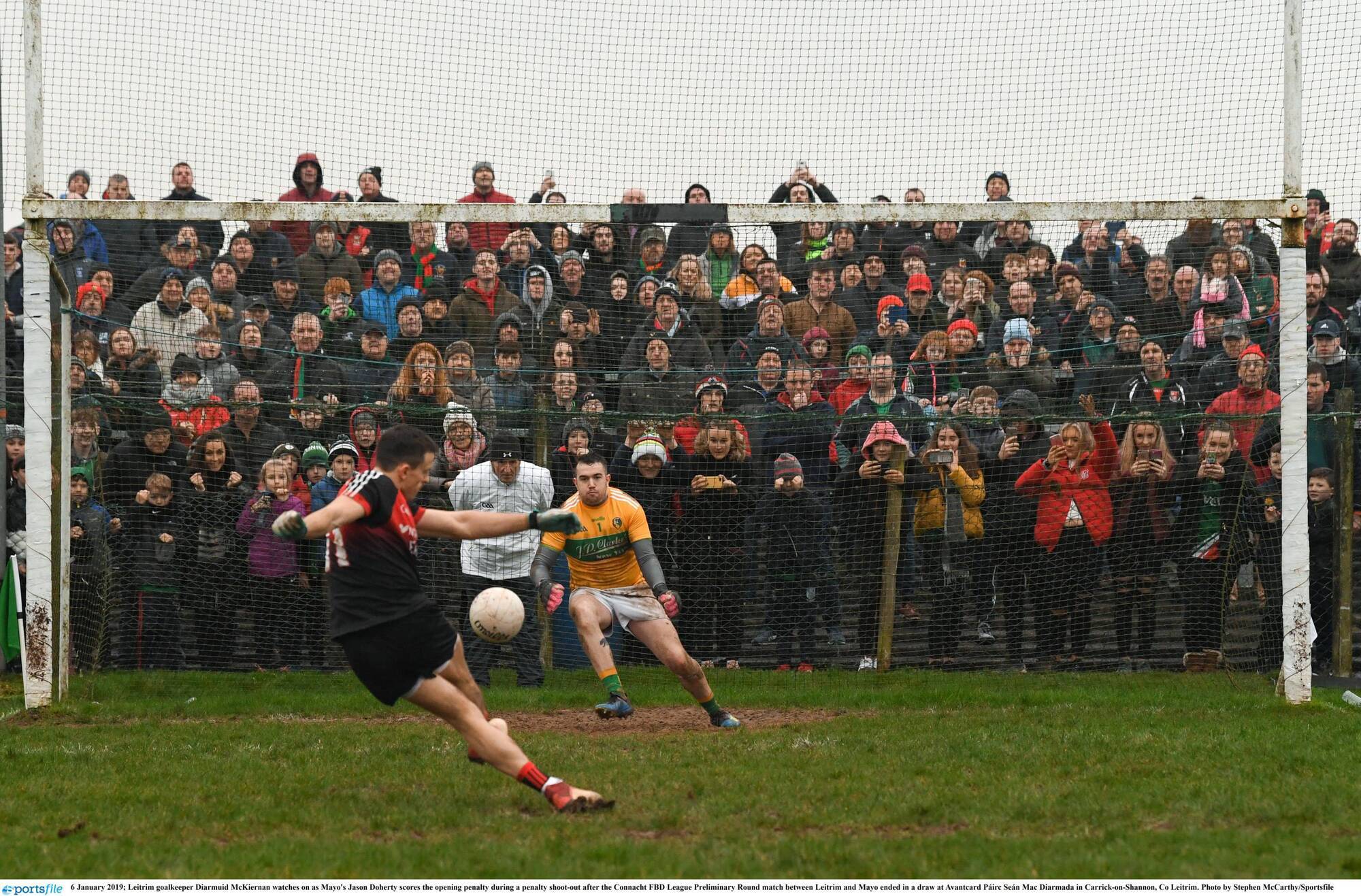
CAPTIVE AUDIENCE: Mayo's Jason Doherty beats Leitrim keeper Diarmuid McKiernan in a penalty shoot-out in the 2019 Connacht FBD League in Carrick-on-Shannon. Picture: Stephen McCarthy/Sportsfile

At the end of November, neighbours Clarinbridge and Oranmore-Maree met in the Galway Minor A hurling final in Pearse Stadium, an epic contest that was eventually decided after a penalty shoot-out.

Level after extra time, both clubs favoured a replay, but the county board had ruled that the match must be finished on the day. When the teams still couldn’t be separated after five penalties each, both sets of supporters chanted for a replay in a clear signal of discontent at what was unfolding.

With the contest now gone to sudden death, everyone knew by then that the misfortune of one young player would decide the result. In the end, that player was the outstanding Rory Burke, the Oranmore-Maree centre-back who had done more than anyone else to bring the contest that far.

Burke, who finished with a tally of 2-8, had already converted once in the shoot-out, while it was another Burke penalty at the end of extra-time which necessitated the shoot-out. Yet this time around, Chris Callanan saved from Burke.

Clarinbridge showed incredible dignity and class in victory. A number of their players commiserated with Burke before beginning their own celebrations. Despite securing successive Minor A titles, some within the club still regretted not making a stand at the end of extra-time, and particularly when it went to sudden death in penalties. How would both teams have been punished if they had walked off the field and demanded a replay the following week?

Penalties may provide the ultimate drama, but it’s a horrible way for a team to lose a game, particularly a young minor team trying to secure a landmark win for their club. There’s also no doubt that a championship win after a penalty shoot-out — at any level — can leave a bittersweet taste in the mouths of the victors.

“I still think it’s an awful way to bloody well end it,” said St Finbarr’s manager Paul O’Keeffe after his side defeated Castlehaven in a penalty shoot-out in the Cork senior football semi-final in November.

“There was nothing between the two teams. And you end it like that then, it’s awful. I still think we should have a mechanism where we finish the game through some kind of play, even if it was another five minutes of extra time or golden score or something where at least you feel like: ‘OK, they scored more than us, we were beaten’.”

O’Keeffe was better equipped than anyone to make a judgement on a penalty shoot-out because his side had lost the 2020 semi-final replay to Castlehaven in a similar manner. It’s not ideal for either side, but it’s definitely becoming more common; a sizeable number of big club games were decided by penalties at the business end of the local championships.

It has rarely happened at inter-county level. Down defeated Offaly on penalties in last year’s Christy Ring semi-final, but the practice is sure to become a lot more common in 2022. In November, the GAA decided that the All-Ireland hurling and football finals will be the only championship games in 2022 with a provision for replays. That will certainly mean a whole pile more of extra-time and, inevitably, a lot more penalty shoot-outs.

There is never an easy way to lose a game. A player could miss a free or a penalty with the last puck or kick in a big game and then suffer even more pain than in a penalty shoot-out because it was all on him.

That happened in the Galway championship in October when Sarsfields met Loughrea in a crucial game, and Sarsfields’ fate in the competition came down to a last-second penalty. Loughrea were leading by six points and were guaranteed to win the match, but securing two group points would have been irrelevant in the grand scheme because of scoring difference.

If Kevin Cooney had hit the net, Sarsfields would have been through, and Loughrea would have been out. Cooney drove a shot towards the top corner, but it was brilliantly saved by Loughrea goalkeeper Gearóid Loughnane. In the end, Sarsfields went out by three points on scoring difference.

It was a cruel way for Sarsfields to depart the championship, having won two of their three group games, but it was even crueller for Cooney than it would have been in a penalty shoot-out. Despite the loneliness and isolation attached to taking penalties, especially around missed shots, penalty shoot-outs almost grant more of a licence for get-out-jail cards because there has always been a lottery element attached to them.

The biggest challenge for GAA players though, will be around the culture change created by penalty shoot-outs. In his end-of-year report, Tyrone county secretary Dominic McCaughey said that the practice is “totally alien” in Gaelic games. He argued that the purer alternative “is to produce a winner from general play, not a staged series of set pieces”.

That refers back to O’Keeffe’s remarks about an additional period of extra time or a ‘golden score’. The golden goal or golden point is a rule used in baseball, lacrosse, field hockey, and ice hockey, where the team that scores that goal or point during extra time is the winner.

Although the term is not used in the NFL, a similar rule also applies when a touchdown or safety, or any score on any possession after the first possession, wins the game in overtime.

In soccer, the golden goal was used at various stages over the years, but it only really came to prominence in European and world football between 1996-2004.

The Euro 96 and Euro 2000 finals were decided in that manner, with goals from Germany’s Oliver Bierhoff against the Czech Republic, and France’s David Trezeguet against Italy.

There were three golden goals scored in the 2002 World Cup, while Uefa introduced the ‘silver goal’ to decide a competitive match for the 2002-03 season, where the team leading after the first half of extra time would win.

In August of 2003, Ajaz qualified for the group stages of the Champions League by virtue of a silver goal against Austrian club GAK.

The following July, the Euro 2004 semi-final between Greece and the Czech Republic was decided on a silver goal after Traianos Dellas scored for Greece at the end of the first period of extra time.

That was the last time the golden or silver goals were ever used though, as they were removed from the laws of the game after Euro 2004.

It was widely perceived as a failed experiment because it hadn’t brought about more open and attacking play as originally intended.

It had also led to more cautious and cagey football because the teams were desperate not to lose at that stage of the match.

The rule also sparked some furiously angry reactions; the Czechs argued that Bierhoff’s goal in 1996 was offside.

The golden goal rule is still utilised in NCAA soccer championship tournaments in the US, but could it work in the GAA?

The concept will be introduced for the first time during the upcoming Connacht FBD League.

With the start times of all games at the Air Dome at Bekan having been brought forward to comply with new Covid restrictions to ensure they are finished by 8pm, the winner will be decided by a ‘golden score’ if the teams finish level at the end of normal time.

The concept may work well in football, but it’s hard to see it ever being applied in hurling, when a point could be scored just seconds after extra-time begins.

On the other hand, that could be counter-balanced by a tweak based on the ‘silver goal’ principle — whichever team is ahead at half time in the second period of extra time would win the game.

It would still be a hard sell, but it may be a more acceptable way to decide a big championship game than a penalty shoot-out.

Either way, there’s never an easy way to lose a big championship game.

More in this section

Cookie Policy Privacy Policy Brand Safety FAQ Help Contact Us Terms and Conditions

© Examiner Echo Group Limited