Been there, didn’t do that. Should I have?: Experts on the dos and don'ts of All-Ireland final day
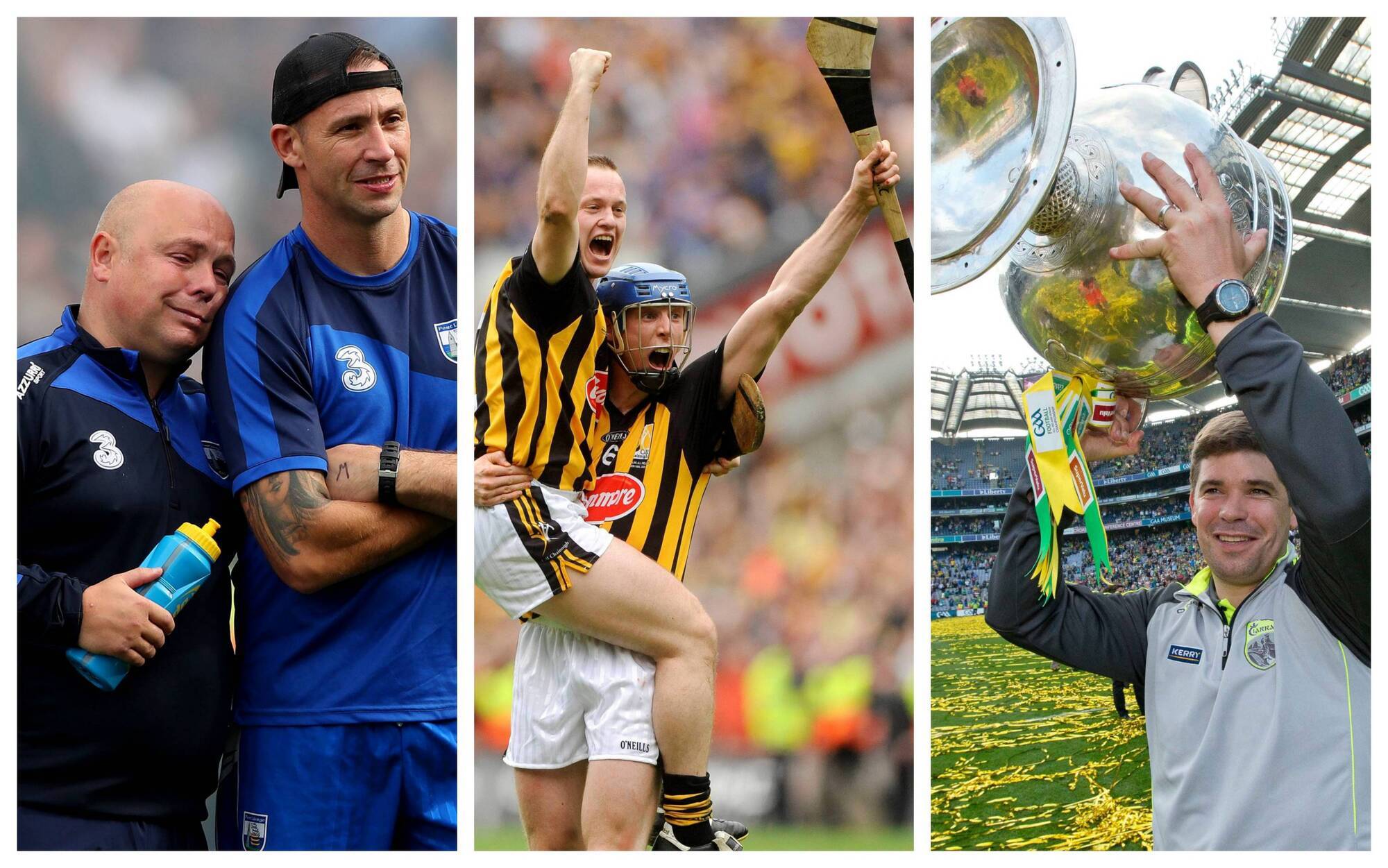
AGONY AND ECSTASY: From left, Derek McGrath dejected after defeat in the 2017 All-Ireland final; middle, Michael Kavanagh and Brian Hogan, Kilkenny, celebrate at the final whistle after Kilkenny beat Tipp in '09; right, then Kerry manager Eamonn Fitzmaurice celebrates with the Sam Maguire Cup in 2014. McGrath, Hogan and Fitzmaurice are among our experts on the dos and don'ts of All-Ireland final day.
Perform. Win. Winners write the story and losers disappear into obscurity. All-Ireland final day is a special and spiritual occasion that a privileged few get to partake in. Enjoying the experience is part of it but again winning is central to that enjoyment. Losing an All-Ireland is zero fun. Balance of approach is key and experience and maturity helps. There are a lot of sideshows that can drain priceless energy, harm performance and need to be avoided.
From suits to tickets, to media gigs and sponsorship opportunities to worry about family and social arrangements post-match there are plenty of pitfalls. For me, it was always about routine and having a really narrow focus on the game at the weekend. Thinking about the match but not over-thinking it. Getting plenty of rest and sleep but not too much.
By Sunday I would have my role reduced to three key points that could fit on a post-it. That’s what I read on the bus on the way into Croke Park and in the dressing room beforehand. Get those right, I was happy and hopefully had contributed to a victory. Anything else was bonus territory.
Play the occasion and not the match. It happens annually and rarely ends well. The red flags can sometimes be visible as early as the immediate aftermath of the semi-final win. For me, the biggest mistake I ever made in the lead into an All-Ireland was before my first one in 2000 and would never happen nowadays.
I had returned to UCC in early September to pursue my H Dip in Education. Advice on nutrition was thin on the ground at the time and I decided to have chicken and rice from a Chinese takeaway. I thought I was being the ultimate pro. My reward? Serious food poisoning. I was laid low for over a week. In between hallucinations and recurring trips to the bathroom, I watched the All-Ireland hurling final from the sofa in Lixnaw. My mother Celine (a nurse) and Hazel Fitzell, a doctor living across the road from us, cared for me.
Otherwise, I would have been hospitalised. Páidí rang my Mom daily to keep tabs on me, advising her on more than one occasion that a good lamb stew would sort me out. I made it back for the drawn final but was myself for the replay when I played better. I haven’t eaten a Chinese since.
You must have total belief - that the work you have done as a player, in the lead up to the final, will allow you to put in a good performance. Total belief that you can carry out your skillset. No distractions or external influences like supporters, tickets and the weather. Tunnel vision.
You will stand firm in your internal battle with your opponent, especially when moments of the game aren’t going to plan. Every player has several personal and team targets they want to achieve. Targets that when the final whistle shrieks they can look in the mirror and say ‘I achieved my personal and team goals’. Basic targets like getting a quick touch of the ball, slipping a handpass or executing a 20-yard punt-pass.
Making physical contact with your opponent, setting down an early psychological marker can shake off any pre-match nerves. Have studied your opponent and when he has been replaced, know the next likely opponent to enter your patch. Believe in your gameplan and persist with its execution, as this is the reason that you’re in the final.
Be too emotional. This applies to player and manager. Balancing your emotions is critical. The famous quip of “Control your emotions or your emotions will control you” is well worn but so true in everyday living. As management, how do you measure the mood of 26-plus individual males on the eve of an All-Ireland final?
Sports psychologists and performance coaches can tell a manager that “they’re ready, they’re hungry and they’ve never looked in better shape”. The only true measure is hindsight and hindsight is a great selector. A manager can keep everyone cool, calm and collected only for his team to look lethargic and flat in the first half. He gives them a half-time rollicking and they win, he’s a genius. Another manager will do the reverse and they lose, he’s a flop. The reality is that each individual player must figure out what’s works for them, but his manager must know what makes each individual tick well in advance of a big game. Why and Who. Why do you manage or play football at the highest level and who do you play for? Every player will suffer moments of poor skill execution over the course of 70-plus minutes.
Managers can only tweak and encourage and believe in his own gameplan and players during this time. Remember, It’s a game not a court trial.
The thought process prior to a final can often be how something monumental or special is required to achieve victory. I’ve always believed the opposite to be true. A performance is required and performances are produced from well-coached and highly focused group with a huge belief in their gameplan. As a player, I always craved simplicity and consistency the day of a big match. The usual team meetings. The usual speakers, key tactical points reinforced, the same coaches organising hotel stretches or activation sessions, right up to the dressing room environment at half-time.
Teams have a routine they follow at half-time; calm and quiet recovery time, stats feedback, tactical discussions and a final speech. In the 2010 final, we were three points behind to Down and playing poorly. I don’t think that game was won by any rousing speech or drastic changes. For me it was experience, calmness and strength in depth that got us over the line. Those things and Daniel Goulding’s left foot! Individually most players will have developed individual goals or triggers to use during a game.
I remember settings goals for games with only slight changes from game to game. As a half forward, it was usually a focus on winninng breaks, making hard runs to show for the ball and maybe one more that changed from game to game. These individual goals, when allied with the team’s goals or KPI focus meant my mind and energy didn’t get wasted on things outside of my control.
Have no regrets, no ‘what ifs’. All-Ireland final day is a day like no other. The traffic, crowd, parade and pageantry are all on a different level to anything experienced on previous big days. With all the pomp and ceremony, teams and players have to be ready for an unexpected change in circumstances that forces a change to their plans; bus being delayed, different dressing room, not getting your usual seat on the bus or in the dressing room, extra-time in the minor match.
From the trivial to the significant, a player’s only focus should be on controlling the controllable. Preparation for final day takes place well before the big day. The itinerary for the day itself is planned out down to the minute allowing players to use visualisation to walk through the day several times in advance. The key thing is to keep the most important thing the most important thing - that is performing. My mind sometimes drifts back to the 2009 final against Kerry and I question everything I did individually and we did collectively before and during the game and wonder should we or could we have done something different or better that would have improved our performance. That defeat is still galling as I’m sure any All-Ireland final defeat is.
Regret is a terrible thing; I should have made this run, I shouldn’t have made that pass, we should have changed tactics, what if we did this, the list goes on. I try to console myself by saying the lessons learned that dark September day were crucial for getting over the line 12 months later.
In an All-Ireland final you must not waiver from your routine, nor your diet, no matter how good (or in myself and Stevie McDonnell’s case, how bad) that happens to be. As a young lad I had very little self-awareness and that overlapped into my football. I never knew how I should act before a game, I looked round the changing room and thought I needed to join the kick-the-doors and punch-the-walls brigade.
But as I developed personally, and as a player, I realised I was not that soldier. I became more relaxed and enjoyed the build up a bit more, enjoyed a laugh before the game and while that hardly made me a better player it certainly made me more likely to perform in the bigger games. It’s important that you don’t allow that to change among all the confusion.
Important also to recognise the different protocols on final day, the ceremony involved with it and to ensyre that doesn’t upset your individual warm up routine. Routine is the key word: sitting in same seat on the bus, the same position in the changing rooms, the same boot on first.
In 2003 against Tyrone, I felt I got too involved in the build-up to the final. I tried too hard to avoid it, consequently becoming uptight and tense to the point I couldn’t perform properly. I found that game extremely claustrophobic, like playing in a straitjacket. It was front page and back page news in the north and really unavoidable. Tickets weren’t managed as well as other years. I just wasn’t properly set up going into it, all my own fault because I hadn’t managed the things around me in the right way. That game passed me by.
I learned a lot that day but it was Armagh’s last All-Ireland final appearance and there was no opportunity to rectify the mistakes. Teams are better equipped to deal with such things now, better at handling the thing from afar, get energy from it. Dublin are an example of how to manage it and make it purely about the game and not the occasion. Tyrone will embrace it and manage it all at the same time. Mayo have surely learned lots in the last 10 years.
I actually felt that I was watching the fans in Croke Park on television, that I was removed from it. Ignoring the occasion is far easier said than done. Much of it depends on your personality; some players will simply thrive on the day of an All-Ireland final while others don't. I don’t buy into the reasoning that the experience of playing in the All-Ireland final guarantees a player, or a team, an advantage. I’d argue that no experience is better than a bad experience. Any baggage from your previous outing could work against you the next time around.
It is a tough one for management to deal with in terms of the final preparations and words have to be chosen very carefully. The advice for one player will be the opposite for another. Some will need to stick to the process while others, the type of guys who have that ability to see things ahead of time, must be encouraged to play to their instincts.
The overriding advice to a player is not to fall away from what they have been coached all year. Don’t force it and expect the unexpected.
Just like their players, the biggest mistake a management team can make in the All-Ireland final is allowing themselves to get caught up in the occasion. Time seems to speed up on big days like this - before you know it the referee is blowing for half-time and you are heading for the dressing room trying to gather your thoughts. The decisions you make on this day could be the most important of your career on the sideline. Your head must be calm, and you must always remain in the moment.
The one positive of big backroom teams is that there are more people to share the load and to take action when required. As with the players, the management must continue to work to the plan that they have had all season.
What if scenarios are vital in any game and these shouldn’t change just because it is a final. A team must have solutions to the problems that present themselves. What if we are seven points down? What if we have lost a man to a black card? What if we concede an early goal? All those boxes must be ticked. Just like the players, the management must expect the unexpected.
Even though you have been meticulous in terms of your scenario planning for every eventuality, it’s important that you set the tone by being completely in the moment, ensuring that you are proactive where necessary and reactive where appropriate.
You and your management team can set the tone for the day and much of this will be done by reading the mood of the group and being consistent in terms of preparation. You must ensure that you are living with a moment-by-moment approach to the game rather than a minute-by-minute approach. All the scripting and planning must present itself but this must be combined with an allowance for gut, instinctive decisions that are made on the spot with a combination of thought, data and instinct.
As a manager, you must visualise all the likely scenarios that may present themselves on the day. Attacking the friction of the day by stepping right into it, not in an attention-seeking aggressive manner but rather with an eyes wide open approach.
Prior to the All-Ireland, not fighting on our backs to ensure Conor Gleeson was available for the 2017 final was a big mistake. Having used the catalyst of Tadgh de Burca not being available for the semi, trying to recreate that edge regarding Conor missing the final, perhaps I tipped the lads over the edge emotionally.
The other obvious mistakes that you can make are as pointed out above. You can have your what-if scenarios embedded in your thought process but you must not allow them to predetermine things either as the war unfolds before you. The balance therefore between emotion and logic is a delicate process on final day.
Five minutes into the 2017 All-Ireland final, five points down I found myself thinking of the 08 hammering that Waterford had received at the hands of Kilkenny. The moment-by-moment, process-driven maxim was replaced by comparison thinking and negative thoughts.
Just because the bench impact of previous games was profound you cannot allow this cloud your approach for this ‘new’ game. It’s an area I probably got wrong too.
For me, routine was important. Dozing on the bus was a big part of my All-Ireland final day because it was the best way to relax and keep my mind off the match. Everyone finds what works for them, and that’s what I’d do to take it easy and keep my mind off the game, really, for as long as I could.
It’s a long day otherwise, and that doze on the bus helped me not to overthink things and not get me worked up. When I say ‘doze’, I mean it. I wouldn’t be falling fully asleep but it chilled me out - some lads would use music, but that had the opposite effect on me, whereas my routine helped me get from Kilkenny to the hotel in Dublin, at least. You can’t get worked up too early, otherwise you’re drained for the game itself, when you need that energy.
Not stressing the small things is very important. For instance, if you don’t get the perfect night’s sleep before the biggest game of the year it’s not the end of the world. Yawning is often a reaction to nerves, but what can happen is a fella yawns and thinks, ‘Oh no, I’m tired’.
What players need to remember is if they’ve looked after themselves for the week leading into the match - for the whole season, come to that - then one bad evening won’t wreck everything.
The same with food - when I started, I thought I had to get every last bit of pasta into me the day of an All-Ireland, but you learn what suits you. Again, if you’ve been doing the right things all year then you can overcome any little issues.
One year - I think it was the night before the All-Ireland - our neighbours had a house party, and they were sitting out on the back wall singing ‘Wonderwall’ at four in the morning.
Now, my wife went down and got them to stop - they were good neighbours, really - but it was a tricky one. If I’d woken up fully and got stressed about it, then I’d have been wide awake at 4am and I would have been stressed out missing my sleep. And then I could have been in trouble for the game itself. So, don’t get stressed about the small stuff.
Whatever about a player, it’s obvious what a manager needs to do the day of a big game, and it doesn’t matter if it’s an U12 championship game or the All-Ireland senior hurling final - or any game in between. A manager has to be detached and not involved emotionally in events. That can be harder than it appears, because there’s so much going on, particularly the day of a big game, but it’s absolutely necessary.
A good manager should be able to take a viewpoint almost as if he’s in outer space, and the game is going on far below him. The manager has to take a detached view and look at what’s going on on its merits, rather than getting involved in it emotionally, which makes it all the more difficult to make good decisions.
The reverse is also true: getting emotionally involved in a game as a manager, particularly a big game, is very dangerous. A big championship game flies by and your concentration needs to be on the events of the game at all times: if you get distracted by getting angry or upset because of an incident or refereeing decision that happened five minutes beforehand, then that has an impact on how you’re analysing the game as it’s happening.
It can be even more challenging now with the lack of a maor foirne to get out onto the field with messages or changes, and that makes it even more important for a manager to avoid getting involved emotionally.
It’s difficult, but if a manager is to make switches to benefit his team and ultimately win an All-Ireland title, then he needs to avoid getting caught up in the emotion of the occasion. That’s for other people.
Smile. I wasn’t long finished playing when I went to the 2008 All-Ireland final, and I remember thinking, ‘Tyrone are going to win this’ because they were smiling in the warm-up and meeting the President and so on.
I was terrible in my first All-Ireland final in 1997 because I was so uptight about the whole thing and looking back, I should have been more relaxed. It’s one thing to be detached, but it’s another thing to (italics) show (close italics) that you’re detached, which is what I think we were doing - to the extent that if you passed your father at the gate going in you wouldn’t say hello.
I know there might be people who think a player can’t be tuned in if he’s smiling, and I’m obviously not saying players need to be going out of their way to laugh their heads off, they shouldn’t, but they should think of the likes of Jack O’Shea and Jack McCaffrey, who always smiled.
A player should try not to be uptight for an All-Ireland final because despite the extra bits of ceremony around it, there’s still a game to be played for seventy minutes-plus. Most of the crowd will enjoy most of the day, and half of the crowd will enjoy the entire day: why shouldn't a player enjoy it when he’s central to the day?
Getting hung up on your sleep. There’s a huge amount of data now about the science of sleep, and I can remember when I started out with Kerry I’d be thinking ‘I’m in a hotel room and it’s stuffy and the air conditioning is loud’ - overthinking it completely.
I didn’t sleep the night before the 1997 All-Ireland final and I played poorly. But Aoife Ni Mhuiri, our physio, said Maurice Fitzgerald didn’t sleep that night either. And he didn’t play poorly.
It’s only natural to be nervous before a big game but you can’t be thinking, ‘I have to sleep, I have to sleep’, that’s counter-productive - if you’re awake at 2 am, don't worry about it. Brian (Hogan) makes a good point, if you’ve been doing the right thing all along, then one less-than-perfect sleep won’t matter, but, of course, that comes with experience.
I can remember wondering, for subsequent All-Ireland finals, whether I should bring lavender to help me sleep - again, overthinking the whole thing - but as it happened, I slept like a baby before those All-Ireland finals.
That’s the benefit of experience. Because I’d been through it in 1997 it was easier in later years.
It’s a cliché at this point but it’s about sticking to your process and looking to improve even further on certain things from your semi-final performance. There was a lot of sense in Paul O’Donovan approaching the recent Olympics as “the Tokyo regatta”; he’d know too many Olympians and their coaches can derail themselves by not adopting a business-as-usual approach. That said, the build-up to an All-Ireland is different to a semi-final.
If you listen to players and teams who have significantly underperformed in All-Irelands, they’ll usually attribute it not so much to what happened on the day but the week leading up to it: Ken McGrath has admitted he was drained ahead of the 2008 hurling final from being so visible and interactive with customers in his sports store.
Since then hardly any All-Ireland finalist in either code has been beaten by the occasion more so than they were beaten by their opponent; teams at that level tend to be psychologically well-prepared and aware of the importance of managing their energy. Yet for all the talk of process, don’t be shy to mention and picture the desired outcome. At half-time in the 2003 All-Ireland final, now Tyrone joint manager Brian Dooher piped up that his team should not just keep knocking on heaven’s door but to kick it down. See it for the opportunity it is while being primarily focused on the key action points.
To get thrown if you’re feeling anxious. Even if you’ve tried to stick as much to your routine as possible, there’s a chance some of your initial responses might not be routine. Brian Corcoran in the book spoke about how he could not eat his pre-match meal before any All-Ireland final.
A semi-final or a Munster final, he’d be perfectly fine, but for an All-Ireland he physically and literally could not stomach that pre-match meal. Yet when he ran onto the pitch, he said he was totally fine, nowhere else he’d rather be. The somatic anxiety he’d felt was something he’d interpreted as excitement, the body’s way of saying he was up for it. The same if you haven’t slept great the night before, as much as you would have wanted to.
You’ve had plenty of rest in the bank from earlier in the week. The anxiety is a sign that you care, that you want this, that you’re ready. Reframe it as a positive.
CONNECT WITH US TODAY



Be the first to know the latest news and updates