Ambrose O’Donovan: ‘I paint the picture for them. No big fancy words’
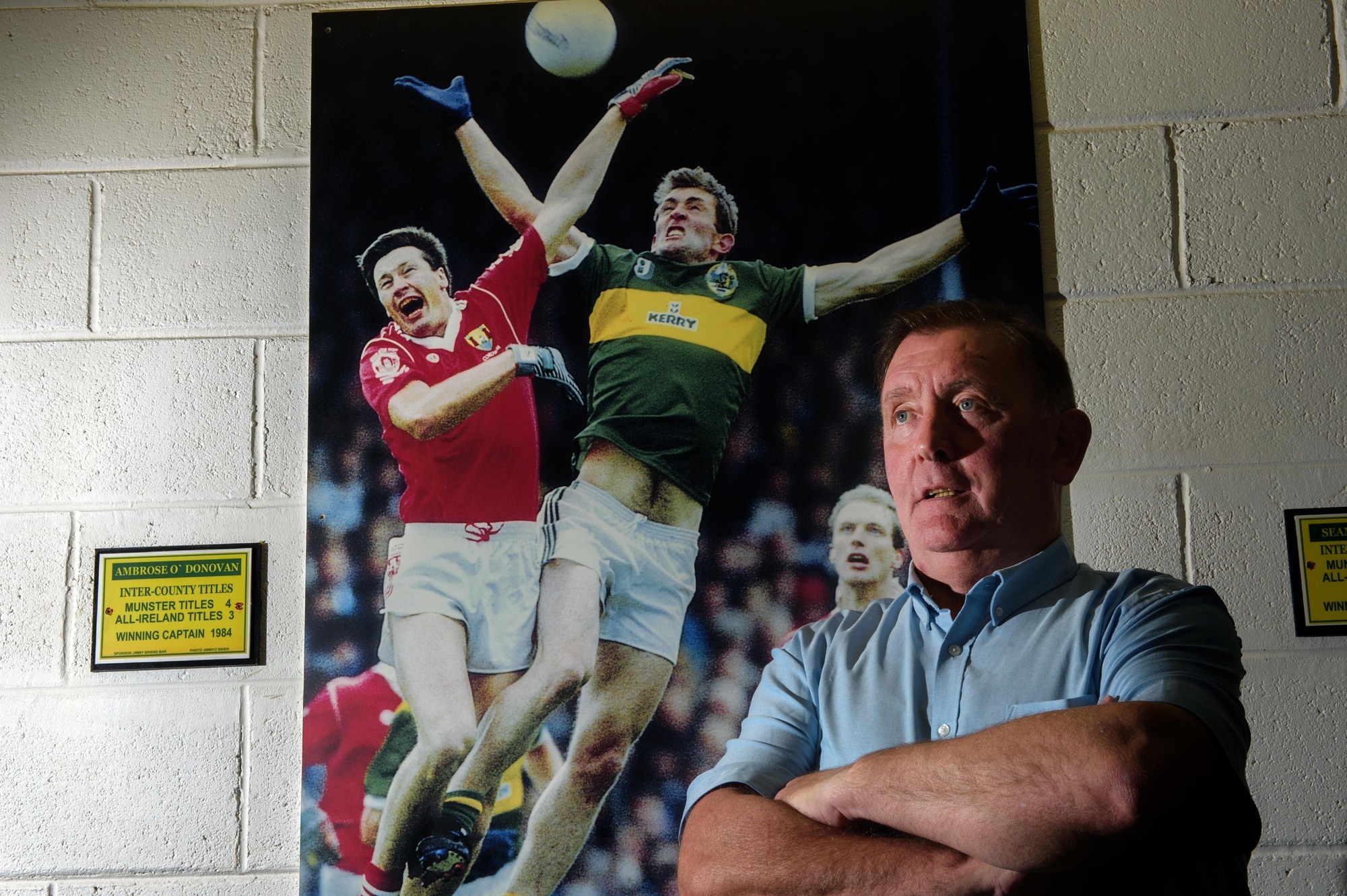
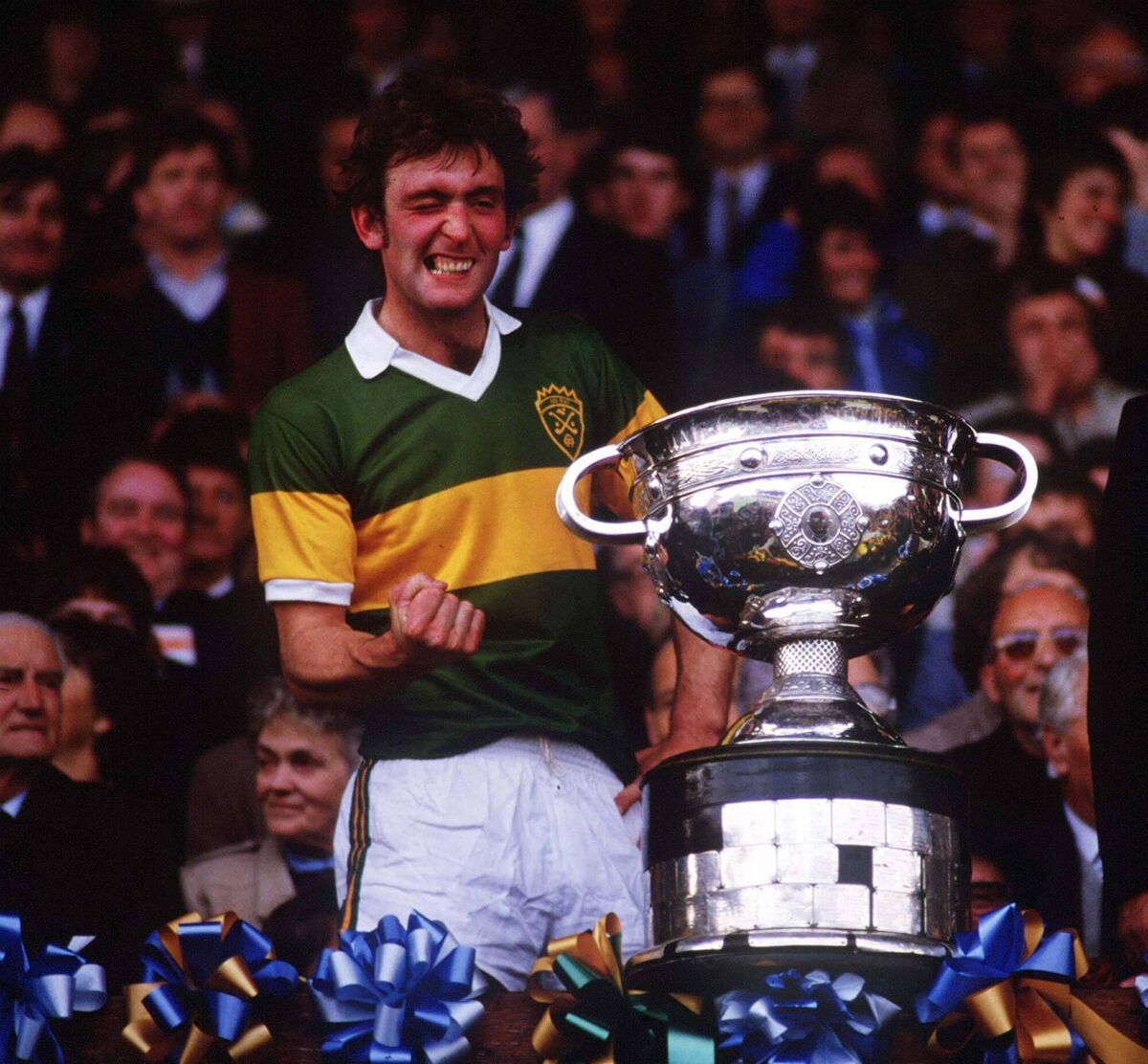
Ambrose O’Donovan, who captained Kerry to win the centenary All-Ireland in 1984 pictured at a famous photograph on display in the tunnel at Fitzgerald Stadium, Killarney this week ahead of the Kerry v Tyrone All-Ireland semi-final. Picture: Don MacMonagle
Outside the county, he’ll forever be the Centenary Captain, the man who lifted Sam the same year Freddie was going Radio Gaga.
Within it, Ambrose O’Donovan is also now known for going all radio gaga himself about Kerry football.
Just like a certain section and generation of the national population see his old teammate Pat Spillane more as a pundit than one of the finest to ever lace them up, O’Donovan these days is as much a voice as he ever was a face, known for catching the feel of a game as much as he once was for catching a ball.
For the guts of 20 years now he’s been part of Radio Kerry’s matchday team. “Liam Higgins, God rest his soul, asked me to [co-commentate] an O’Donoghue Cup match, [O’Donovan’s native] Gneeveguilla against Kilcummin. So I did the match with him and after that they started asking me to do more games, mostly minor and U21, and I got a great kick out of them. I nearly enjoyed them more than watching senior football at the time.”
It went from there. While he actually never did a live commentary with the late great Weeshie Fogarty, he often linked up with him and Higgins to offer half-time analysis of any big game Kerry were in, often after he and Ger O’Connor had commentated on the minor game. Now that both Higgins and Weeshie have left us, O’Donovan and Tim Moynihan carry the torch and the mic.
Like his predecessors, his appeal is in his authenticity. He doesn’t just try, as he says, “to call it as I see it”; he just tries to be himself. While Martin McHugh pointedly refers to his own sons as Ryan McHugh and Mark McHugh to create some greater distance and sense of objectivity, O’Donovan in his commentary has unapologetically — instinctively — called his son and namesake, who has won multiple county and provincial titles with Dr Crokes, as “Amby Junior”. In local radio, being passionate often works better than being dispassionate or polished. It’s part of its and his charm.
“I often think of the man below in south Kerry, or a Kerry person in a bar in America. They want to know what’s going on so I paint the picture for them. No big fancy words.”
To him the whole point and appeal of this gig is people. Serving them, meeting them. He’s thinking of old opponents like the aforementioned McHugh and Nudie Hughes he’s befriended in the press box in Croke Park. But he’s especially thinking of the Kerry supporters he’s met, maybe staying over in a hotel the night before a league game.
“We’ve had some fantastic nights up the country in places like Omagh, getting to know Kerry supporters and having a bit of a sing-song. They’re the real die-hard supporters.
“You might have seen it a year or two ago on social media, Peter Keane getting onto a supporters’ bus after some game up the country, thanking them for their support. Páidí Ó Sé, God rest his soul, initiated that tradition. He never left an away venue without getting onto a supporters’ bus without thanking them.
“And Peter Keane would be very aware of their loyalty because his own mother would still be one of them. It might be quarter-past-six on a dirty Sunday evening when you’d see those two buses pulling out of Ballybofey or Omagh, which means it could be three o’clock in the morning before they’re back home in bed. A lot of them would now be in retirement age yet still they travel to the games and they’d have a very close bond with this team in particular. I’ve seen the players above in places like Edendork spot them all sitting together in the stand and giving the thumbs up to them.”
Even back in his playing days O’Donovan would have been well familiar with how long but rewarding those journeys could be. Although he’s gone down in history as the rookie captain of ’84, having been handed both his first championship jersey and the armband the week of that year’s Munster final, it wasn’t like he was just parachuted into the team.
He’d served a long apprenticeship. He played three years at minor for Kerry, the first in 1978 when he came on as a sub in the Munster final and put a goal past Cork’s dual netminder, one Ger Cunningham (“I’ve told Ger I was the making of him. I finished him as a football goalkeeper and he didn’t do too bad concentrating on the hurling!”) He’d already featured in four different national league campaigns before at 23 years old finally getting to partner Jack O’Shea in championship.
“I suppose for a while after [three years playing] minor I was as much interested in what was going on off the pitch as what was happening on it, but I still got called up for a lot of league games. I made my debut against Down in Killorglin only a couple of months after we won the minor All-Ireland in 1980. The next year I played a couple of games before Christmas above in Roscommon and Crossmolina. In early ’83 we played Offaly in Tullamore; it was soon after the [‘82] All-Ireland and you could cut the tension with a knife.
“We actually won that one but for the most part, I think the best way you could describe us was that we were great travellers and bad travellers. We’d wine and dine well on the Saturday night and the following day would stand testament to that.”
For 1984 though that changed. Kerry went unbeaten in the league that season, and though O’Donovan only featured in the opening game, his drive to finally break into the championship starting team would supplement and complement Mick O’Dwyer’s.
“I would have been on the championship panel in ’83 when we lost to Cork with that Tadhgie Murphy goal but I had a lot of trouble with my ankle so couldn’t give it the full whack. And you were trying to break onto a team full of superstars. In midfield you had Jacko, Seánie Walsh, with fine players like [Vincent] ‘Shin’ O’Connor knocking around. I remember Jimmy Deenihan once saying to me, ‘To get on this team you have to work twice as hard as anyone else.’ And in fairness as ’84 went on, the injuries cleared up and things went right for me.
“We trained very hard in ’84. It was sink or swim for Kerry. We had to win it or else it was the end of that team.
“The training would have been different to now. The winter sessions would have been mostly lap after lap to build up the stamina. I absolutely hated it but you had to do it; Dwyer would always say you had to do it because it would stand to you against Cork in July. Then in the spring and early summer it was more speed work, wire to wire, at least four nights a week. You’d get out of bed in the morning, gingerly putting your feet onto the floor, with aches and pains in places where you didn’t know you had muscles.
“But then after the first eight or nine weeks I found the training was getting easier and I began looking forward to it. Because there was a bit of craic. There was always someone with a great story to tell.”
You had Egan, Páidí, and Bomber. But it didn’t take long for the younger fellas to join in or even start the banter. While they’ll always be overshadowed by the core of the team that would end up with a seventh or eighth Celtic Cross in their pocket, the contribution of the new wave of players that replenished the side tends to be underappreciated.
On the field you had John Kennedy, who was so prolific from deadballs, Mikey Sheehy could hand them over to him; they’d even nickname him ‘Shoot’, such was his willingness to pull the trigger. There was Ger Lynch, who, as Joe Ó Muircheartaigh put it, “for three years swept along the Croke Park tram lines like an old outside-left, dodging the traffic as he went.” You had Willie Maher who scored that decisive goal against Meath in ’86; Timmy O’Dowd who got that vital goal against Dublin in ’85. Off the field too they stamped their mark.
“Ger Lynch is a terrific, witty character,” says O’Donovan. “We called him the fourth Spillane brother, he hung around with them so much. I gravitated more to the likes of PÓ [Sé]. Dowdie did as well. He could live with any of them when it came to the one-liners. PÓ might say, ‘You could do with shedding some of that arse, Dowdie!’, and quick as a flash Timmy would say something like, ‘Jesus, Páidí, have you looked in the mirror yourself lately?!’
“We all just gelled. The one thing I’ll say about the established players of that team, they’d help you in any way that they could.”
He gives an example. The year they were going for the three-in-a-row O’Donovan was building a new house outside Killarney. The building contractor was due to visit the site this particular Saturday, which presented O’Donovan with a dilemma. He’d been picked to play for Kerry up in Down on the Sunday. With the team travelling up on the Saturday, he wouldn’t get to see the engineer. It was a sign of the times that while at 25 O’Donovan was well old enough to get married, he still didn’t feel old enough to approach O’Dwyer about his conundrum. But his older teammates did.
“That Thursday night, Dwyer came over to me. ‘I heard you’re in a bit of bother.’ I said I was; I’d all this machinery and wanted to be there to see the engineer myself. And he said, ‘No problem. Take the weekend off. We’ll say that you were injured. You need to be there yourself to meet that engineer. I know how those fellas can scalp you. We’ll see you back training next Tuesday.’
“Dwyer was as hard and as fair as you’ll ever meet. One night Jimmy Deenihan came to training about 10 minutes late. We’d only done a couple of laps, were still just warming up, but Micko told him, ‘We start training at quarter to, Jimmy, not seven. See you tomorrow.’ Now Deenihan was a senior player, but still, gone — out the gate. Another night then PÓ came in late after crashing his car on the way and somehow Dwyer got wind of it. So Páidí came in and Micko gave him just one lap of the field. ‘We train at 6.45, Páidí.’
“He just had a brilliant way of managing people and setting standards. If you were lagging behind he might say to you, ‘Yeah, you obviously don’t want to be the best this year because look where you are in this run.’
“He’d great philosophies, ones that have stood us all for life, and probably the biggest of the lot was that you get out of something what you put into it. But you are successful you can look back on the work with fierce satisfaction. And he always told it was a hugely personal feeling. People will celebrate with you but no one can do the work for you. My All-Ireland medals are no good to you just as your medals are no good to me.”
There’d be no more All-Irelands for O’Donovan after ’86, though he takes pride in how he and his teammates strived to drive on. He still feels they possibly left one behind in ’91, but the inexperience of playing in Croke Park hampered some of the younger players whereas Down had played a league semi-final and final there the previous year.
“We were right in that game with seven minutes to go but the number of shots we had come back off the posts was ridiculous. I remember I was so sick afterwards, I didn’t get onto the team bus. I called one of the younger lads aside. ‘We’ll slip away here and go for a pint.’ And while we were walking to the pub, he looked at me with a tear in his eye and said, ‘It’s only now the life has come back into my legs.’ Back then the stands were made of sheet iron and the Down supporters banged it all day, and while they were used to it, some of our lads weren’t.
“It’s a pity because the Meath team Down played in the final were a very tired side. But fair play to Down. We hadn’t bargained for Peter Withnell and some of their other forwards were great players.”
Now, 30 years on, Kerry find themselves up against another set of Ulster champions in an All-Ireland semi-final. O’Donovan is nervous about it.
“This is a very dangerous game for Kerry. I’d read nothing at all into the league semi-final. You could tell from their body language that Tyrone weren’t interested in it. They would have preferred not to have got a hammering but they primarily came down to Kerry that weekend for a training camp or bonding session or whatever buzzword you want to give it. In my time we called it a piss-up. Whatever the Tyrone boys called it or did that weekend, they stayed down in Killarney that Saturday night and been the better and closer for it.
“I know some of the Tyrone lads have had Covid but the extra time has given them the opportunity to get players like Darragh Canavan back. And they can smell an All-Ireland. Dublin are now out of it and all three teams, Tyrone as much as anyone else, will figure they have a great chance of winning an All-Ireland, which is a huge incentive.
“There’s no doubt in Kerry we have very good forwards but for the first 20 minutes of the Munster final Cork showed a lot of inadequacies in our defence. They ran at us and opened us up going down the centre. That bothered me so it’ll be interesting what Dooher and Logan learned from that.
“What we don’t want to encourage is to bring Tyrone men back down the field. I’d like us to see what Mayo did in the second half against Dublin and have their six defenders mark their men straight up. Our forwards need space. Tyrone will be crowding it enough without us having cornerbacks soloing up the field and allowing them to crowd it even further.”
And so, that’s something he’ll be looking out for from his vantage point up in the press box on Saturday afternoon.
Life, he says, has been good to him. “I started working with the ESB in May 1980 and haven’t looked back since, they’re a great company to work for.”
He’s still passionate about his football, something the gig with Radio Kerry reflects as well as feeds.
And his friends who helped him skip that game in Down remain his friends. With Covid more of their most recent meetings have tended to be on the golf course but with a favourable result on Saturday, they could be back wining and dining together soon again.
Just like old times.


Cancel anytime
CONNECT WITH US TODAY



Be the first to know the latest news and updates