Peter McKenna: 'Lack of fans has been financially catastrophic' for the GAA
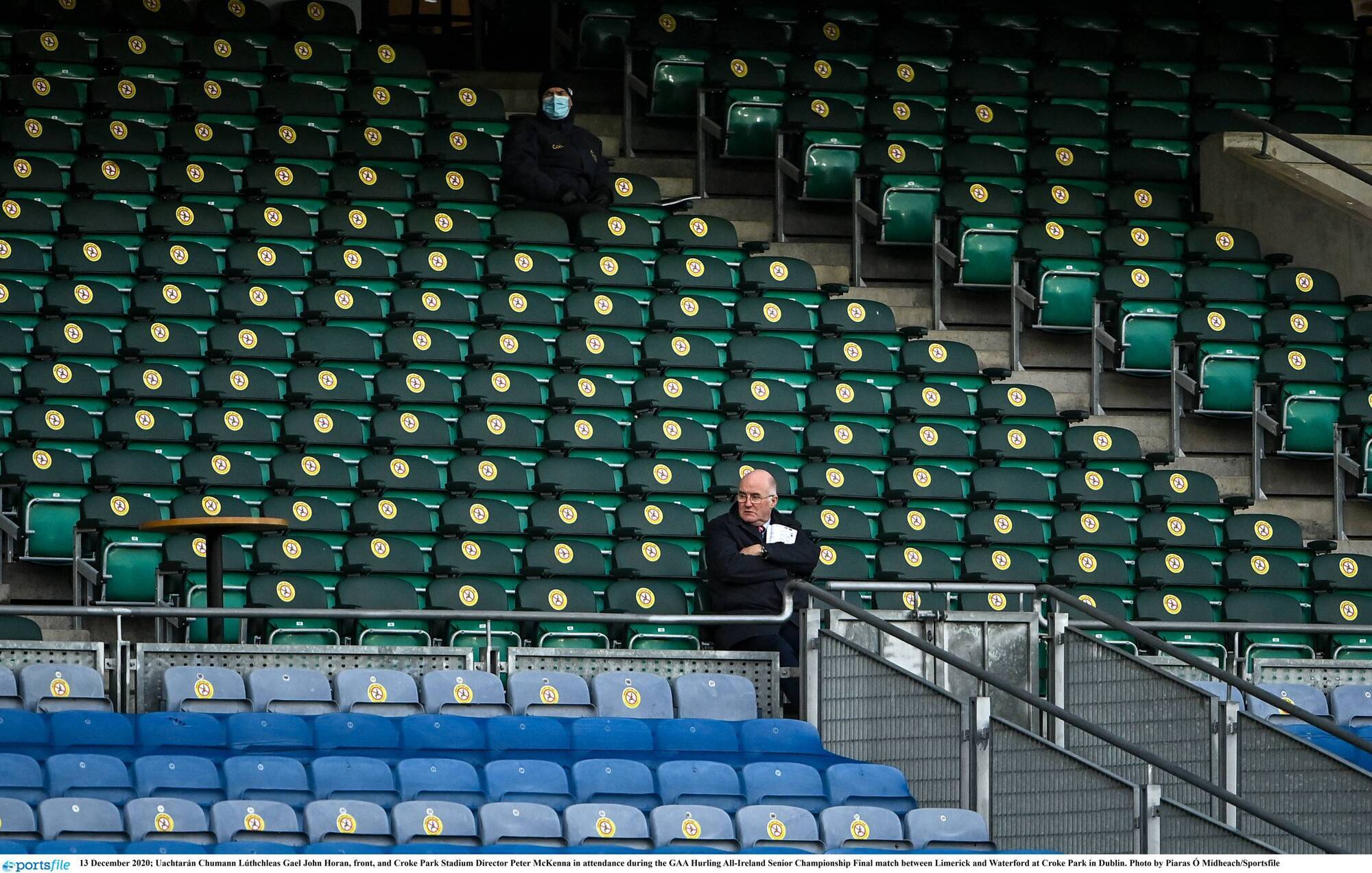
Then GAA president John Horan at the All-Ireland hurling final between Limerick and Waterford at Croke Park in Dublin in December 2020.
The Black Swan of uncertainty which has overshadowed Irish sport for the past two GAA championships hasn’t gone away.
Its slow and tardy retreat, is however, revealing greater levels of optimism than even those with the most vested interests thought possible in the dark days of last January.
A significant expression of better times will be found in and around Croke Park by the time Cork and Limerick take to the field in Sunday’s All-Ireland hurling final, in front of the largest crowd to assemble during the pandemic.
Even at half capacity, those 40,000 supporters in Croke Park, will carry the hopes of sports fans across all codes and all corners of the country that we’re close to a fully normal fan experience, once again. While all eyes will be on the clash of old rivals and a ferocious field battle for the greatest glory in Irish sport, one man will be as gripped by events immediately off the pitch.
For the GAA’s commercial director, Peter McKenna, the sights and sounds from the stands on Sunday will have been a faraway place in the dark days of ‘Lockdown January’ as the national leagues prepared for a return with no fans, empty grounds, and zero ticketing revenues.
Here McKenna tells of the journey travelled to get to a final in front of tens of thousands of fans. He reveals the GAA’s expected losses for the year and discusses a range of subjects, like managing mask wearing inside Croke Park which he admits is “not good” and a range of fascinating insights.
: Really we’ve got to go back to late summer 2020, when the major sporting bodies formed a group to propose a pathway for a return of spectators to sporting events. When we first became a body of sport, along with the IRFU and FAI, we found it a very useful way of discussing how we could get fans back into stadia. Collectively this group has considerable experience in running and organising mass participation events and we used that experience to interpret government health guidelines and suggest a safe pathway back for spectators. Equally we were conscious that in the earlier phases of the pandemic, governments were grappling with more serious national issues than crowds at matches, so we adopted a long game approach. And that was to get supporters back by effectively interpreting the Covid guidelines and as a way of overcoming a little bit of inconsistency in what the rules were, and that is the nature (that you will have inconsistencies).
“We were coming from a situation where you were allowed to have relaxed social distancing on buses and on trains, necessary for essential workers to get to work, whilst stadiums were operating behind closed doors. So forming a collective worked very well in our discussions with the Department of Sport, and they were very engaged with us. It was agreed to start small and gradually increasing in numbers to allow more and more sports fans attend events, with the stated aim of having full houses by the time the Autumn internationals come around (in rugby) in November at the Aviva Stadium. It was important for this to work that we worked in concert together and not as competitive sports organisations to successfully determine if we could interpret the Nphet guidelines.
: Well to date there have probably been 160,000 fans in attendance at fixtures so far, and there has not been a single case of a transmission, which is massively positive. It suggests that outdoor events are safe, and we’re a long way short of where we’d like to be. But still, it’s a fair distance than where we were.
Obviously attendances are only a fraction of the demand so ticket income is correspondingly reduced. Still it is better to have some spectators than none. The atmosphere for last Saturday’s semi-final (Dublin-Mayo) with 24,000 supporters in Croke Park was as good as a full house and the players thrived on it. As part of our return to spectator protocols we took the collective decision to limit food and beverage offerings. So food service is a ‘grab and go’ offering and there is no alcohol on sale. Naturally this provides a safer environment but it does impact of our revenue potential. The difference for us from where we were (pre-Covid) is that we took the decision not to sell alcohol, there is very little hospitality and in fact we have been very conscious that any of the small number of hospitality activations are within the Fáilte Ireland guidelines which restrict large indoor activities and gatherings, that type of activity. For example on Sunday we will have boxes and suites at 50% capacity, with very little by way of hospitality.
We felt the fairest approach was to give every premium seat holder the opportunity to get two tickets. This meant that individuals with multiple tickets are restricted. For both 2020 and 2021 we were unable to deliver to people’s contractual expectations so what we’ve done is they are credited into the future so they don’t lose out financially, or otherwise. Box holders, as I said will observe social distancing and will be only at 50% capacity, with no dining.
The policy adopted by the combined sports group is cautious, absolutely. But to be fair the government approach has been one of cautious optimism, more slowly than our nearest neighbours, but the benefits of that are that we’ve brought everyone together through this. And at Croke Park we have been operating in a very safe environment, with no alcohol, avoiding restaurants and bars and you still have a very fluid situation. I believe the government advice has been appropriate and proportionate. Don’t forget also, that 100% capacity is still not guaranteed in the near future, and there are many people still deciding not to go to matches, there’s a nervousness there which is a feature of it. I’ve been looking at various statistics from hospitality companies which have been showing that (in the UK and despite full capacity audiences) numbers are down by 20%, so people are exercising caution.
These things are always going to be a mix, in a macro sense. Obviously ticketing revenue is down and our returns for food and beverage, programme sales etc are way back. From a television income perspective, the rights holders still broadcast the matches, and the rights fees have stayed solid. For sponsors and premium ticket holders, I will say this, they have been very, very supportive and I couldn’t praise them high enough. For the team here this was a huge morale boost. Obviously when you have thousands of premium customers, one or two will be unhappy. People are passionate fans and they want to go to the match, and some misgivings are inevitable. We are about trying to do something equitable for vast majority of our customer base, it’s not always going to sit well with everybody.
The normal contract for 2021 commences for 2022, so we’re committing to starting again at no extra costs for next year, where a normal contract for a box doesn’t entitle you to that, but we’re happy to do that. This required a degree of mutual understanding because we know that nobody reacts well to a unilateral approach, and there was a general appreciation that we were in a difficult position.
We always make a huge virtue of distributing everything (money) we get in, so a ‘black swan event’ like Covid means there are no reserves to carry all the things that make an organisation like the GAA great and that hit us badly. The Government has been very supportive, and while supporters are gradually coming back, albeit from a very low base, the lack of fans has been absolutely catastrophic. The key understanding is that revenue is gone and won’t be coming back, but the organisation is very prudent and there will be better times coming.
I’m not so sure, we’re not going to be far off last year’s results. Last year the pandemic didn’t start until the national leagues were almost completed, and this year we had no crowds at our National League games and very limited crowds for our championship. Also, not forgetting there is an awful lot of cost in running pilot events, so we will not be that far away from 2020.
Compliance with mask-wearing is not good, and getting people to act as a barrier to transmission by wearing masks, particularly earlier in the summer when we had hot weather and it was stifling to wear masks, this certainly has been a challenge. Some of it has to do with people when they’re in their bubble in Croke Park, say a brother, a wife or partner and “sure we’re at home all day, we’re safe”, it is hard trying to get that message out, but we are pushing hard. I believe mask-wearing is effective and important. Naturally, with our matchday personnel there is 100% compliance, but that number with supporters is only at 30%. We have found that by announcing draws for All Ireland final tickets, for people shown on screen wearing masks, has helped. I feel the best way to deal with this issue is a little more carrot and less stick, none of the sporting bodies want to be going after fans in crowds, nobody wants that.
It was hugely important. I think it was a great result for everybody. Sport by its nature needs competitive activity, and I’m very conscious that while a Covid infection is a really unfortunate thing to happen (with Tyrone) and despite the huge pressure on them, I am glad we’ve reached an accommodation. Look, at the end of the day, nobody wants an All-Ireland football final with an asterisk over it.
It’s not so much a challenge in terms of the ground operations on match days, and that’s just what we do. But to rearrange a fixture is quite tedious, in that all pilot events require a statutory instrument, which is very cumbersome. But it has worked and continues to work well, in fairness to the attorney general’s office, who look at the legal idiosyncrasies around these events. It has been positive, but it does bring challenges.
Oh I think it would be way too early to write them off, Dublin are way too strong. I will say this, it was the best/worst game I had ever seen last Saturday. It wasn’t a classic in terms of football, but as a passionate display, one of the special days. Dublin haven’t gone away, they’re still a fantastic team — in fact, they’ve lifted everyone else’s standards. I think they will be back strong in 2022.
: It’s at the very early stages, but the approach we’re taking is very much like with the rugby bid (RWC23).This would provide a fantastic economic stimulus for Dublin City and the country. Big international events benefit everyone, from taxi drivers to bars and hotels. It would give a huge lift to the country and from a Failte Ireland perspective, it’s always positive. It would be another of those great sports occasions and we are happy to play our part, in the same way we were supportive of the rugby bid.
CONNECT WITH US TODAY



Be the first to know the latest news and updates