How Matthew Ruane went from the shadows to centre stage as Mayo’s midfield general
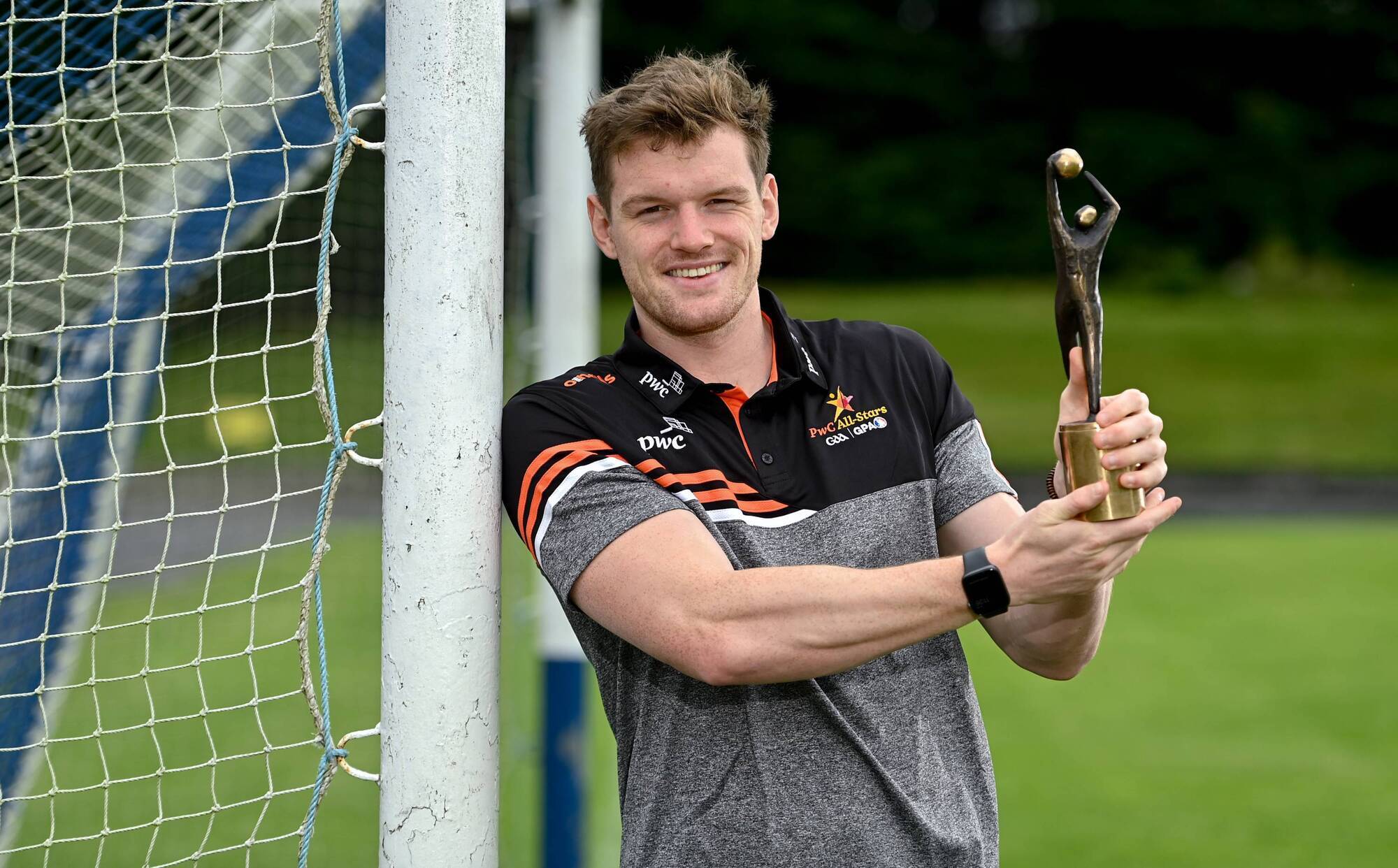
BIG TALENT: Mayo midfielder Matthew Ruane with his PwC GAA/GPA Footballer of the Month award for July. For all Mayo’s prowess and athleticism in midfield this past decade, Ruane has brought a dimension they haven’t had there before. Picture: Sam Barnes/Sportsfile
To finally make their breakthrough against Dublin, Mayo will be looking to Matthew Ruane, not least because it’s something he’s literally done against them before.
Back in 2016 the counties met in an All-Ireland U21 semi-final in Tullamore, Dublin managed by Dessie Farrell, Mayo by Michael Solan. With 12 minutes to go, Dublin seemed in complete control; thanks to a goal and a fistful of points from a promising young full-forward called Con O’Callaghan, they’d come from six down at half-time to go ahead by four.
Back home on their couches the twitterati couldn’t help but compare what they were watching on TG4 to the senior clash between the counties the previous September which had turned on Lee Keegan uncharacteristically kicking a ball short.
Youngsters with All-Ireland minor medals already in their pockets were being casually dismissed as typical Mayo bottlers, coughing up another winning position to those serial champs the Dubs.
What they hadn’t counted on though was that in their ranks Mayo possessed someone like Ruane with no regard for lazy historical narratives and labels.
Along with Stephen Coen he’d create a midfield platform for Mayo to score three consecutive points. Then with just a couple of minutes of normal time remaining, he latched onto a Dublin kickout Coen had broken down and duly took off on a marauding run, skipping or powering past an army of Dublin defenders, using all four limbs and feet before kicking a magnificent point off his left.
It was an act of sheer audacity and defiance as was his response to it: Running back out the field, he clenched his fist and gritted his teeth, prolonging the wall of sound from the Mayo crowd.
While Dublin would score from the resultant kickout, Mayo would edge that game by a point, thanks to a couple of injury-time scores from Ruane’s current senior midfield partner, Conor Loftus.
It was a monumental victory, setting the team up to win the All-Ireland outright a fortnight later in Ennis when Ruane would be adjudged to be the man of the match against Cork. Yet while his teammates understandably sang and danced in the aisle of the team bus, Ruane and his fellow workhorse Diarmuid O’Connor were already sound asleep from sheer exhaustion by the time it had encountered the second roundabout outside Tullamore.
In giving everything to claim the victory they had no more left to celebrate it.
“Mattie’s always had an animal workrate,” says Solan, his manager that day and to the majority of the current senior panel at some stage. “Whatever he needed to do for the team he was willing to do it. It was the same in the final against Cork when he again ran 50 yards to kick a point when we were under pressure. Leo Cullen once said leadership is showing up every day and Mattie brought that leadership. You knew what you were getting from him every day.”
What wasn’t so obvious though was when he’d get to shine in the senior limelight.
While Diarmuid O’Connor made his senior championship debut in 2014, Ruane had to wait a further five years for his.
“You knew he had the raw materials to make it, but physically he wouldn’t have been ready to go at 19 or 20 the way Diarmuid was,” says Solan. “Like with most players, it took a while to adjust to intercounty where he was training three or four nights a week and every session in a setup like Mayo’s was as intense as club championship.”
Donie Vaughan similarly felt it was just a matter of when, not if, Ruane would make it. He reckons it must have been sometime in 2015 that he first came across Ruane because the lad showed up to the gym and the subsequent in-house game still in school uniform. Whenever it was, right away he could see the kid had it.
“In his very first AvB game he kicked three points and I was saying to myself, ‘God, who is this fella?’ The potential was obvious. But I remember a few years later, sometime during Stephen’s (Rochford) time, he was still struggling to even make the bench and the two of us were talking in the carpark in MacHale Park. He was having doubts about whether he was ever going to make it. But I told him that in 30 other counties he’d probably be starting. He was getting better, being exposed to training with who he was. It was just that he was trying to break into what we felt was the strongest team in the country in the area of the field where we were strongest.”
It was a valid point. At that time his Breaffy clubmate Seamus O’Shea and Tom Parsons were at the peak of their powers. With the advent of Paddy Durcan, Vaughan himself was fighting for minutes around midfield as much as he was trying to regain his spot in the halfback alongside Colm Boyle and Lee Keegan. Aidan O’Shea was also hovering around midfield, Barry Moran too.
Ruane had the humility and resilience to stick it out. In 2013 he had been left off the matchday panel for an All-Ireland semi-final but his club minor coach Sean Deane has told the story to the Mayo News about how Ruane’s instinct wasn’t to sulk but to improve: When the pair next met Ruane was talking about how he could get back onto it for the final, which he successfully did.

There’s a school of thought that Stephen Rochford could have thrown him in a bit sooner, but with Ruane still U21 in 2017 and that campaign going up to the end of March, there wasn’t a chance to play him in the league and with Mayo using up their first life early that summer, Rochford opted to stick with the tried and the trusted. In 2018 he’d likely have got his break at some point only he was injured. In 2019 preparation finally met opportunity.
He was made for James Horan just as Horan was made for him. While Rochford brought and preferred a more methodical style, working the ball on the edges, Horan didn’t mind if you ran down the odd blind alley so long as you could run and run. Three games into that year’s league he got a start against Cavan.
“By the end of the league,” says Vaughan, “I’d say he was the first name on the team sheet.”
In the league final win against Kerry he’d score 1-1 which ultimately proved to be the difference between the sides, but possibly even more impressive was when a fortnight earlier he scored a similar return on a dirty night down in Tralee.
“His goal that night and the way he linked up with Andy for it was brilliant but the point was even better,” says Vaughan.
“He got a ball around our halfback line and started running. And he kept running. You could see the Kerry lads looking on as if to say: ‘He’s not going to be able to keep going, is he?’ But he did and went all the way down to score a point. He’s just a powerhouse.”
For all Mayo’s prowess and athleticism in midfield this past decade, Ruane has brought a dimension they haven’t had there before. By virtue of the 1-2 he scored against Galway last month, it brought his career championship tally to 1-10 from just 10 games (he missed all the 2019 qualifiers and all but a minute of the Super 8s through injury). That’s an average of 1.3 points per game. From 2013 to 2018, Mayo’s starting midfield averaged only 0.7 a game (2-24 from 43 games).
Throw in this year’s league and there’s not a higher scoring midfielder or midfield combination from play in the country. Caolan Mooney has scored 2-1 from there for Down. Oisin O’Neill has scored 1-5 from there for Armagh (as well as a bit more from playing minutes in the forward line). Dublin’s midfield as a collective have scored 0-10 this year, 0-8 from Brian Fenton, in keeping with his remarkable scoring rate in recent years.
Joint-second in all competitions this year are both Munster finalists, Kerry with 1-11, and Cork with 0-14, half of them from their north star, Ian Maguire.
Ruane by himself trumps them all, with 1-13 from only seven games, for a staggering average of 2.3 points a game, all from play.
Combine that with Conor Loftus, who has scored two points from play in every championship game to date this summer, and that’s a total of 1-20 for the year, giving Mayo an unprecedented edge.
He’s more refined in how he goes about getting the scores too, Solan notes and laughs. “If you look at the old footage of that (U21) score against Dublin, he just fired it onto his foot and had a swing at it; it wasn’t the prettiest strike and he got a bit of slagging over that. But now his striking of the ball and his overall game is just so much smoother. He’s put a huge work into the development of his skills as well as his strength and conditioning.”
Everyone talks about how affable and grounded he is; after studying business and playing Sigerson in DCU, he’s now back in his native county, working in Ballina for Coca-Cola — like James Horan himself does — as a supply chain analyst.
For most of his career, for all his talent, he’s never been the main man. At underage, there were the likes of O’Connor and Coen. With Breaffy, there’s been the shield, shadow, and inspiration of the O’Sheas.
Now he’s what inspires and drives Mayo.

Cancel anytime
CONNECT WITH US TODAY
Be the first to know the latest news and updates