Eamonn Young, arguably Cork’s greatest and most influential Gaelic Footballer, was born on August 7, 100 years ago.
By then it was already 14 years since Cork had defeated Kerry in the Munster Senior Football Championship.
Cork did win the Munster Championship and All-Ireland title of 1911 and the Munster Championship of 1916, but Kerry had not been defeated by Cork in either year.
Eamonn’s father, Jack Young, a 23-year-old teacher from Dunmanway who was teaching in Cork City and a member of the city-based Nils Desperandum Football Club was a member of the Cork 1911 team that defeated Waterford and Antrim to win the 1911 All-Ireland titles. He moved back to Dunmanway, where he took up a teaching post at St Patrick’s National School, Dunmanway. He married and the family grew to 14 children; seven boys and seven girls.
Jack continued to play football with Dohenys and encouraged all the boys in St Patrick’s School to play too. As his sons followed him into the school, they all played football and hurling. Jim, who would win five All-Ireland hurling medals with Cork was the most successful of the family on the playing field. His younger brother Eamonn, was a keen hurler too. He won All-Ireland minor medals with Cork in in 1938 and 1939. He received his secondary school education at Good Council in New Ross where he won interprovincial hurling honours with Leinster Colleges. In 1940 he won a National Hurling League medal with Cork and a Cork senior medal with Glen Rovers.
This was a very impressive reward for the 19-year-old Eamonn Young and it augured well for a very successful hurling future for him. He chose a different sporting path. Gaelic football was the primary game in Dunmanway. Jack Young, as the “Master in the School” and the holder of an All-Ireland Football medal, was an important figure in the town and Eamonn chose to pursue football as his first love.
Young scored his first football success in 1933 when he was part of the St Patrick’s School team that defeated Greenmount in the Schools Shield final. He was part of the first Cork minor football team that won the Munster Championship in 1939. The following year, 1940, he won a Munster Junior football medal with Cork. In November of that year, he enlisted as a cadet in the Irish Army.
Even though he had yet to play senior championship football for Cork, Eamonn Young was selected to play with Munster in the 1941 Railway Cup where he, Dick Harnedy of Dromtarriffe and 13 Kerry players won Munster’s first title in a decade. He and his brother Jim, were then selected to play in the Munster Championship against Clare but he had to cry off the team at the eleventh hour. Cork lost to Clare. A month later he lined out at centre field with another brother Fachtna, in the Munster Junior Championship against Kerry. The game finished level. Eamonn missed the replay a week later and Cork lost.
Eamonn Young made his championship debut in 1942. Cork played much better than the previous year but still lost to Kerry 3-7 to 0-8 in the Munster Final. The headline in the Cork Examiner read: “Cork Make Fine Effort at Tralee, but Craft Tells.” The tide turned in 1943 when Cork defeated Kerry after a replay in the Munster semi-final to close a 36-year gap and then went on to defeat Tipperary in the Munster final. Inexperience cost Cork in the All-Ireland semi-final which was lost 1-8 to 1-7 to Cavan. A further measure of Cork’s progress as a team at this time is that seven players lined out for Munster in the 1944 Railway Cup defeat to Ulster.
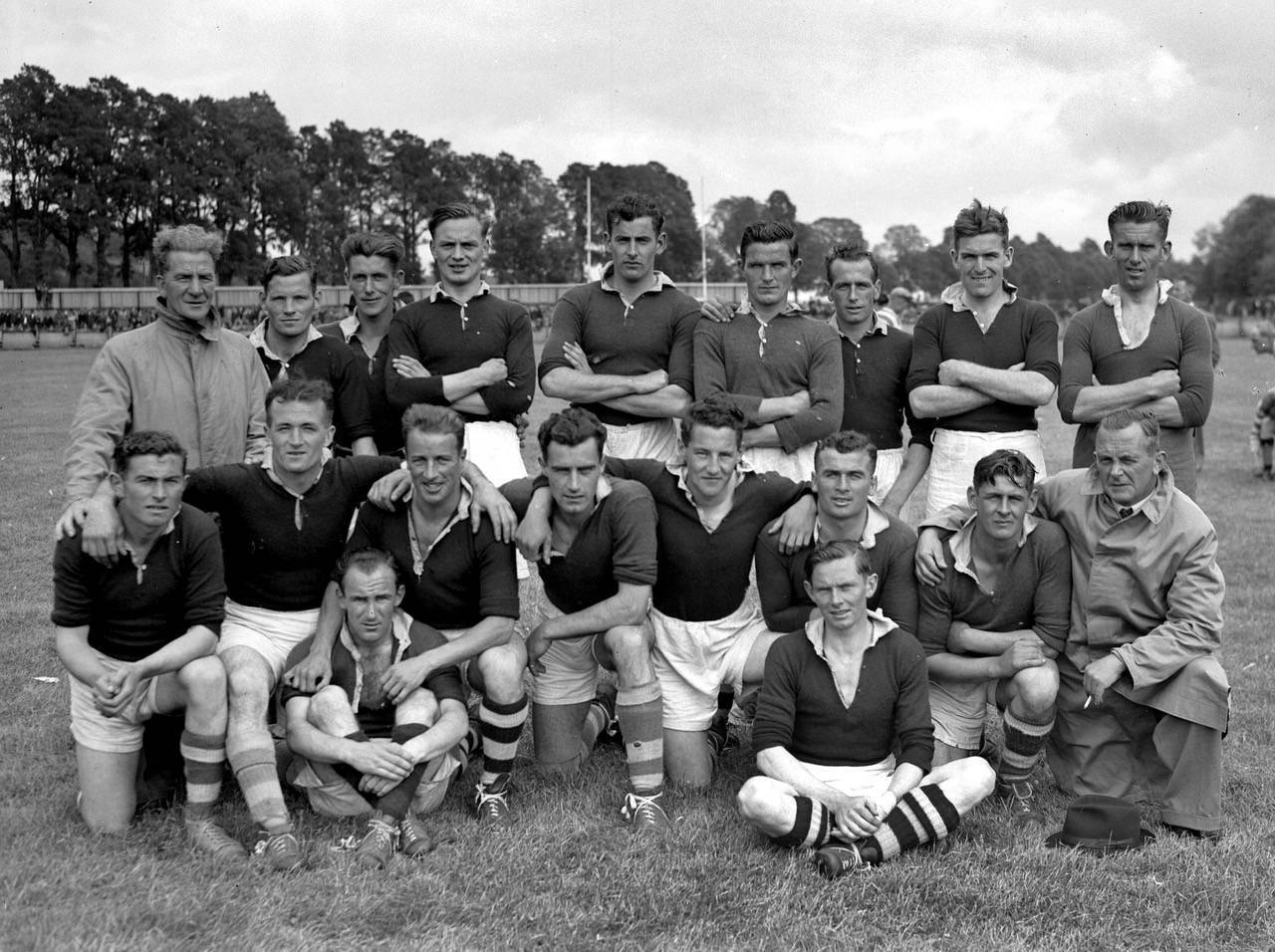
A surprise defeat by Tipperary in the 1944 Munster Championship did not impede the teams progress for long. The addition of other “Army” players like Caleb Crone (Air Corps) and Mick Tubridy (Army) in 1945 to supplement the strong backbone of seven Clonakilty and Fermoy players helped Cork to regain the All-Ireland title after 33 years. Cork defeated Tipperary and Kerry in the Munster Championship, then Galway in the semi-final before scoring a 2-5 to 0-7 win over Cavan in the final. All the newspapers agreed that Eamonn Young, playing at midfield and 5ft-8in tall, was Cork’s man of the match.
The 1945 win was a turning point for Cork football. The county became more competitive from then one. Kerry continued to be a serious impediment to Cork’s ambition, but during the rest of Young’s playing career, which ended in 1953, Cork reached the final of the National League in 1948 and won it in 1952, Cork also won the Munster Championships of 1949 and 1952. Young was the star player throughout this time. He did not play in the 1952 NFL final against New York in New York. He withdrew from the travelling party in protest over the non-selection of team trainer, Sgt. Behan O’Brien as part of the travelling party.
Eamonn Young moved from the Dohenys, Dunmanway club in 1944 to play his club football with the Army. While playing with the Army he won three senior county medals in 1949, ’51 and ’53. He transferred back to Dohenys in 1960 and won a junior county championship medal with them in 1966 at the age of 45.
It was a natural progression for Young to get involved with coaching and training and his influence on the Cork team was seen when he coached the teams of 1956 and 1957 to the All-Ireland finals. Unfortunately, both finals were lost to Galway and Louth respectively.
From the time Eamonn Young retired as an intercounty player he had been writing a very popular weekly column in the Cork Examiner under the nom de plume, “Rambler”. The column moved to the Evening Echo in the 1960s, he continued to write it for more than 40 years.
In 1958, his writing embroiled him in a controversy resulting in him receiving a six-month suspension for writing articles on Gaelic Games for the English Sunday newspaper, The News of the World. The Cork County Board requested Young to cease writing for an English paper or resign from the GAA. In the Board’s viewed his actions were “contravening a fundamental principle of the GAA” by promoting sale of an English newspaper. When Young met the Board’s Executive, he defended his position entirely through Irish. He pointed to 14 other prominent figures from other counties who had written for English newspapers, but to no avail.
Young appealed his suspension to the Munster Council where he spoke for almost two hours and, despite several delegates speaking on his behalf, the suspension was upheld. Cork were the ultimate losers however. Young was not available to coach the team in 1958 and the bid for a third successive Munster title failed. Instead Eamonn Young concentrated his sporting energies on squash where he became one of the most successful players and coaches at local and national level over the next decade. He was eventually enticed back to the GAA as a football selector/coach in 1966.
Con Paddy O’Sullivan, Urhan and Beara, was a member of the Cork football panels from 1957 to 1970. He recently recalled how Cork football went into the doldrums during the years of Eamonn Young’s exile.
“There was no consistency and players were coming and going all the time,” he said. “Things changed immediately when he (Young) came back in 1966. The first thing he did was insist on a general clean-up of the dressing room, they were filthy.
“He introduced long training runs where everyone was timed and ranked. This brought out a competitive streak in some of the lads who found they did not show up as well as they thought they should. He was a great presence in the dressing room. He created an atmosphere that brought the team together and whenever we did get together after a game, you knew the evening would not be over until Youngie stood to attention, and belted out his favourite song, “The Scottish Soldier” and by God, he could sing it. We were given very little hope of winning the Munster final in Killarney, but we surprised everyone and won and “The Scottish Soldier” was sung that night with gusto”.
Young’s return was brief. In April 1967 he went to a serve six-month term of duty as O.C. of the 8th Infantry Battalion UNFICYP in Cyprus. This was his second tour of duty. He served a similar tour in the Congo in 1963. Cork reached the All-Ireland final but lost to Meath.
He achieved the rank of Commandant before retiring from the Army in 1971. In the late 70s he attended UCC as a mature student and qualified as second level teacher and taught at Coláiste Spioraid Naoimh, Bishopstown for the remainder of his working life. When he retired from teaching, he became involved with the Munster Council Coaching Programme, then in its infant years, where he did a great deal of coaching especially in Clare and Tipperary.
Eamonn Young understood the importance of communication and promoting Gaelic Games long before the digital age. As well as his Rambler column in the Evening Echo, he contributed to numerous other productions including Gaelic Sport Magazine, and the Our Games annual. When Cork won the All-Ireland hurling and football double in 1990, he wrote the book “Rebels on the Double” to mark the occasion.
While the purpose of this piece is primarily to laud the contribution of Eamonn Young to Cork GAA and especially Gaelic football on his 100th birthday, it was only one aspect of a very full life. He had successful careers in the Army, as a teacher and as a writer. He was a great man to keep up contact with people. In the pre-electronic years, he wrote thousands of letters and postcards to friends and acquaintances congratulating them on successes, wishing them well or just conveying his condolences.
Like many of the Young family, including his father Jack, his uncle Ned who fought at Kilmichael or his brother Dr Jim, winner of five All-Ireland hurling medals, he did not conform to public opinion for the sake of it. He regularly and fearlessly challenged opinion and convention as he did with his 1958 suspension. Eamonn married Monica McNamee, a renowned opera singer, and both of them could hold their own in any musical company or occasion. The couple had four children Alan, John, Eleanor and Michaela.
The wavelength of Cork football is long. The peaks are few, and far apart, and the troughs are deep. The gap between 1911 and 1945 was the deepest of these troughs. It needed a messiah to lead Cork out of those depths and Eamonn Young was that messiah. His contribution to Cork football has rarely been equalled and never bettered.
- Eamonn Young Born August 7, 1921 – Died August 3, 2007.


Cancel anytime
CONNECT WITH US TODAY



Be the first to know the latest news and updates