Rory Gallagher: Crazy, rebellious, troublemaker, whatever you call him, you can’t ignore him
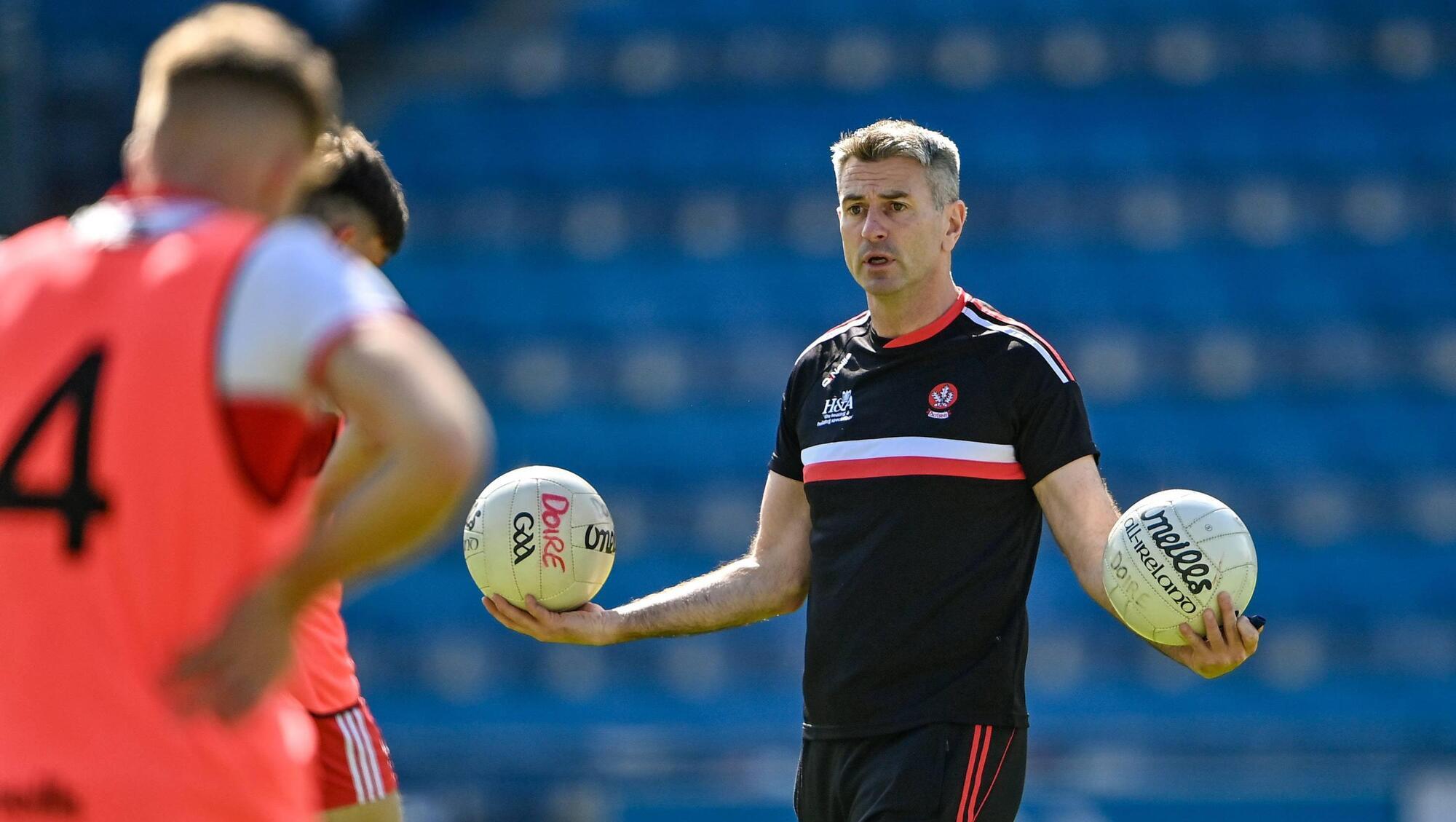
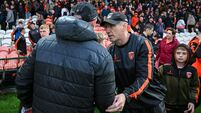
19 June 2021; Derry manager Rory Gallagher before the Allianz Football League Division 3 Final match between Derry and Offaly at Croke Park in Dublin. Photo by Piaras Ó Mídheach/Sportsfile
NAMES might mean a lot to Rory Gallagher but the size of them does not.
In Donegal the players still talk about how he immediately commanded their respect. On a dirty night the Tuesday after their second McKenna Cup game, they arrived in Castlefin to find a new selector laying out cones and footballs. Some of the veterans would have recognised him from his days playing with Fermanagh and recently winning an All-Ireland with St Gall’s, but most didn’t know who was in their midst. What bowled them over was that he knew every one of them. Every single player on that senior panel, and on the U21s training alongside them, he was able to refer to by name. He literally had them at hello.
In Derry they tell another story about how he so quickly won them over. At one of their first training sessions he froze the play and called out Chrissy McKaigue, team veteran, serial winner, International Rules star. It was like that moment when the Leinster rugby players’ jaws dropped when Joe Schmidt said to Brian O’Driscoll he shouldn’t have dropped a pass, as imperfect as it may have been. Someone had called out and pulled up The Main Man? That had never happened before. Clearly there was a new sheriff in town with new rules and higher standards, creating the kind of place and environment they needed and deep down probably yearned.
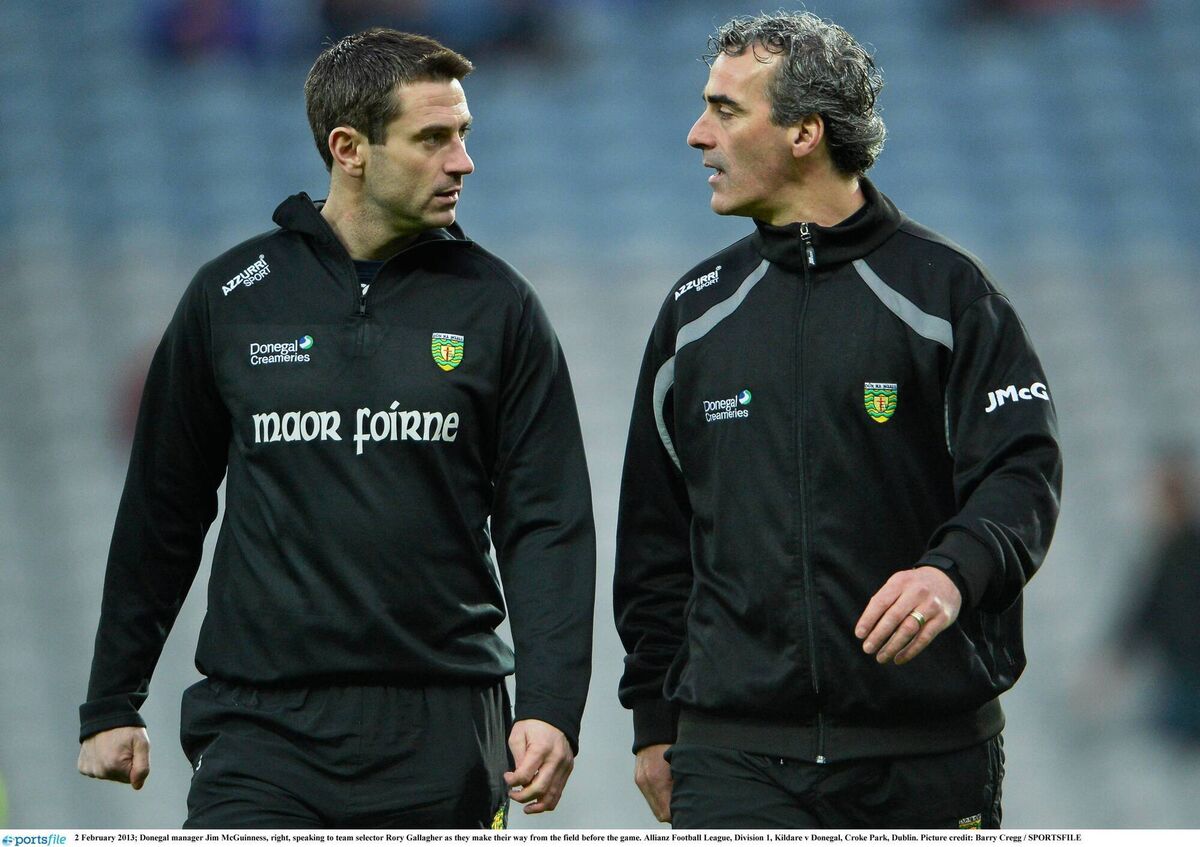
Gallagher has had that kind of transformative impact in almost every coaching stint he’s had. Firstly, with Donegal as Jim McGuinness’s right-hand man before their breakup at the end of the 2013 season, and then as a manager himself. For seven consecutive seasons, he’s been at the helm of one county or another, meaning Mickey Harte and Colm Collins are the only active senior county football managers with a longer uninterrupted spell on the sideline.
Although their relationship eventually turned sour, McGuinness acknowledged Gallagher’s contribution and qualities in his memoir, .
“He was very sharp and analytical and had a terrific knowledge of players from all over the country,” he’d write. “And he was hungry. He came from Fermanagh and he was keen for success. Over the first couple of seasons we used to hash things out over the phone. We would talk for hours about tactics or about players and where to use them. Both of our opinions counted and sometimes I would end up shifting my viewpoint and sometimes he would. We would always reach a resolution that we were happy with.
“Over [2013] I felt our conversations were becoming more fractious. [The end] was farcical and sad [after] three years of working together. We had been through a lot and had lived through many extraordinary moments together.”
McGuinness was certainly right in identifying Gallagher’s ambition. In an interview he gave this paper on the eve of their watershed win over Tyrone in the 2011 Ulster championship, Gallagher admitted, “People would be constantly talking about Fermanagh having an inferiority complex. I certainly didn’t have that. People and players would get sentimental about the idea of just reaching an Ulster final or playing in Croke Park. I never got caught up into that idea. I was thinking it would be great to win an Ulster final and win in Croke Park.”
In that respect his mother Deirdre was probably as influential as his father Gerry who coached so many Erne Gaels club teams he’d have played on all the way up. She was from Ballygawley, Errigal Ciarán country, and he’d have grown up watching his uncle Eamon winning county titles and even an Ulster one. As a teenager he’d pull off feats rare, almost unprecedented, for a Fermanagh footballer. He was playing minor for the county at 14. He won an All Ireland vocational schools A medal with Fermanagh College. He’d win Leinster titles with St Brigid’s in Dublin, All-Irelands with St Gall’s in Belfast, Sigersons with Sligo IT.
It never sat well with him when Fermanagh’s preparations and ambitions didn’t match his, meaning his own county playing career was an intermittent and often frustrating one. Once he met McGuinness on Christmas week in 2010, less than six months after playing for Fermanagh in the championship, it was clear he could be part of a setup he’d always craved.
Marty O’Reilly, whose first season on the panel coincided with the 2012 All Ireland breakthrough, thinks he speaks for every player in saying that once Jim McGuinness stepped down at the end of 2014, there was only one man they wanted for the job.
“He was the obvious successor. My first year on the panel, I couldn’t imagine two people who could be more obsessed with football as Jim and Rory. They were an unbelievable partnership. Tactically both brilliant. I don’t think there could have been anyone in football who had a greater knowledge of more footballers in Ireland than Rory had in those years. It was frightening how much in-depth knowledge of opposition players he had. What foot they kicked on, what they tended to do, how you could disrupt them. It was a huge source of confidence for us knowing our coaches knew opposing players more than probably their own managers did.”
Kevin Cassidy made a similar observation in Declan Bogue’s book that led to his own tension with McGuinness. Long before teams could call on a resource like Hudl, Gallagher was providing Donegal players with DVDs of their upcoming opponents. He sometimes even knew what kicking coach or sport psychologist they might have been working with, as an astonished John Doyle would discover in the 2011 All-Ireland quarter-final. Somehow or another, Gallagher had got wind that Ronan O’Gara had been in the Kildare camp that summer and also that Hugh Campbell, the sport psychologist with Armagh when they won the 2002 All-Ireland, was also working with Kieran McGeeney’s setup.
“I don’t know how Rory found out,” Cassidy would recount in the book, “but any time myself and [Rory] Kavanagh were walking past Doyle, we would say, ‘Hugh’s not happy with your kicking,’ or ‘McGeeney doesn’t have much faith in you.’ We’d also heard that McGeeney was lining up another free-taker that week too. [Doyle] didn’t want to know about frees after that.”
That ruthlessness was – and is – another feature of Gallagher’s character. In 2015, Gallagher’s first year as Donegal manager, O’Reilly scored three goals on their way to the Ulster final yet found himself dropped for the final against Monaghan.
“Rory is very black and white. Players know where they stand with him. There is no ambiguity. But I think players appreciate that. I had played all the games up to that Ulster final but then I met him an hour before training in Ballybofey and he told me were going a different way, that he was going with Mark McHugh. But at least he had the decency to say that straight to my face. And if you weren’t on he’d let you know what you had to do.
“He was always full of encouragement and supportive. He’d be far more empathetic than how he’d be perceived. I know how much he’s helped boys with different things like finding work or stuff going on in their life. He genuinely cared and had an interest in what was going on in a player’s personal life. If say someone with a young family like Frank McGlynn had a communion coming up in the house, Rory wouldn’t have a bother giving him a pass for training. He understood players were people first and foremost.”
In O’Reilly’s view, with a bit more luck Gallagher could still be manager of Donegal. In both 2015 and 2016 they came within a kick of winning the Ulster final. In 2017 they were comprehensively beaten by both Tyrone and Galway in championship, prompting a section of the Donegal public to turn against him, and so a bit like Éamon Fitzmaurice would do in Kerry a year later, he’d step down so not to weigh down the young players he’d blooded, even though he knew success wasn’t far away.
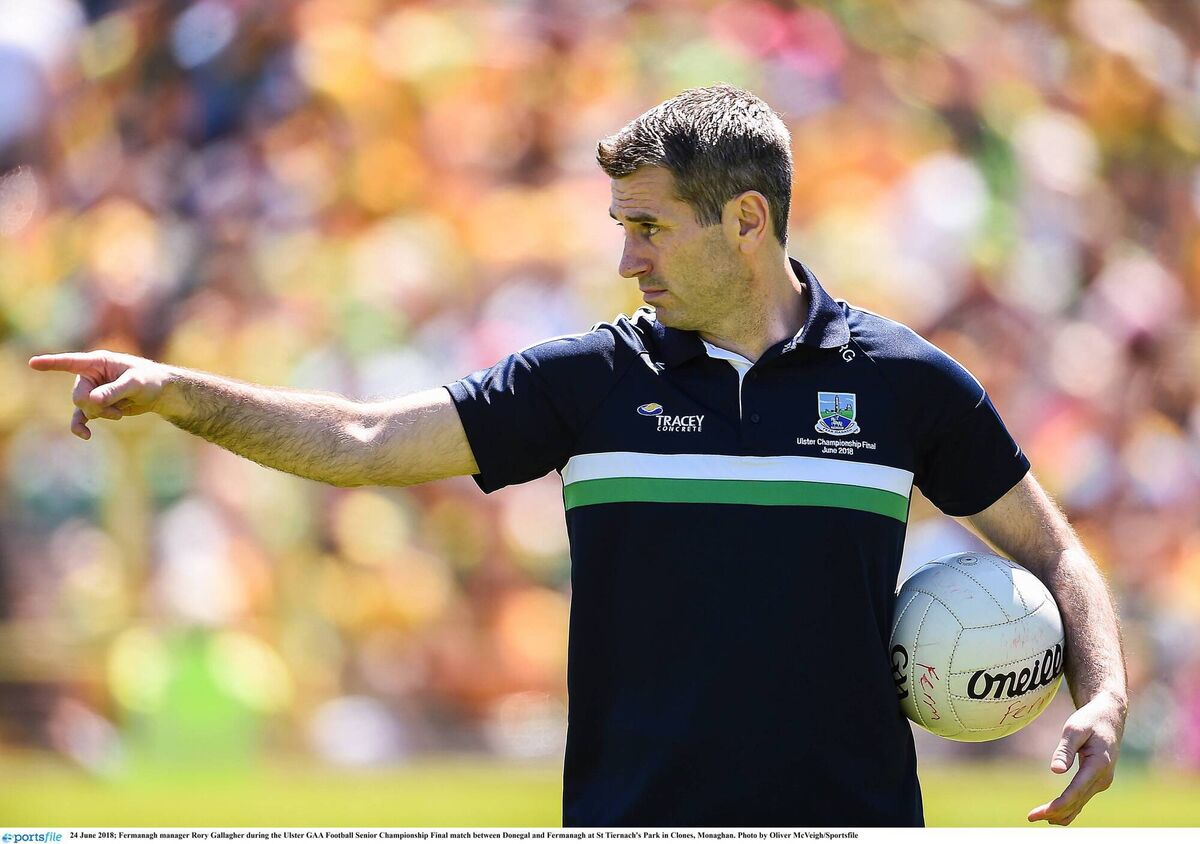
A year later he was coaching against Donegal in an Ulster final, seeing up close Ryan McHugh, a player he is as tight with as any opposing coach could be with a player, score a goal that dashed any hope of his native Fermanagh winning their first provincial title. That was possibly the biggest flaw with how he set up Fermanagh during his spell: if they ever went four points or more down, it was hard to see how they were ever going to come back.
But he still got them to win games that seemed beyond them, finish higher in the league and go further in the championship than almost everybody else’s expectations. In 2018 they’d shock a Monaghan team that would reach the All-Ireland semi-final. In 2019 they’d be top of Division Two with two games to go only to just fail to win promotion. Unlike Donegal, he knew Fermanagh was a squeeze, that the core of the team were in the second half of their careers. So he dogged them, demanded more of them than they’d ever imagined and they responded, loved it even.
While the style of play ultimately turned off some flair players like the Corrigan brothers, others played some of the football of their lives and were in peak shape, including Seán Quigley, hardly renowned for being the most dedicated player.
Now he’s in Derry. Although he has more firepower and greater talent at his disposal, there are some similarities with Fermanagh. Just like he transformed a corner forward in Pat Cadden to become the Fermanagh goalkeeper in his 30s, he has Derry players playing in positions and being in shape they couldn’t have imagined before.
A couple of things have certainly fallen in place for him. The return of Conor Glass. The split season, meaning Derry weren’t down four of their back six like they often were without the Slaughtneil contingent for the first half of several previous league campaigns. But so much of it is down to how he has every player clear on their role and the team’s offensive and defensive principles.
He still has that saucy side to him. At the start of the year Fermanagh brought in a new coach who did a bit of a Brian Clough at Leeds on it, promising a new attacking brand of football. When the sides met in the league in May and Derry were on their way to racking up five goals on his former charges en route to winning Division Three, Gallagher turned to the stands, enquiring where was all this attacking football he’d heard Fermanagh were going to play. He’s the kind of figure you’d love to give a dig if he were you were opponent – but love to have in your own setup.
Steve Jobs once said, “Here’s to the crazy ones. The misfits. The rebels. The troublemakers. The ones who see things differently. You can quote them, disagree with them, glorify or vilify them. But the only thing you can’t do is ignore them because they change things.”
That’s Gallagher. Crazy, rebellious, troublemaker, whatever you call him, you can’t ignore him. He helped change Donegal, Fermanagh, even for a while there, how the game itself was played. Now he’s changing Derry.


CONNECT WITH US TODAY



Be the first to know the latest news and updates