How Big Brother is watching but also helping referees
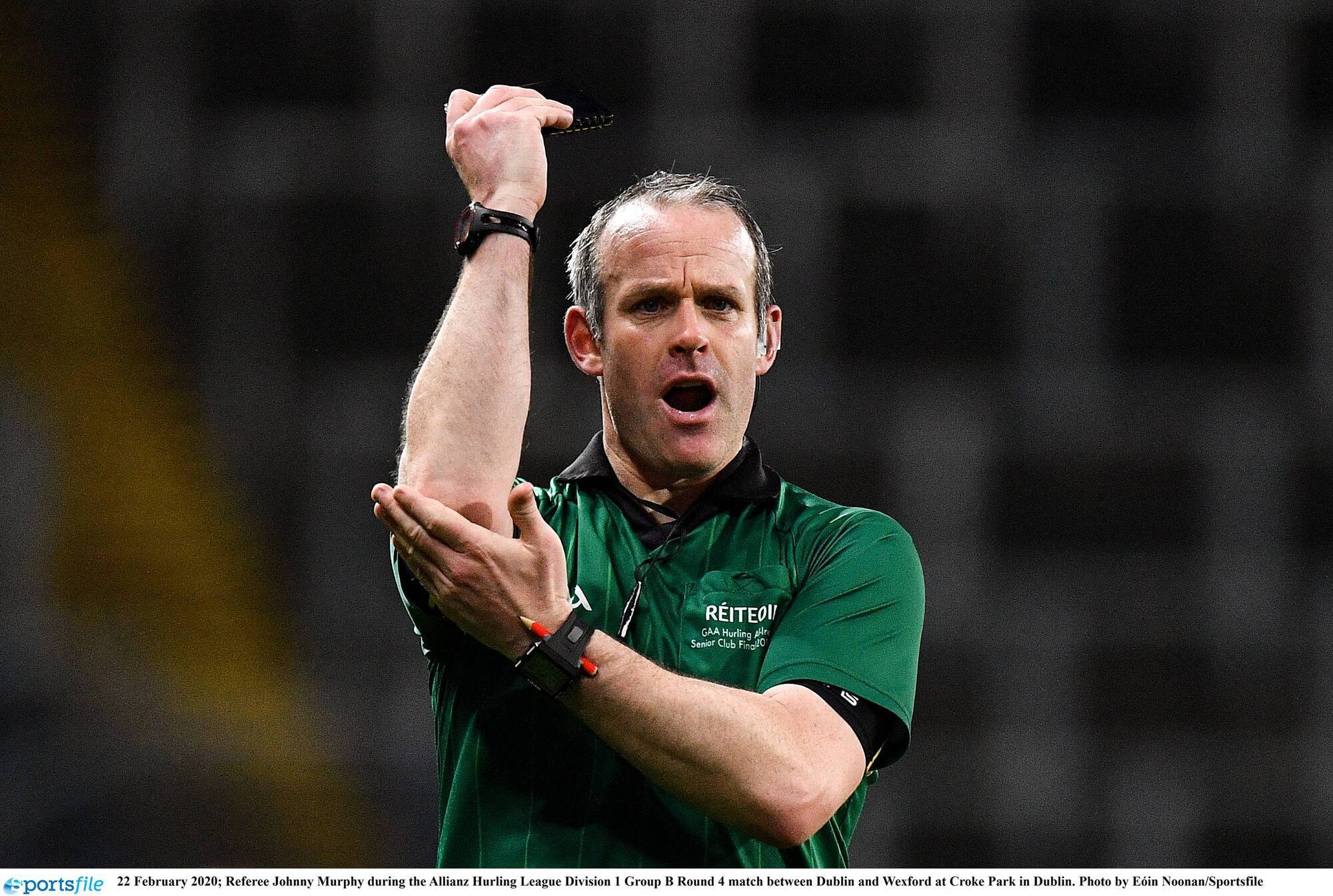
LOOKING TO THE FUTURE: Johnny Murphy is amongst the match officials partaking in a new pilot scheme that aims to assist in the development of top-flight GAA referees.
How to play it cute as an inter-county manager? Lesson one — don’t blame the referee. Instead, blame “the man in the stand”, the man who he is trying to impress so as to be appointed for a later, bigger game. That way, you are seen to be sympathetic to a referee whom you may come across further down the line.
Examples: “It’s down to the pressure that referees are under to apply the rules to the letter of the law” — Pat Gilroy, March 2011, six months before Dublin win the All-Ireland SFC.
“Some of the matches I see now the defender is not supposed to be there at all. That honest defending is disallowed, because there’s a fella sitting in the stand scrutinising every move the referee makes, and I feel massively sorry for referees” — Brian Cody, June 2011, three months prior to Kilkenny lifting the Liam MacCarthy Cup.
Assessors, or assassins as some managers would judge them, is how they used to be known. Former referees who would analyse the performance of the man in the middle and report it back to the referees’ committees with little in the way of explaining to the men in the middle directly where they went wrong.
From Pat McEnaney’s time as referee development chairman, their titles were changed to advisors and they were encouraged to communicate more with the referees as opposed to simply reporting their displays.
“We’ll start with zero and be more positive in our approach, rather than starting with 100 and being negative,” McEnaney said in 2012.
As part of the development plan released in 2018, they are now termed ‘mentors’ following a programme in Connacht where experienced whistlers partnered up with current ones.
At inter-county level, it is currently operating on a pilot scheme but the early signs are encouraging.
Big Brother remains, there is still somebody watching the referee, but it is not so much the Orwellian kind as the American community-based mentoring scheme sharing the same name. Semantics, this is not, insist the GAA.
“What we’ve done is we’ve used four referees on both sides of the house, four in football and four in hurling,” explains the GAA’s national match officials manager Donal Smyth. “We had a proposal to roll it out but we then chose to pilot it. We have had a couple of meetings with the advisors about what we want. The idea of it was a new referee starting off at inter-county level, that he be mentored and not just thrown in at the deep end.
“So the question was how do we work back from there so at the national level we’re working in small groups. So it was then a case of examining how does it work for the referee, the mentor and the referees’ development committee and how does it fit into what we do as well. It started in the last term of the referees’ development committee with Willie Barrett and now with Seán (Martin, referees development committee chairman).”
In hurling, Barry Kelly is working with Seán Stack as Johnny Ryan is with Johnny Murphy. In football, Pat McEnaney is helping Seán Hurson while Mick Curley is offering advice to Barry Cassidy. If there is criticism, it is constructive.
“Mentoring only works if it’s a three-way buy-in between the referee, the mentor and the development committee, how it connects into refereeing as a whole,” stresses Smyth. “If there is a breakdown in any of them it doesn’t work.
“We picked fellas who are in the developing group, those not at the very start of refereeing at county but not close to the end either, who are making progress and we want to see that continue. We could have another six, seven or eight on both sides but we felt we would dilute it. We need to take the learnings out of this and then hopefully expand it.
“It’s our intention for all referees to benefit from it but if we were to match up some referees and mentors how would the interaction work. The decision between who you pick is very important because communication is at the very core of what we do and experience counts for a lot too.
“The referee has to be comfortable with the mentor. That’s not saying the referee should have a say in who their mentor is but if there is a personality conflict then it’s not going to work.
The initiative appears to be more holistic than before and logical, as Smyth explains: “You could have eight different assessors or advisors for the eight games you did every season. With that, you could have eight different views or varying interpretations and you weren’t picking up advice from game to game. Whereas now you’re hearing the one voice and there is consistency in the information and assistance that is being passed on.”
In the past, only some referees would talk up the offer to speak to advisors. Smyth recalls: “We tried a number of things where we identified referees who would talk to referees after the advisor forms would come in. Some would take advantage of it, some wouldn’t. It was more than ad hoc than formalised but we did formalise it for new referees in recent years. Now, this communication is one-to-one and will be better.”
The loneliest gig on the field is not the goalkeeper position but the man without a team, who may begin his refereeing career relying on linesmen and umpires from the participating clubs.
As recruitment becomes more onerous, Smyth hopes the expansion of the mentoring system will see more match officials retained.
“The ideal thing for me would be when a young referee starts out at club or county level that a senior referee will go to their first four or five games and help him on, that we’re not just throwing them to the wolves. One-to-one consultations should work better than anything else.”
CONNECT WITH US TODAY



Be the first to know the latest news and updates