Explaining hurling sin bin will be tough, admits GAA refs chief
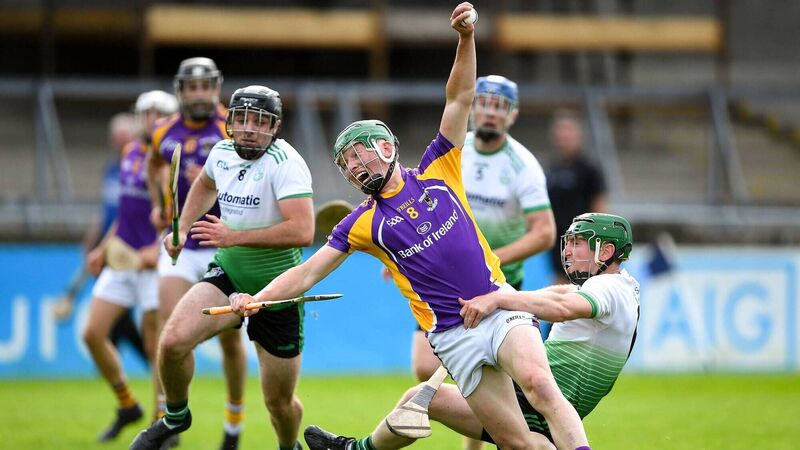
Cynical: Fergal Whitely of Kilmacud Crokes is fouled by Johnny McCaffrey of Lucan Sarsfields, before McCaffrey was shown a yellow card by referee Damien Burnett in a Dublin SHC game. Pictures: Piaras Ó Mídheach/Sportsfile
GAA referees chief Donal Smith admits implementing and communicating the new sin bin/penalty in hurling will be a challenge.
Now that it and other rule changes such as the adjusted advantage rule and concussion substitute will be part of the inter-county season when it commences, it is up to the national match officials manager to ensure they come into effect clearly and are understood.
Because the sin bin is a yellow card offence, Smith is presented with devising some way of referees signalling that it is not just a bookable offence but one that merits a penalty and the offender being sent to the line for 10 minutes.
“Where it will cause difficulty is the whole perception of it,” he said.
“Say a fella is going through and there’s a high challenge on him in the [semi-circle] arc, so that’s rough play and the defender gets a yellow card and there’s a free in.
“But say a fella goes through and is pulled down by a defender in the arc. The defender picks up a yellow card for that, but he is also sin-binned for 10 minutes and it’s a penalty. We will have to look for some clarification on that.
“For me, it’s not the rule, it’s the implementation of it and how it’s communicated. We really don’t want to leave (a situation) where people don’t understand the referee’s decision. That’s why the education of this will be vitally important.
“That message of what this experimental rule is about needs to be made clear to everyone involved, from the players and managers to the administrators and the supporters, and that is going to be a challenge.”
Were it not for the fact the black card was overwhelmingly defeated last year, it would be the most appropriate way of signalling a sin bin in hurling as it will be the case in football.

Smith hopes the leagues can be used to help referees get practical experience of the sin bin.
“We have to see how it runs in the league. We’ll have the education done before then, and then we can learn from that going into the championship. It’s a learning curve for everyone.”
The Meath man sees no potential difficulties with referees allowing concussion substitutes.
“If you see a bad challenge, you call on the medic straight away. The most important thing for the referee is to protect the players. When he goes out onto the field, that’s his number one. I wouldn’t see a situation where a referee would be slow about calling on medics.
“If a fella goes down with a leg injury like a hamstring, you’re not going to stop the game, you’ll wait until there’s a stoppage to allow for it — but when it’s bad, you’re going to deal with it straight away.
“I presume the signal will be the same as it is for the blood substitute with the referee making a ‘T’ signal for temporary.”


CONNECT WITH US TODAY



Be the first to know the latest news and updates