The perfect hurling manager: A 44-year-old teacher who played full-back?
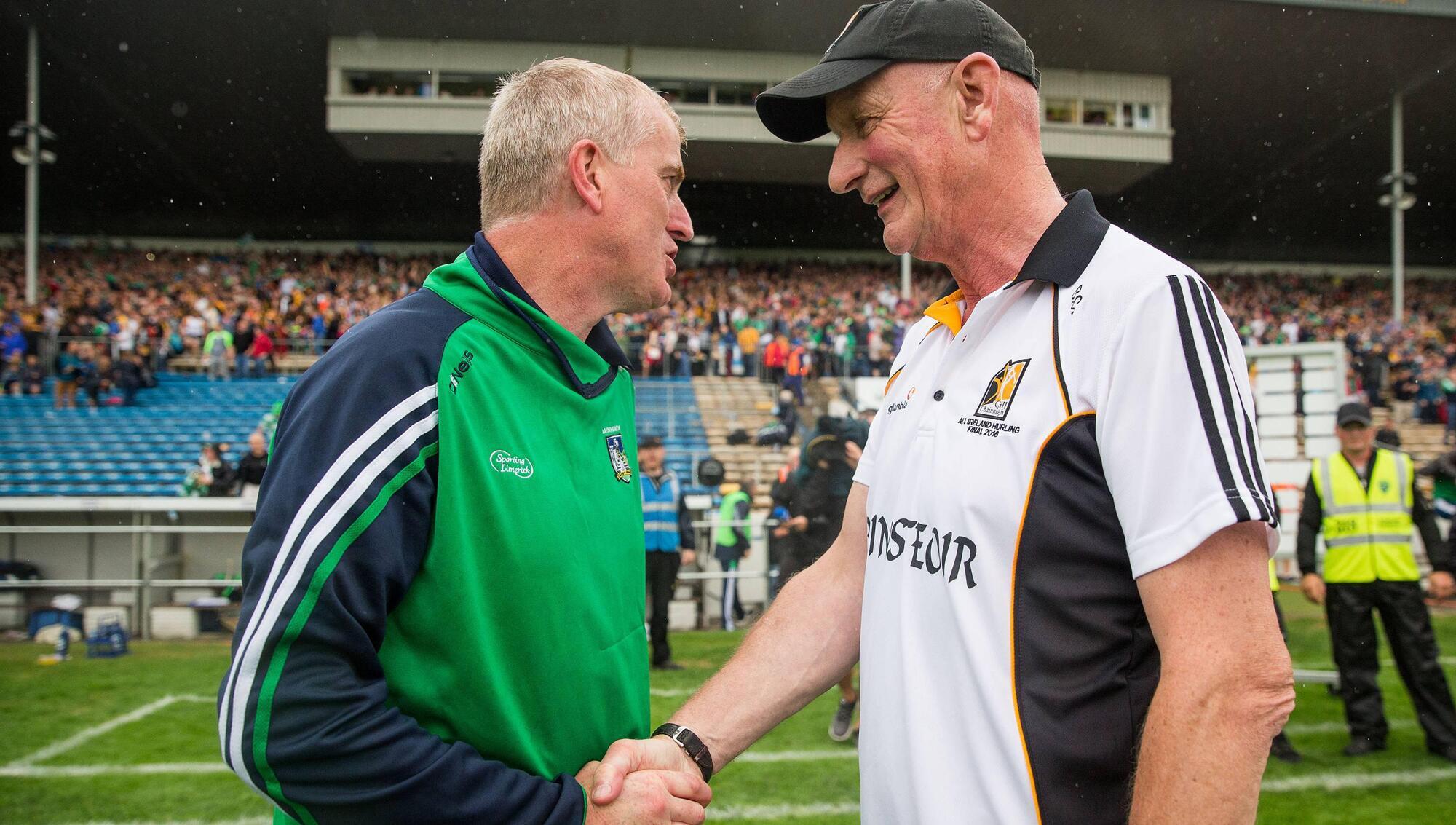
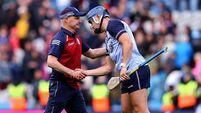
SHAKE ON IT: John Kiely shakes hands with Kilkenny manager Brian Cody after Limerick’s victory over the the Cats in the 2018 All-Ireland SHC quarter-final at Semple Stadium. But what are the criteria for making of a perfect manager? Picture: INPHO/Oisin Keniry
It’s around this time of year that a county secretary’s thoughts turn to freshening up management teams, and nowhere is that more important — or more fraught — than with its senior inter-county teams.
What are the criteria? They vary from county to county, of course, depending on a) the level of expectation for the team and b) the reality of those expectations, two realities which don’t coincide quite as often as you might think.
Maybe we can help. We decided to have a look at the most successful inter-county hurling managers of the last three decades to see if there are traits they have in common which would help a county board streamline its appointment process.
First, is inter-county hurling experience itself necessary for a manager?
Take the All-Ireland winning managers of the last 30 years — there are 17 in total, but not all of them had significant senior inter-county championship careers.
Fr Michael O’Brien, Michael Bond, and Liam Griffin didn’t feature for their counties’ senior sides, while Micheál Donoghue’s senior career was sharply curtailed by injury.
Despite the perception that former players are the default selection as managers, that means a quarter of All-Ireland winning managers don’t have a lengthy career at the top level to draw on, and some of them have no senior inter-county experience at all to speak of.
But looking at the CVs of those managers, it’s notable that O’Brien, Bond, and Griffin came at the very start of our sample period, while Donoghue did play senior inter-county for Galway. Does the modern player need to know his manager has togged out at the highest level? His predecessors in the 90s didn’t seem as hung up on that as a requirement, but the current cohort seem to respond better to a former player.
Here’s another indicator that could help a harassed county secretary: what position on the field is the best preparation for a manager?
Parking the four names above, the managers in our sample break down by position as follows. Goalkeepers (two), defenders (six), and forwards (five). Close enough, but drilling into those numbers a little deeper is revealing.
Of those defending managers, Ger Loughnane and Liam Sheedy seem to be the only half-backs available: the others — Brian Cody, Donal O’Grady, Michael Ryan, and John Kiely — played most of their hurling in the full-back line. In other words, their inter-county experience gave them a view of the entire pitch.
Significant? Perhaps, when you compare them to the forwards who became managers, because it’s interesting that those forward-managers aren’t as immediately identifiable with set positions.
When you think of those five bosses — Babs Keating, Jimmy Barry-Murphy, Eamonn Cregan, Nicky English, and John Allen — what positions come to mind?
Babs Keating started off out in the half-forward line before coming closer to goal later in his career. Jimmy Barry-Murphy followed the same path over the course of his time with Cork, and so did Nicky English.
Could you argue that this gives them a wider awareness of the demands of each position? Perhaps, but on balance it looks like our beleaguered county secretary will need to pick a former back as his manager, and preferably one who spent his inter-county career wearing number 2, 3 or 4 on his jersey.
Does the manager’s nine to five matter? Have a look at the 17 winners’ day jobs.
Finance? Five. Sales? Three. Hotelier and TV show host, one each. Priest? One, but Fr Michael O’Brien was also a teacher, so he counts as one of the six teachers as well.
The narrowness of the margin between those in finance and those in the classroom is a bit of a surprise, given the lazy assumption that teaching is the only profession that allows its practitioners the time necessary to devote to serious coaching and managing. Still, the number of titles won by teachers in that time — 19 — compares favourably with the finance titles (six). Teaching it is, then.
How about maturity, relative and absolute? Consider the age of the manager at the time of his first trip up the Hogan Stand steps wearing a bainisteoir’s bib.
Counting from 1990 onwards the ages of managers claiming first All-Ireland final wins: 57, 47, 55, 49, 42, 51, 50, 45, 46, 39, 51, 50, 41, 42, 46, 43, 46.
That averages out to just over 46 years of age, though if you cut out the oldest of the managers in the set, Fr O’Brien — sorry about that — the average drops to under 44 years of age, which seems to reflect the general downward trend as the years roll on.
Why is this? Does it relate to the belief that a younger manager can identify and communicate better with younger players? Is it a result of managers spending a relatively short time in the hot seat? Is it a young man’s game, given the level of commitment needed? Or all three?
In any event, a manager in his mid-40s seems the best option.
So far so good: we seem to be agreed on the position the manager needs to have played at inter-county level, his work background, and his age.
Are there anomalies we need to be conscious of? Hurling aficionados will immediately pick out a couple of flaws in our logic.
Among the forward-managers, for instance, you have Éamonn Cregan, one of the top attackers of his or any era. But one of his greatest displays came at centre-back for Limerick in the All-Ireland hurling final of 1973, when he was deputed to mark Pat Delaney.
Nicky English famously gave a stellar display at number six for UCC in a crucial Fitzgibbon Cup game. Brian Cody served as a full-forward in Kilkenny’s bid for All-Ireland glory in 1978.
Does this undermine our thesis? No, but it does bring up the biggest challenge to our efforts to construct a manager from statistics: the Kilkenny boss.
Brian Cody’s standing as the most successful manager in hurling is unchallenged, but collecting 11 All-Ireland senior titles tilts our sample size more than somewhat. Take the number of All-Irelands won by teachers as a prime example.
Or does it? When Kilkenny won their first All-Ireland under his stewardship in 2000, Cody was 46, a schoolteacher who had played as a full-back for almost all of his career in black and amber, conforming almost exactly to our template.
There’s the key, if you’re a county secretary. Just find a former inter-county player in his mid-40s who’s working as a teacher.
Or invent a time machine and go back to sign up Brian Cody early in 1998.
All-Ireland winning managers from 1990 to 2000: Fr Michael O’Brien, Babs Keating. Ollie Walsh (2), Eamonn Cregan, Ger Loughnane (2), Liam Griffin, Michael Bond, Jimmy Barry-Murphy, Brian Cody (11), Nicky English, Dónal O’Grady, John Allen, Liam Sheedy (2), Davy Fitzgerald, Michael Ryan, Micheál Donoghue, John Kiely (2).
CONNECT WITH US TODAY



Be the first to know the latest news and updates