HERBERT Park in Ballsbridge, early May of 1955.
Casual walkers spying a young man with a hurl. There he is, tossing a ball skywards, running on hard, catching it, killing it dead on his hurl, tossing up, running on. He is 19 going on 20, a native of Cappamore, studying pharmacy in Dublin. He is about to captain Limerick against Waterford in a Munster semi-final.
“I received a notification from Jackie O’Connell, county board secretary,” Paddy O’Malley explains. “About three weeks before that game, saying I was on the team. That was the only communication I ever had from them.
“Living in Dublin. No training whatsoever for those three weeks. No one to train with. I was in digs in the Ballsbridge area. So I went to Herbert Park and did the best I could. But that was no preparation for a Munster Championship match, and I played accordingly.”
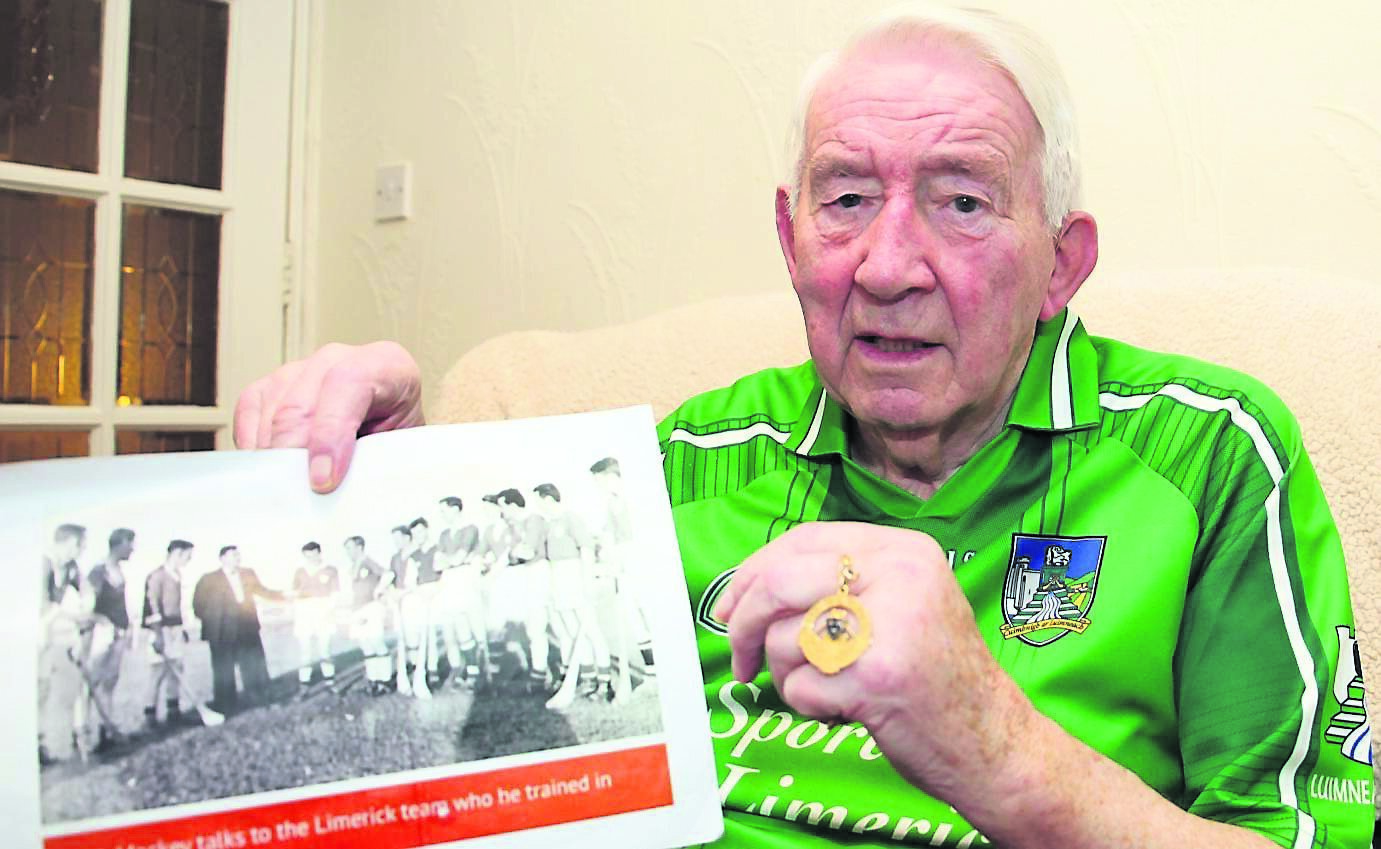
Sixty-five years later, I am listening in his sitting room. The years have treated that young man, 85 last September, kindly. Himself and his wife, Bríd, are graciousness and welcome without reserve.
Those years ago, O’Malley lined out right corner forward. Éamonn O’Malley, an older brother, lined out full forward. Waterford were seen off, 4-5 to 3-5. Clare, rampant favourites, became Munster final opposition.
The pair, along with Liam Ryan and Séamus Ryan, drove a remarkable surge in Cappamore. 1954 saw them senior champions, a first title since 1904.
“We just came through together,” O’Malley explains. “Cappamore managed four senior championships, between 1954 and 1964. We often didn’t have Liam and Séamus, two brothers, because they wouldn’t be released from Maynooth Seminary until the middle of summer.
“Fr Liam is gone. Éamonn is gone. I went to see Fr Séamus in his nursing home last year. His memory is not what it was. I walked out the door home and I could have cried.”
Paddy O’Malley was reluctant to be interviewed, despite natural fluency and warmth, feeling his inter-county career did not cut a deep enough groove.
Yet his generation is a significant one, a Limerick oasis between the senior All-Ireland wins of 1940 and 1973. Their startling triumph in 1955 against Clare, scourged off the field by a young selection dubbed ‘Mackey’s Greyhounds’, proved the county’s sole Munster title over 32 seasons of desert life.
O’Malley’s perspective should count. The porch is every bit as much the cathedral as the spire. No entry, no prayer.
For 1955’s final, Liam Ryan took his place (and the captaincy). “Only fair,” O’Malley acknowledges. “He was that slice better.”
Séamus Ryan, eligible for minor but physically powerful, hurled magnificently at centre back. Clare flopped and lost by 10 points, 2-16 to 2-6.
Limerick fell to Wexford, 2-12 to 2-3, in the All-Ireland semi-final. “They were a super team,” O’Malley emphasises.
Wexford are the best bunch of men I ever saw on a hurling field. They really were.
1956 spun round. Limerick returned to the Munster final around the final bend. As O’Malley recalls:
“We had Cork beaten. How could I forget it? Ring’s three goals… Those feckin’ goals.”
This denouement endures as one of hurling’s most celebrated moments. Most discussed, into the bargain. O’Malley offers fresh explanation: “Jim Quaid was injured and I went in, at midfield, on Gerald Murphy. And I said to our centre forward: “Go back in. I’m on Murphy.” He had dropped out there, after Jim went down.
“Willie John Daly was centre back for Cork, and a very good one. And our man never went back in on him. I don’t know why. He stayed floating around. Willie John got those three key balls and sent them down Ring’s way. And bang bang bang.”
Seven decades squeeze into mind’s eye: “And I can still see Ring going in, and he putting up the green flag for his second goal.”
This man remains perceptive and pleasant, that ideal mix. This man remains every bit the young person who dealt so capably and so easily with any amount of people, on the road and then for 38 years in their pharmacy shop on Limerick’s William Street. This man stayed level.
Following 1956’s lacerating disappointment, O’Malley’s inter-county career tapered into league appearances. Championship wise, by the later 1950s, he had come and gone. Ditto for Limerick, in a sense. Not until the early 1970s did the county retake its place among hurling’s nations. But personality meant a gift for friendship endured.
“I often thought about 1956,” O’Malley adds. “We wouldn’t have been far off winning the All-Ireland, after the experience we banked in 1955. We would have had that experience and better belief to bring to Croke Park.
“But I became great friends with Ring. I was on the road, after qualifying in the pharmacy, and Ring was on the road as well, for an oil company. We used meet in Tralee, in the old Manhattan Hotel (now Ballygarry House), as it was.”
Paddy O’Malley saw plain the other side of Christy Ring, a man who could be, off the field, diffident and unsure. Never more so than in September 1962, when Ring, at 41, was leaving the single life. As O’Malley recounts: “I remember well he was coming up to getting married, and he was nervous as hell. He didn’t know how he was going to face it. We were more or less nearly writing out, at the table in Tralee, what he’d have to say. We were trying to put his message together.”
The moment clicked: “That time, Kerry were about to play in the All-Ireland final. And because of the colours of the Cappamore jersey, the same green and gold, I have a big grá for Kerry football. I love to see Kerry playing in an All-Ireland final.
“Ring and myself were talking about it, and I said: ‘Any possible chance, Christy, of a couple of tickets?’ He said: ‘Look, the best thing I’ll say to you is meet me at Barry’s Hotel at 12 o’clock on the day.’ That was that, and we went off about our business.”
O’Malley continues: “We went up that weekend and stayed with Bríd’s people in Roundwood. I said to her: ‘Will we drive in at all?’ I thought that was the end of it, that Christy wouldn’t remember. I wouldn’t have thought any the less of him.
“But Bríd said to drive in and we did, and we went to Barry’s at 12. And there Christy was, on the steps. He just handed me the two tickets. I’ll never forget him for it.”
Kerry beat Roscommon in 1962 before a crowd of 75,771 in Croke Park.
There are zero ticket problems for this weekend’s All-Ireland final. The occasion is unique but entirely the same. Limerick hunger to win after an achingly long two-year gap. Waterford hunger to devour a 61-year gap.
A sliotar will forever be falling from the sky for young men in Ireland, pandemic or no pandemic. 2020 is a year that clarified eternal drives, eternal truths. Paddy O’Malley expects but never jumps from his level self: “Limerick will have to play better than against Galway in the semi-final. They were no way clinical. If they don’t play better, they will lose. Waterford are good and improving.”
A long view facilitates clarity: “Limerick hurling is the talk of the city, the talk of the county. Isn’t that great? There can only be a positive knock-on effect, down the line. But I’m around long enough not to take that talk one tiny second for granted.”
He raises a subtle point: “I wouldn’t like to see Na Piarsaigh become dominant in the way Ahane did in the 1930s and the 1940s. That level of club dominance in not good, overall, for a county. Ahane’s success caused an awful lot of problems, and Limerick otherwise would have won more All-Irelands.
“Then again, I am all for Na Piarsaigh. We have two grandsons there at the minute. Eoin [O’Sullivan] is 12 and Harry [O’Sullivan] is 10. And a granddaughter. Louise, Harry’s twin, loves camogie. They are doing extraordinary work with youngsters in the club. The current senior players come in and mentor young groups. William O’Donoghue is with Harry’s group, and he is brilliant with the kids.”
East Limerick made Paddy O’Malley. Tineteriff National School made him, before St Flannan’s College, before he won a Harty Cup in 1954 and played on that year’s Munster Colleges team.
“I started school the day after World War II broke out, September the third 1939,” he told me. “Myself and Fr Liam Ryan. We were neighbours at home, neighbouring farms. Fr Séamus was a year or so younger.
“Later on, we’d be scuffling home every evening, no shoes or boots, and the ESB poles at that time were made of a ceramic material. We used to have competitions between us to know who could break the bloody things, throwing stones. I was the world champion at that!”
His voice hitched: “Fr Séamus often reminded me afterwards: ‘Do you not remember it, Paddy?’ I always said: ‘I remember it very well, Séamus.’
“And I often wondered if we ever blacked out Cappamore as a result.”


Cancel anytime
CONNECT WITH US TODAY



Be the first to know the latest news and updates