Why has kicking off both feet been pushed down football’s skills pecking order?
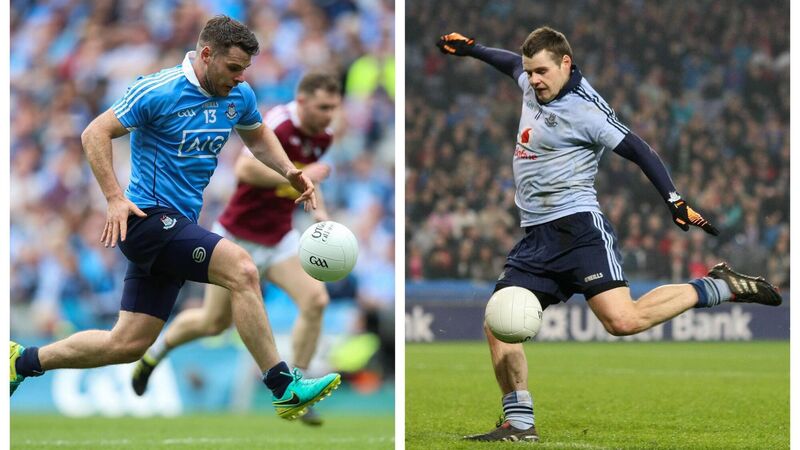
Dublin’s Kevin McManamon showing his skills with both his left and right boot. Every year we hear about the preparation of inter-county teams reaching new levels in terms of strength and conditioning, nutrition, and psychology. However, one of Gaelic football’s core principles is the ability to kick or hand pass from the so-called weaker (non-dominant) side, like McManamon is able to do.
In the 37th minute of the 2016 All-Ireland quarter-final between Dublin and Donegal, Kevin McManamon received the ball and soloed up the Cusack Stand side of the pitch using his right and left foot.
Many will have missed the importance and significance as he proceeded to bounce the ball with his left hand, soloed with his right foot, bounced the ball with his right hand, and finally fisted it over the bar with his left hand. By using his four limbs in this one passage of play, eyes should have been opened all over.
Every year we hear about the preparation of inter-county teams reaching new levels in terms of strength and conditioning, nutrition, and psychology.
However, one of Gaelic football's core principles is the ability to kick or hand pass from the so-called weaker (non-dominant) side.
In a study involving 14 players and five coaches and managers with experience of Division One at inter-county level, I investigated how players and coaches view the importance of being bilateral (two-sided), the challenges to becoming two sided, and how players and coaches develop both sides. The study produced 450 pages of transcripts and offers an invaluable reference point for coaches and administrators going forward.
Two-sided players were seen as being unpredictable, with the ability to leave you "looking like an ape", "they can fool to fool to fool", they are able to "open up the pitch", "be more flexible in the positions they can play", and "increase their options in possession".
"If you’re a corner-back and you’re marking a corner-forward and you don’t really know whether he's going to turn on his right or his left, or whether he’s going to dummy back, that's the nightmare situation," said one player.
One noteworthy aspect is how being two sided was seen as affecting not just the player in possession, but the team as a whole. A one-sided midfielder or centre-forward was seen as impacting the ability of an inside forward to get the ball or what run he has to make. As another player said around this: "If they can't deliver the ball to you, the way you need it to be delivered to get the best out of yourself, then we're both in trouble."
Further to its impact on team tactics, it was noted by one player how their whole game plan fell apart in the latter stages of the All-Ireland Championship due to having two midfielders who were simply right-sided. The result was all the play coming down one flank, an issue the opposition had identified from the very outset. Of course, the importance of two-sided players has further been heightened in the increased use of video analysis in the weeks prior to games. One coach even spoke of a five-year database on opposition players, with their preferred side being a key area catalogued.
Coaches and players reported that the increased emphasis on strength and conditioning has resulted in a metaphorical tug of war between skills development and physical preparation.
Physical gains are easier to quantify in the short term but with an ever-increasing demand on weights, activation work, band work and physios before training, this limits the time afforded to skill development.
"Now with the way it's gone, Jesus, you’re inside the dressing for 30 or 40 minutes before you can actually go on the field," said a player. "Doing the band work and strappings and everything else, whereas at minor you’d do five minutes, training would be at half five and fellas would be landing from four to go out on the pitch kicking."
While no one is arguing that physicality and fitness is not a vital component of an inter-county player’s preparation, some of the coaches themselves accept that things may have gone too far away from skills development.
As one such high-level coach put it: "It's a balancing act and I mean, in an ideal world, I would absolutely way prefer for the players to be out on the field practising their skills. I accept it’s nearly gone too far. What you're doing is you have professional levels of preparation in an amateur setup."
From the players’ viewpoint they lamented how coaching of the weaker side was "non-existent", "tokenistic", and "haphazard".
There was a clear lack of consistency in approach from juvenile level all the way up to senior inter-county level. Related to this, and something which clearly angered some players, was lip service; for example, a selector telling a player to improve his weaker side, with no detail given on how to make the improvement or any subsequent feedback in the following weeks and months.
In some players’ minds the increased use of possession statistics has also hindered the development of players’ weaker sides. One commented that you were better off not getting the ball than getting it and giving it away twice. Coaches need to be careful that the environment they create is conducive to developing the weaker side, and accepting of the mistakes that will inevitably follow.
There was even an argument from a coach and player that practise on the weaker side should be done away from the team group, due to time constraints, but this was countered by participants who said that the eyes of coaches and your peers are far more beneficial than working alone.
Not all responsibility lies with coaches though because attitudes to basic drills were seen as being a hindrance to skill development.
Players, it was said, "have been brainwashed" into thinking drills have to be complicated to be effective, while "simplicity is just not respected anymore". One player, pointedly, asked whether players feel they are there to be trained or entertained.
Contrast all that with how some actually did develop their weaker side. Participants who felt they were comfortable on both sides had similar experiences in their formative years; using their environment to play two sided games with their peers: “We had a basketball court where I grew up, and there was a back board,” recalled one player. ‘We used to go to the half way line to try and kick with the right leg, left leg, off the board.”
Another common trait among the two-sided players was playing in more than one sport growing up: "What I found was that soccer players, the lads from the towns, they seemed to have a much better handle on kicking off their left and their right and just had a broader range of skills", said one player.
Consistency in coaching, from coach to coach, and even within the same season, was seen as paramount in developing the weaker side.
One coach said, "I think for the for the two years I was with the U21s and the two years I was with the seniors we would have spent 20 minutes on every single training session, working bilateral [two sided] skills and that never changed".
Other positive examples included a club hosting internal leagues at underage level which only allowed players use their weaker side.
The use of two footballs at once, known as complex skills a term coined by Dublin’s Mick Bohan, has also been shown to reap benefits at underage and senior level. Complex skills (the use of two footballs) forces the player to develop their weaker hand and leg and stops them from hiding in drills.
Any initiatives by coaches must be framed around the fact that practice and an almost obsessive desire to be two sided was seen in many participants. Related to this point, is the notion, by some, that a player may be ‘naturally talented’ when it comes to being two sided.
When this was put to some participants it was notable how some got visibly angry; it was seen as an insult to the thousands of hours they had put into honing their skills. As one player put it, "everything you get you work hard for".
There is no question that the advent of development squads and academies has brought about considerable improvements in strength and conditioning, nutrition and character development.
Despite all this one needs to ask whether we are losing sight of our end goal, which is to develop a better, all-round footballer, who can carry out the core skills of the game under pressure? As one player said, seemingly without realising the significance of his words:
“I think there could be scope for more time for ball skills as opposed to the gym.”
Coaches and players not taking stock of the importance of the weak side are being forewarned though, especially in light of one prominent coach’s words:
“I would say to you not only in the lad’s game, but very soon in the girls’ game, without being able to use both sides of your body you are going to be left in the shop window.”


CONNECT WITH US TODAY



Be the first to know the latest news and updates