Hurling hands - Éamonn Grimes: 'I’ve only one finger that wasn’t broken'
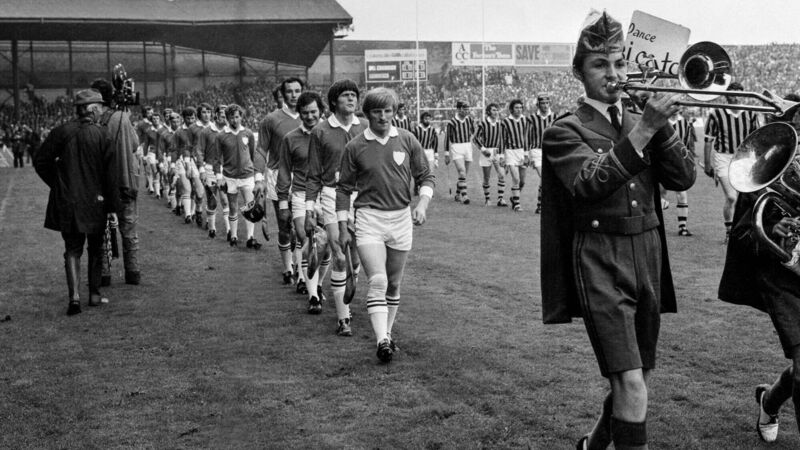
The Limerick team, led by captain Eamonn Grimes, parade behind the Artane Band ahead All-Ireland hurling final against Kilkenny. Picture: Connolly Collection/Sportsfile
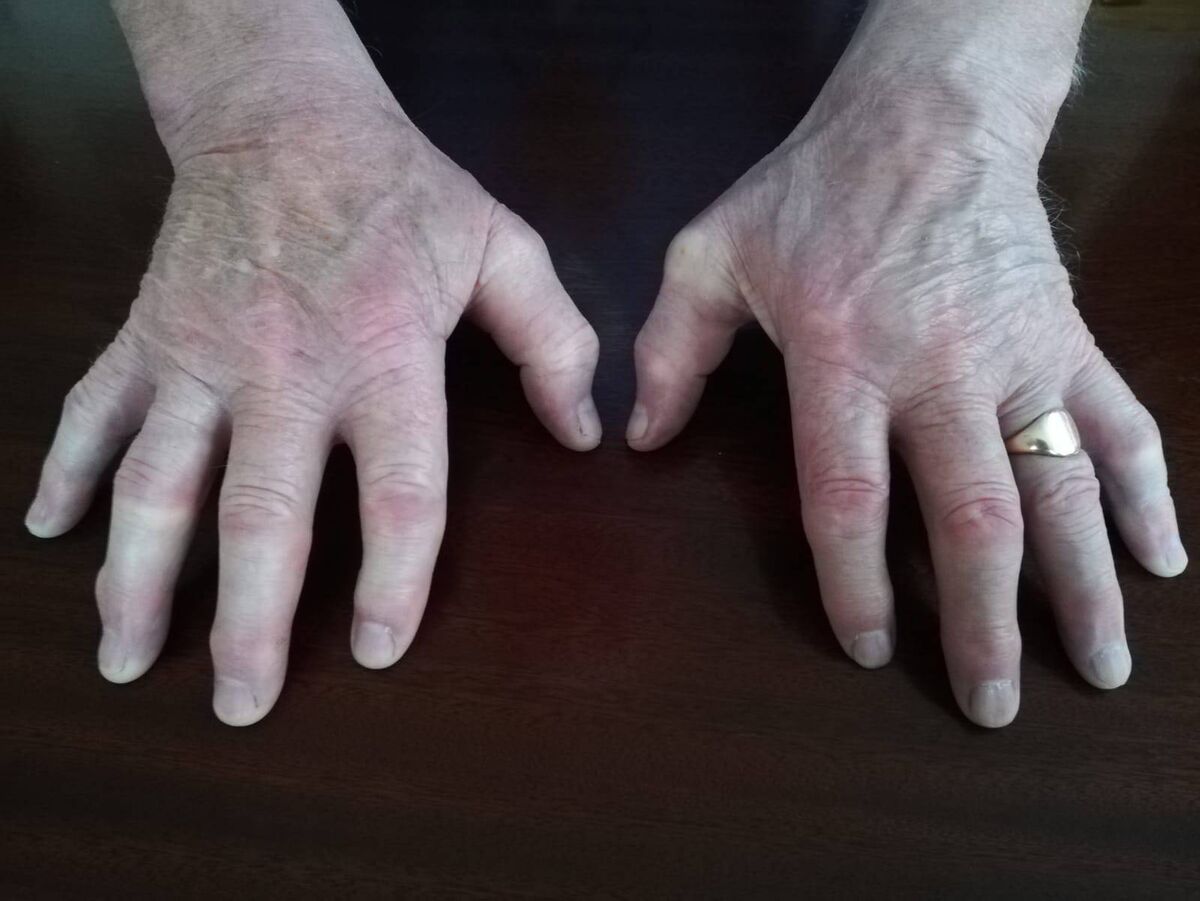
I’d say I’ve only one finger that wasn’t broken, the middle finger on my right hand. All the others were broken over the years, and all the breaks were hurling-related.
That time you were talking four to six weeks in plaster, at least, each time you broke a finger, and often the broken finger would be plastered to the one next to it to get it to heal properly.
The thumbs came in for a lot of punishment as well - I broke the right one three times and the left twice. Another player’s hurley would run up along your own and you’d get it on the thumb, but no complaints. We had great times. And I can still play golf, anyway. Am I any good? I’ll take you on for a fiver if you’re up this way any time soon and we can find out!
I was particular enough about my hurleys, I certainly took a lot of care with what I played with, but a lot of that came about because we had a man living across the road from us, Michael Ryan, who made the hurleys for us.
Michael was a farmer but he knew carpentry as well and he made all my hurleys. In the sixties there’d be very few games between October and April, so that was the time of year we’d start organising our hurleys.
We’d set out around this time of the year - say on a Sunday afternoon - up along streams in the country to look for ash. You’d find some ash with a lovely bend to it and cut those down towards the end of November, and we’d store them above in Michael’s hay barn until April or May.
Then we’d bring them to the sawmill and use the bandsaw to make the hurley - you’d obviously try to replicate the style of the one hurley you’d like, and you’d use a broken bottle or a spokeshave to get it into shape.
Michael was very particular with the hurleys. He’d always have the bás three-quarters of an inch thick at least, never less than that.
And that was needed. Nowadays players strike the ball very long distances, but going back to the sixties and seventies the sliotar was made of cork and hemp. Any bit of rain or damp and it wouldn’t travel. You wouldn’t hit it any distance at all with a light hurley.
We didn’t think in terms of hurley measurements, we measured the hurley to our own thigh bone. Then, you’d put it across your finger three-quarters of the way down, and if it balanced there you had the proper balance between the handle and the bás.
In the hurling of today there’s great skill. I wouldn’t deny the players that. But going back to someone like Theo English of Tipperary, he rarely put his hand up; he’d play the ball in the air.
Now no hurler attempts to hit a dropping ball. Everyone puts their hand up and no-one gets a belt or takes their hand down and looks to see if a finger is gone afterwards.
The shemozzles around the ball are the same - there doesn’t seem to be a player who can flick the ball out into space when there are eight or 10 players around it.
But the game is faster, and there’s certainly an ability now to pick someone out with a pass from a long way out, whereas before it was very tight marking.
The thing that drives me mad is the corner-forward going out to the middle of the field: there’s no contest then up front because you have the full-forward and corner-forward up against two corner-backs and a full-back inside. Two versus three.
What brought me on in my own time was the fact that I - and five or six more on that Limerick team in the seventies - came through the Limerick CBS sides in the sixties. They won four Harty Cups in a row and I was on three of those teams, so I learned a lot.
We had a Brother Burke from Tipperary and Jim Hennessy from Mount Sion - and still involved with Mount Sion - and the two of them were instrumental in developing hurlers. That’s where we learned it and those two men had a big involvement in developing hurling in Limerick at that time.
Players I admired? Without a doubt my own county man and teammate, Eamon Cregan. He started off as a goalkeeper when he was young, then he was a fantastic forward until he went back to the backs for the 1973 All-Ireland final.
Left or right, he could judge the ball no matter how it came to him . . . he was by far the best when I was playing.
Nowadays players like Joe Canning and TJ Reid - they seem to be able to read the game, carry the ball, their striking . . . they always seem to be able to make plenty of time for themselves. Someone like TJ Reid can do everything, including carrying the bag of hurleys.
Michael Moynihan


CONNECT WITH US TODAY



Be the first to know the latest news and updates