‘In 2001, everybody worked in unison and for a communal cause’
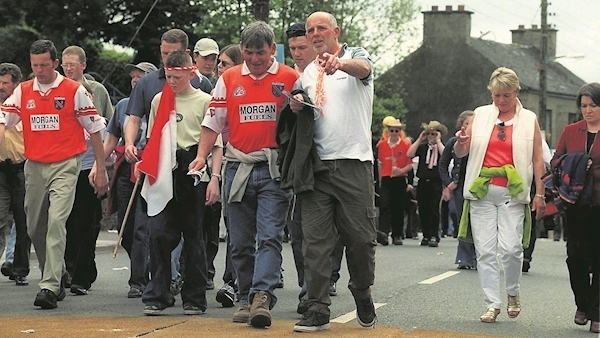
Thursday's decision to adopt a blanket ban across all GAA-associated activities for at least the following 16 days brings to mind the four-week suspension that was imposed in 2001 arising from the first foot and mouth case on the island of Ireland in Armagh, writes
GAA PRO Danny Lynch was having lunch on Wednesday, February 28 with then GAA director general Liam Mulvihill and president Seán McCague when he received a phone call he had been expecting and dreading.
“It was from a guy who I knew very well in the Department of Agriculture, Danny Carroll, who is an uncle of the former Tipperary hurler John Carroll who won an All-Ireland later that year,” Lynch recalls. “He said that they were after having a live case and to brace ourselves because something had to be done.”
Lynch relayed the details of the call to Mulvihill and Lynch, but the trio knew what would follow. In preparing for the eventuality, they had already taken soundings from all four provincial councils.
“The foot and mouth in Ireland at any stage would have been considered a disaster of abnormal proportions in the sense that one of our main industries, agriculture, could have been wiped out,” remarks Lynch.
“The GAA were very conscious of that — not least because many of us came from rural backgrounds and farming backgrounds. The message that came back from the provinces was ‘whatever has to be done, should be done if it comes to it’.
They were saying there was no need for Central Council meetings or anything like that.
The following day, a meeting with Department of Agriculture officials took place. Games were going to be called off — that much was certain — and the initial consideration was given to postponing matches involving northern teams.
But, following discussions, it was clear there could be only one course of action.
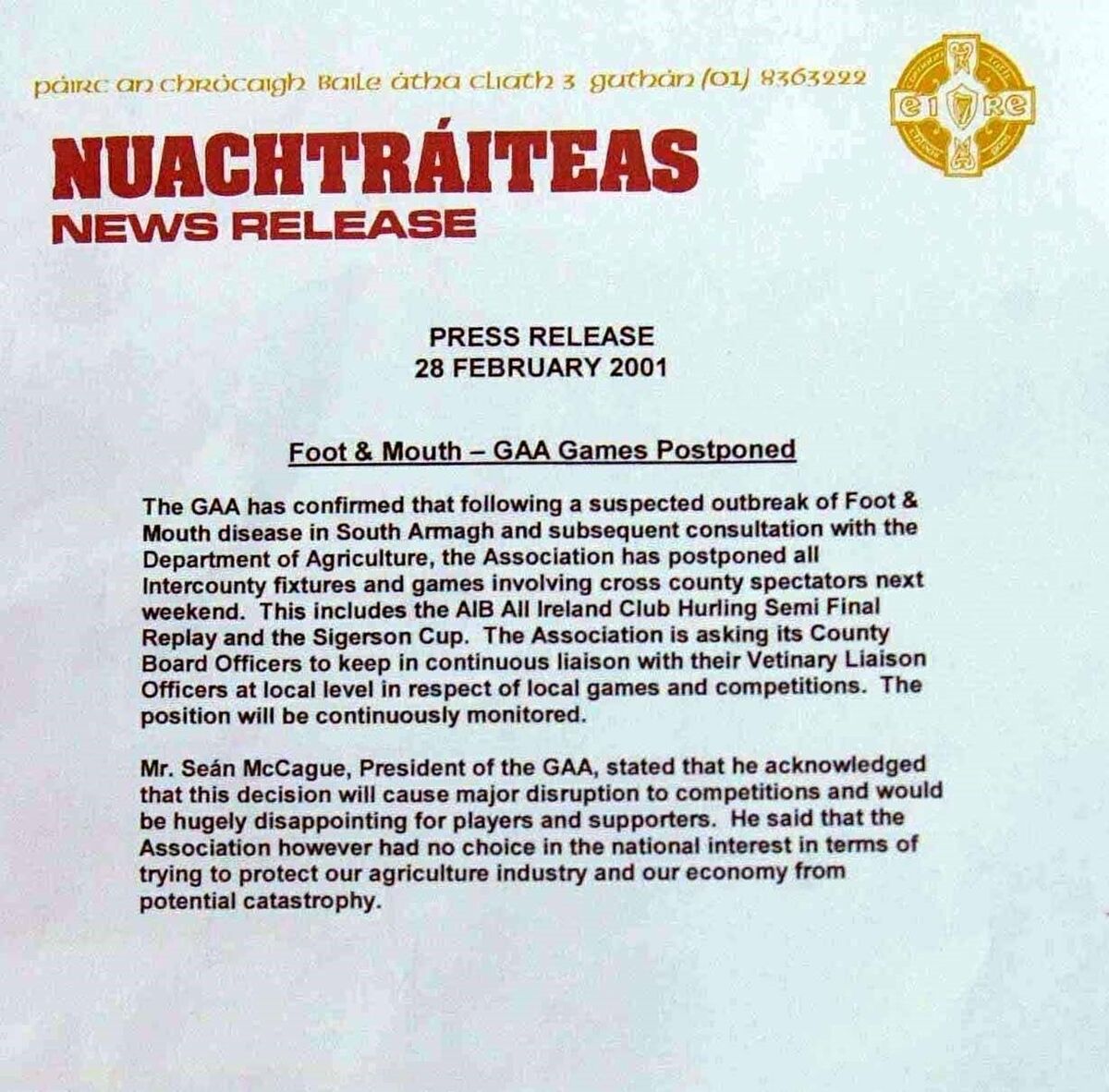
Lynch continues: “The Minister for Agriculture at the time was Joe Walsh, a good friend of mine from West Cork, and the department’s secretary general was a fella called John Malone, who I knew for 30 years in the civil service, a good friend and still is. We discussed it with them and asked, ‘What do we need to do?’ and the decision was the nuclear one — no matches, no gatherings, no meetings, nothing. We announced the decision that evening.”
The initial announcement was a ban on all inter-county games that weekend as well as the Sigerson Cup that was to be held in Sligo. However, rescheduling plans went up in smoke when another outbreak was recorded in Tyrone and the GAA later extended the pause on matches to four weeks. Inevitably, some games and teams fell by the wayside.
Following that case in Ardboe, Tyrone were ruled out of the Division 1 football semi-finals and replaced by Roscommon. Tyrone’s U21 Ulster final against Fermanagh also looked to be in jeopardy before it was eventually played and Mickey Harte’s side went on to claim All-Ireland glory in Sligo that October, while the All-Ireland senior club finals were delayed until April.
After the only case in the Republic was identified in Jenkinstown, Louth’s National League campaigns ended prematurely, although their footballers returned to action with a Leinster SFC first-round clash with Longford in early May.
They lost, but went on to beat Tipperary and Offaly in the qualifiers.
Because of restrictions, London didn’t enter the Connacht championship. Another case in Cushendall meant Antrim’s Ulster SFC quarter-final against Derry was pushed back to June, although Derry were also affected by what happened in nearby Ardboe.
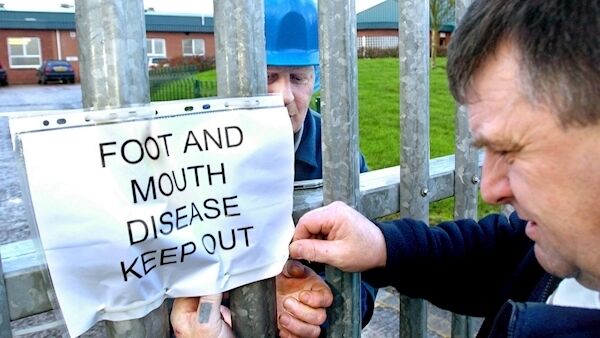
“My recollection is that the directive was by and large universally received,” says Lynch.
“There was some minor cribbing about it as there is with everything but everybody rowed in behind it and the success of it proved that the decision was the right one to take. The State’s whole economic fabric could not have been put in jeopardy. It would have had repercussions for several decades afterwards.”
On April 1, the GAA at inter-county level was back up and running with the remaining league fixtures.
There had been economic difficulties, but Ireland had overcome the disease to ensure it avoided the destruction it had done to the country in 1941.
Even in those serious times, there was room for levity. Lynch recounts: “I was told a story about how various agricultural advisors from the South were sent up to the North to basically police the border at the time to make sure there was no traffic of animals. Micheál Ó Sé, the father of Darragh, Tomás, and Marc, told me a very funny story about a colleague of his, a prominent GAA official but also an agricultural officer, stopping this guy coming across the border in his jeep with his dog.
“There were words passed, a disagreement, and the officer insisted there was no way the dog could come across. The driver said that he could piss off, that he always crossed the dog. Eventually, the officer got his way and took the dog out of the car. He set him down as the driver drove across the border.
"Our friend thought he had won the argument when what does the driver do only stop the car and whistle for the dog and he shot away from the officer over the border to him.”
What Lynch isn’t so good-humoured about is the decision by the British government to greenlight the Cheltenham Festival this week. The idea of so many punters returning to Ireland having been in close proximity with one another worries the Dingle native.
"I’m absolutely flabbergasted that it was allowed to go ahead, which has nothing to do with Ireland or the Irish government other than it could have serious repercussions for the Irish people in terms of the people who have gone there and coming back.
It beggars belief that it would be allowed to go ahead when there are soccer matches being played behind closed doors — 60,000 people in Cheltenham there and all of them cheek by jowl.
“In 2001, it would appear to me that everybody worked in unison and for a communal cause. I would hope that’s the way it will happen now. That’s really the only lesson from 19 years ago. I think that this situation might be a lot more complex and difficult — but everybody should heed what the authorities and experts are saying. Certainly, from the GAA’s perspective, I don’t think it will be found wanting because these precautions are in the national interest and in everybody’s family’s interest.
“I just hope that in the long term it will peter out, but it won’t unless organisations and people generally act together and make sure it doesn’t spread. I was in the bank the other day and a fella sneezed without a hanky as if nothing is wrong. But I think the gravity of the situation will smarten people up in the next week or so.
“It’s not so long ago that Ireland was able to beat the TB scourge in the ’40s and ’50s. So hopefully we can overcome another battle.”
CONNECT WITH US TODAY



Be the first to know the latest news and updates