Conor Lane outlines 'serious problem' with advanced mark
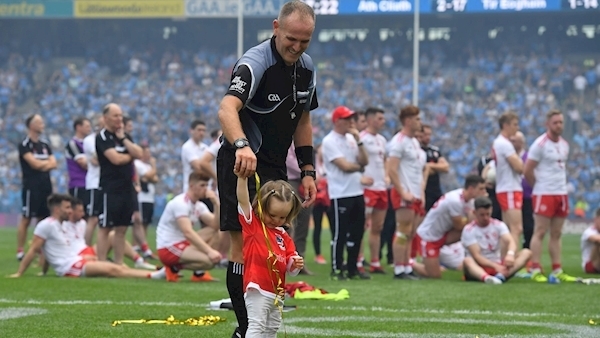
Leading referee Conor Lane has described the advanced mark as an ‘awkward’ rule and believes players have to take more responsibility in calling it.
The Banteer/Lyre man took charge of the Limerick-Clare McGrath Cup game on December 29 when there was just one such mark made but it caused consternation.
According to the new rule, notification of an advanced mark is made by the referee by blowing his whistle.
If a player wishes to take the mark kick, he must raise his hand to signify he is doing so.
However, Lane would prefer if the referee only confirmed the mark once the player has chosen to take it.
“It’s a bit awkward,” he admitted. “At one stage, a Clare fella caught the ball for an offensive mark, I blew the whistle as I am now directed to, he stopped then and did nothing. His team-mates told him to put up his hand, which he did, and the next thing a Limerick player complained that it shouldn’t be up to me to help the Clare fella in taking a point by blowing the whistle.
“He was right and that’s the serious problem I have with it.
“If a player wants to take a mark he must stop himself and take responsibility. It shouldn’t be up to the referee and that’s going to cause bother. Players are cute, they’ll be trained in it too and they’ll probably stop, quickly survey what’s on and if there’s nothing on they’ll take the mark.
“It’s going to take time to get used to it. We might get some help with the linesmen in terms of the 20 metres the ball must travel.
“How many offensive marks will you get in a game? Maybe five or six. You might not have anything for 50 minutes and it’s like anything if you’re not practising then you’re not going to get good at it.
“It’s there now and we just have to go with it.”
Last month, Lane’s fellow 2019 All-Ireland finals referee David Gough highlighted the potential difficulty posed in adjudging the 20m kick from outside the 45m for the advanced mark, when they're used to judging 13m for free kicks.
“The added difficulty with that is that when we’re asked as referees to judge on 13 metres, the ball is always stationary [whereas it'll be moving when judging 20m]. It’s really, really difficult,” said Gough.
“I can see important decisions being made by referees, which will be shown to be incorrect on TV when they take out their arrow and measuring tape.”
It’s a concern Lane shares especially if a pointed mark, which could be awarded having not travelled the minimum 20m, is the difference in a championship game.
“Then all hell would break lose,” he stressed.
He doesn’t envisage many problems with the 20m kick-out — in the Limerick-Clare game he noticed both goalkeepers have quickened up their restarts to counter the extra seven metres they must travel to kick the ball out.
Lane feels the sin-bin time keeping will have to replicate what is the case in rugby and allow for stoppages.
According to the rule, the 10 minutes a player is sidelined on receipt of a black card will commence as soon as the referee restarts the play following their indiscretion and doesn’t allow for stoppages, running down the clock or time-wasting.
“I think it should be like the rugby where the clock is stopped and restarted. The sin bin will be positive in the grand scheme of things.”

CONNECT WITH US TODAY



Be the first to know the latest news and updates