'People are going to be sick of looking at Kerry’
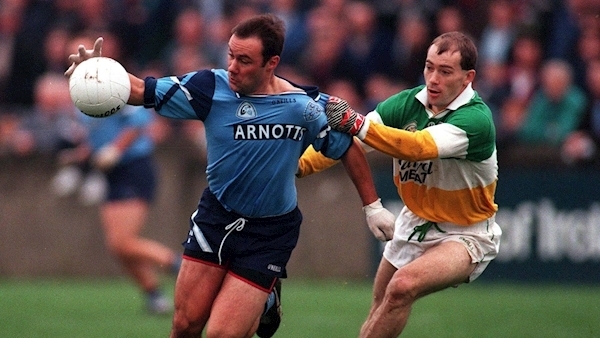
Dublin legend Paul Curran on his mate Jim Gavin and how Kerry will live in Croker for the guts of the next decade.
Paul Curran is so many things in his own right. The 1995 Footballer of the Year.

One of the sport’s first great attacking halfbacks, a harbinger to Jack McCaffrey raiding Kerry for 1-3 the other week.
A bona fide Dublin legend and nowadays one of the most respected and sought-after coaches on the club circuit as well as a long-standing newspaper columnist.
And yet for the footballing times we live in, this being the era of Gavin, there’s another prism through which to see him, one you probably wouldn’t have been aware of.
Curran and Jim Gavin aren’t just old teammates — they’re mates, proper. So much so that Curran chose Gavin to be the godfather of his third and youngest child, Jessica, not the kind of thing you’d bestow on anyone.
“When he came onto the panel, we just hit off. I know it’s not how people view him or how he portrays himself in the media but Jim’s actually a very amenable, friendly person.
"Can be good fun. He’s just a good person to be around. But obviously he’s become obsessed with this thing.Obsessed.”
It’s why in recent years Curran has tended to leave Gavin well alone during the season; the autumn and winter is time enough to catch up with one another.
And even when they do meet up now, the talk is rarely about football, or at least the inner workings of the Dublin team.
Curran doesn’t want to seem like he’s prying, and as he says himself, “even if I was, you wouldn’t get any information from him.”
It was different in the early stages of Gavin’s tenure when Curran was someone to confide in on the challenges of taking over a panel who had such a strong connection with Pat Gilroy.
Gavin made it look easy, winning the league, Leinster and All-Ireland all at the first time of asking, so easy numerous commentators questioned why he edged Davy Fitzgerald to the Philips Manager of the Year award. Those close to Gavin knew there was nothing easy about it.
“Jim had a very difficult job in the initial weeks and months. Because the players were still Pat’s players. Fellas were still contacting Pat. A text here, a text there. And I think Jim was very aware that he had to set down his own marker.
“One of the first things Jim did was that on matchdays that if you were coming off the field [having been substituted], you had to shake his hand.
And he was saying to me that the first couple of matches, there were fellas annoyed he’d taken them off and were about to walk past him and underneath his breath with his hand out he’d have to say, ‘Take my hand. Take my hand!'
“Eventually it became part of it. And what it was saying was, ‘It’s not about you. It’s about you doing your business and now there’s another fella coming on now who is just as good as you to finish the business. So out of respect for him and out of respect for me and the management, take my hand.’
“Now, not everybody does it. [Brian] Cody doesn’t do it. Other managers don’t do it. But I think you’re seeing it more and more [elsewhere] because there’s something in it.”
He offers up that insight in the context of how his and Gavin’s own playing careers petered out. He has yet to read Neil Cotter’s terrific book, Dublin: The Chaos Years but he accepts one of its central findings: that the dressing room any young player would have walked into, loaded with so many hardened veterans from ’95, would not have been the most inviting one.
“Fellas were more thinking of themselves,” accepts Curran, “rather than the collective. It wasn’t like it would be now with Jim.”
Could Curran have done more to alter and improve that environment? “I think when the team of ’95 started breaking up, I probably should have taken on more of a leadership role,” he concedes. “But I didn’t.”
Why didn’t he? After all, he wasn’t just one of the most respected and best players in that dressing room but one of its most popular.
He could be devastatingly direct in his feedback — John O’Leary and Jason Sherlock in their respective autobiographies recall him coming into the dressing room straight after the 1997 first-round championship exit to Meath and having a go at the forwards “for not doing the business” and even Niall Guiden for not keeping his last-minute penalty lower — but teammates also recall a more sensitive and caring nature.
Ray Cosgrove and Johnny Magee, who both lament to Cotter how protective and guarded many of the proud, competitive veterans of ’95 were, speak about how Curran and Dessie Farrell “put the arm around [our] shoulder; they looked out for us at different stages, gave a bit of encouragement, which was great”.
The problem was Curran felt compromised in challenging other senior players to be as open and welcoming.
There were several windows in the season when he wouldn’t be around. After being among the first batch of games development officers Dublin GAA would employ — “or coach organisers as we were called” — he secured a job as a rep with Killester Travel where he still works over 21 years later.
No one in the setup could ever doubt Curran’s capacity to keep himself in shape while away from the group — a habit and discipline he maintains to this day while approaching 50 — but plenty would have been ready to question if he’d been around enough to challenge the dynamics and leadership of the group.
“I could spend five months of the year away. I could be away two weeks in January, another two weeks in February. March and April was very busy, maybe even a fortnight in early May.
“I remember when Tommy Lyons came in, I was training well and getting very fit when before our first league game against Donegal I had to go to Thailand at the last minute because another travel rep pulled out. I didn’t want to go but I had to. I don’t think Tommy was too happy with that. And that was probably the start of the end for me.”
He would finish up that 2002 season, a starter on the side that won the county —its first Leinster final in seven years but an unused sub in the All Ireland semi-final defeat to Armagh. On reflection though the end had come some time before Lyons ever took over. The Chaos Years were precisely that.
“When I look back on the years after ’95, I never felt we were good enough to win anything, to be honest with you. Well, we were good enough in ’96 but there was too much change in ’96 from a winning team. In years like ’93 and ’94 as well as ’95 we had it — that feeling we were good enough, that we’d do it. But after ’96, I never got that feeling again.
"Even in 2002 when we won Leinster, I still didn’t think we were good enough to win the All-Ireland. Just too many little bits didn’t feel right. In a lot of those years, we just didn’t have enough quality players. To win it all, everything has to feel right. And even then you’ve got to get a little bit of luck.”
He doesn’t bemoan his innings. When he watched from the stands last Sunday week the Down silver jubilee team of ’94 being honoured at half-time the thought briefly occurred to him alright that had he not been played out of position on Mickey Linden, he’d maybe have more than the one All-Ireland medal to his collection.
But it hardly tormented him, either that day or for many years. The way he looks at it, they got “that little bit of luck” to win one in ’95.
“Your career is your career. I’m not saying I’m happy because I won one [All Ireland]. If I didn’t win one, I’d maybe have slight regrets but I wouldn’t be carrying them.”
Curran is too much of a realist to deal in what-ifs or any embellishment of the past. Unlike other players of the 1990s who bemoan on various platforms the state of the current game, Curran can see his era for what it was. Outrageously competitive, for sure — “Eight different counties won the All Ireland in the 1990s.
That will never, ever happen again” — but hardly more skilful.
The game is much better now. You can’t put the ’95 team up against the present team. They would blow us off the park. Just as the ’95 team would have blown the ’77 team off it. It’s just fitness, everything. Evolution.
It’s funny though how some things come round again. Curran didn’t watch last Sunday week’s drawn game through blue-tinted glasses but with the eyes of a discerning football man and he was enthused by aspects of the spectacle.
“For the first time in a long time there was unbelievable high catching. You had terrific fetches from the likes of [David] Moran, [Brian] Howard, [Dean] Rock and [James] Barry caught a great ball falling backwards. That was a skill that was completely gone for five or six years. Because goalkeepers refused to go long and teams were allowing them to kick it short, thinking, ‘We’ll get our defence sorted, you can have the kickout.’
"It was all about getting 14 men behind the ball and trying to eke out a one-score win, reducing it to a game of rugby, basically. But now the whole thing has changed. Kerry and Dublin were out to deny the kickout, press the kickout. The pressure was being put on the goalkeeper not to make the first mistake, not a wing-back or wing-forward kicking a stray pass.”
He’s attuned to such trends, being one of the leading managers on the club circuit for over a decade now. After a couple of years coaching Gavin’s native club of Round Towers, he took over Ballymun Kickhams who he’d guide to the first county title in 28 years and within a kick of a ball of winning the 2013 All-Ireland title.
Two years later he’d somewhat avenge that defeat to St Brigid’s by guiding Clann na nGael to their first Roscommon title in 19 years.
Now he’s with Celbridge, a club out to add to the one Kildare county championship it won in 2008.
There’s barely a county within 90 minutes of Dublin that he hasn’t either been connected with or offered their senior county job outright. And yet he has declined them all. Why?
“I just don’t like going into a job where I know myself I can’t do anything. With the present [competition] structures, you can’t do anything!”
Well, there’s the national league, where you can bring a county up the divisions?
“It doesn’t matter! It [the league] is not in the summer where you’ll come out and bring your kids to the games. But you take an Offaly, or a Derry, and say they’re in the All-Ireland intermediate championship next year. Something where you have a real chance of getting something done. Then I might consider it.
"Because you’ll have earned your way up. You’ll progress more if you’ve earned your way up. You’ve played more games, you’ve won something or at least contested finals, you’re ready for the next step.
“At the moment you’re never ready for it. Never! Because all you’re getting is two or three games a summer and it’s just a vicious, vicious cycle for these counties. How can you develop football where they get so few championship games a year? The supporters don’t see it, the young kids don’t get to see it…”
It’s not like he’s holding out for the Dublin job. “If or when Jim goes, there’s only one man for it,” he states definitively.
“Dessie [Farrell]. If Dessie wants it, Dessie gets it. Just look at his record with Dublin teams. We’ve only won one minor since ’84 — he was over it. He looked after 21s and won with them as well. He’d be very serious. A bit like Jim, in making sure there’d be no loose stuff tolerated. You’ve got to create an environment where you can be relaxed but it’s still very serious.”
And does he see Gavin stepping down any time soon?
“I see it happening if we lose [the replay]. I expected it if they had lost last Sunday week. I think he’ll go on for another year at least if they win, but if they lose this replay I think he’ll go. It takes an extraordinary amount of work to keep the thing going. The man has a young family. He also has a big job. He has a lot of stuff going on.”
But, you point out to him, the core of the starting 15 are still in their 20s.
Gavin seems to have enjoyed rebuilding the team on the go and empowering and developing the likes of Niall Scully and Brian Howard while weaning the side off having to depend on Paul Flynn and Diarmuid Connolly; ditto with facilitating the ascension of Paul Mannion and Con O’Callaghan as Bernard Brogan’s star has declined.
Would Gavin not relish replenishing the side over the next league or two? Curran’s not so sure.
“The big change will be in two years’ time. Up to now there’s been only one or two fellas going every year. Last year it was Denis Bastick.
"This year it was Paul Flynn. But in two years’ time there’ll be eight or ten fellas gone. Bernard will go this winter and a few more with him. And then most of them will go the following year. Most of them could even go this [winter] if Dublin lose.
“[Stephen] Cluxton will be 39 next year. The rest [of the veterans] mightn’t be starters now but they’re still very important players in that setup. Could one or two of them be replaced? For sure.
"But I don’t think the quality is there to replace eight or ten players of that stature. I don’t see that same quality in depth coming. I think we’ve good players coming. But we're talking here about once-in-a-generation players. There’s no other McCaffrey coming. There’s no other Bernard coming…”
But isn’t Mannion another Bernard?
“Well, put it this way, I don’t see the next Mannion coming behind Mannion the way Mannion came in behind Bernard. We’ve good players coming but not exceptional players like that.”
So what else does he see? Well, starting with this replay, for Dublin to be a lot more disciplined in their tackling and in their shot selection.
You can maybe shoot from outside the scoring zone with the inside of your boot. And you can maybe shoot from inside the scoring zone with the outside of your boot.
"The last day you had Dublin players shooting from outside the scoring zone with the outside of their boot. You won’t have that the next day.”
But he also sees some Kerry players being emboldened from the last day. He’s thinking of Killian Spillane in particular.
After seeing him as a minor in 2014, Curran predicted in print that Dublin “would be sick” at the sight of Kerry within a few years for a decade to come.
The timeline on that prediction proved faulty as Spillane’s trajectory dipped but now that Spillane is back on track, Curran believes so is his initial prediction. Kerry will live in Croker for the guts of the next decade.
“I was talking to a lot of respected past Dublin players before the first day who felt it was going to be a one-sided game. And I just could not see it. I just knew they were going to bring it to the wire.
“And they’re only going to get better. Clifford is still only 19. O’Shea is still only 20. And there’s more behind them. People down the country are probably sick of looking at Dublin.
"Well, they’re going to be sick of looking at Kerry. I don’t know when it’s going to happen for them, it could be Saturday, but when they get over the line, they will have it in them to do what Dublin are doing.
“And that’s what this is all about. Kerry have one thing on their mind and that is to knock Dublin off their perch. Nothing else.
"Nothing else. I actually think they got caught last year because of it but this year they’ve had the right focus.
"They want to stop this [Dublin domination] and they will be the team to stop it. There’s no other team going to stop it.”