Three of hurling’s most successful managers on the emotional rollercoaster of life on the sidelines
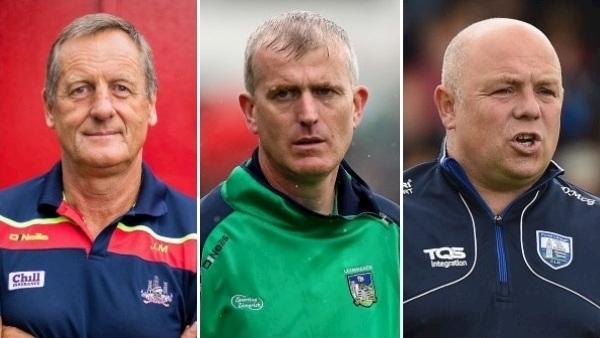
From fearing the sack to analysing referees and dropping players, John Kiely, Derek McGrath, and John Meyler offer some lessons from life as an inter-county manager, writes
What would you do in the pursuit of All-Ireland glory?
Would you drop everything and drive half the length of Ireland to convince a player to commit for another year? Would you endure the barbs from your own fans as everything you’ve built malfunctions? Would you look a fella in the eye and break his heart?
Derek McGrath, John Kiely, and John Meyler gave some insight into these questions and more at CBC’s ‘The Road to Success’ event, which delivered a riveting insight into the minds and methods of some of Ireland’s top GAA managers.
There were stories of persistence from Kiely, who feared being sacked a year before winning the All-Ireland with Limerick. There were stories of preparation from McGrath, who revealed Waterford’s forensic video analysis of referees.
And there were stories of psychology from Meyler, who strives to influence his Cork players’ lives in every hour outside the training ground.
Three managers, three educators, and three grounded, decent men who set the example for what they want their players to live up to.
Jackie Tyrrell wrote about Brian Cody’s greatest trait in his autobiography: “Brian completely understands the power of calculated instability, that tension he generates between hope and desperation.”
There can only be one Cody, of course, and few managers can afford to replicate that austere, business-like relationship.
For more, it’s about conversations which tiptoe between providing for the psychological wellbeing of their players and retaining the necessary emotional detachment for team selections. On a straight-talking and often light-hearted night in aid of the CBC Zambia Immersion Project, there were plenty of lessons and virtues to be absorbed.
Dedication
It was the autumn of 2014 when Derek McGrath got the call. One of those calls inter-county managers dread.
On the other end of the phone a player with star potential, Jamie Barron, was talking about going to America the following summer.
It wasn’t exactly the best time for McGrath to be taking this call. Waterford had been relegated from the top division of the League after a play-off against Dublin. They’d been knocked out of the Championship after losing to Wexford. Then he’d lost two selectors, Willie Maher and Frank Flannery. “The outside perception was the whole thing was falling apart,” he said. All in all, not the best of starts to his reign.
But the real reason why it wasn’t the best time was because McGrath was with his father at the Beacon Clinic. McGrath Snr was going in for “a shutdown on the heart, where they put a bit of mesh outside of his heart”.
“My father went into the Beacon and Jamie Barron rang me in the Mardyke to tell me he was going to America, that he wasn’t committing for the next year.
“I actually left my father in the Beacon Clinic, I said ‘stay there’, and I drove from the Beacon Clinic in Sandyford down to the ’Dyke, I walked around the field with Jamie Barron, said to him: ‘Jeez, we were going to play you in midfield this year’.
It’s easy talk about it now because it worked out well for Jamie, he got an All-Star and was nearly Hurler of the Year, but you feel like you’re Mother Teresa doing everything for them.
Perseverance
Autumn again. Three years have passed. Another manager, another backside on the bacon slicer. John Kiely is dreading his phone ringing.
He, too, hasn’t enjoyed his first year in the hot-seat.
Let’s just say his first home game was a seven-goal drubbing by Cork in the Munster Hurling League, and first impressions are lasting. They fail to gain promotion from Division 1B and strikeout in the Championship — two games, two defeats.

“I’ll be straight, I was waiting for the phone call to say: ‘Thanks for everything but we’ve decided to move on. We don’t feel you’re going to be the manager that brings us on.’
“I was waiting for the phone call and… there was a void of about three months of communication.
“So I was waiting but at the same time, I was at home trying to figure out how can we improve things? How can we get better? How can we have a better season the year after?
“That’s all we wanted, a better season where we were more competitive with the bigger teams, and try to win a few matches. That was it in a nutshell.”
A few wins, a Munster League, promotion, and you know the rest. Last autumn involved much happier phone calls.
Ruthlessness
There are uncomfortable conversations to be had from week to week. Every team announcement will delight and devastate in equal measure.
John Meyler has had more clubs than Jack Nicklaus, he says himself, but he’s still chasing that last major, and knows he’ll have to make plenty of hard calls to get there.
The hardest thing to do is go to somebody and say: ‘You’re not in the 26 on Sunday’. Then the guy faces you and says: ‘Why not?’
I found it really difficult last year… one player, I stood in front of him and said: ‘You’re not in the 26 on Sunday’, and he looked at me, and his eyes lit up because he really wanted to be not alone in the panel, but in the team, and he felt he was good enough.
“Sometimes you have to be brutally honest, and that is the most challenging thing to do. And when you’re reviewing the panel, to say: ‘Look, I’m not going to involve you in the panel this year’, that’s the cruel part of it.”
You can’t stand still, and you can’t look back.
Years later McGrath still has regrets over not meeting the 10 or so players he dropped at the end of his first year, instead breaking the news to the likes of Jamie Nagle, Liam Lawlor, Ray Barry and Richie Foley over the phone.
“I came out of a parent-teacher meeting in school and I’d say I gave maximum two-and-a-half minutes on the phone. I didn’t even meet them face-to-face. It was five seconds, ‘you’re not in the plans this year’, hang up, next fella.
“I wouldn’t be proud of that now but I just needed to move on.”
Honesty
John Kiely doesn’t tell players individually if they’ve been selected or not. He names the team and that does the talking. So long as it’s honest and fair, the right thing for the group, then they can’t complain.

No team owed as much to their subs as Limerick last year. Three late points from the bench against Kilkenny, 2-6 against Cork, a crucial goal against Galway in the final. Kiely is keen to communicate their ferocious importance through his actions, even just before throw-in.
“On matchday, we’ve a game for the fellas who are starting on one side of the pitch — it’s only a three-minute thing, seven or eight balls — but the subs go over to an area to do a possession game.
“I’ll generally go over with the subs and let Paul Kinnerk or whoever go with the team, so the subs feel like I’m giving them more attention than the starting 15. They’ll appreciate that more than if I did send somebody else over to them.
“It’s all about communication, honesty, and if your selections are reflective of true form, true effort, true potential, and true to the group, and if they know you’ll make the right decision for the team, there’ll be no issue.”
Diligence
Derek McGrath is a man on a mission. He’s constantly battling this notion that the traditional teams just go out and hurl. That the Kilkennys and Tipperarys and such royalty of the hurling world don’t do tactics.
He wants people to know the true level of planning, of minute, leave-nothing-to-chance detail, that goes into a summer Sunday.
“We would’ve planned for referees, if you want to know the nature of planning.
“We’d have tapes of their decision-making over the last three years. Every decision they’ve made, patterns in terms of decision-making, what they give frees for normally.
“So we’d have Fergal Horgan, we’d have Paud O’Dwyer, we’d have James Owens, we’d have James McGrath, and you’d have video detail of every decision they’ve made over the last three or four years.
“If you want to know the forensic detail that teams go into, ‘They’re more likely to give a decision for that, this fella gives a throw handpass, this fella doesn’t’. You’re looking for an edge.”
Even when decisions go against them, there’s an emotional currency to be cashed in.
He felt Diarmuid Kirwan’s controversial late call in the 2016 League final replay was a genuine mistake, and said as much in the media. But it was a different story inside the dressing-room walls.
“We were seething over it. We completely felt an injustice had been done and we were trying to use that as a fuel or a catalyst for a performance against Clare in the Championship, and it worked against Clare.”
Mindfulness
Things have changed in John Meyler’s 35 years of management. The game has changed, tactics have changed, and management has changed, from the coach, jersey-washer and waterboy all-in-one to more of an executive overseeing an expanding business.

And most importantly, players have changed, and that changes everything.
“You need to manage the environment, the culture, for players to thrive… It’s about mindfulness, wellness, psychology today as much as it is about hurling.
“The three hours at training are the easy three hours. It’s the 21 hours outside the three hours that’s critical.
You expect a guy to turn up at training at 7 o’clock, you don’t know what’s gone on all day. The wife could be giving out, the girlfriend could be giving out, the mother could be giving out, work could be looking for him to do a shift on Saturdays, or ‘we need you to come in now’. You don’t know what’s going on.
They’re balancing pressures from family and friends, work and study, social life and sleep, achieving in their parallel lives on and off the field.
Underperformance could be down to a hundred different factors whirring around inside that helmet.
“It’s work, it’s social, it’s something. In our time it was just ‘get on with it’. Whereas now, ‘are you alright?’”
He has members of his backroom team to look after his players in those 21 hours — one for those in work, and one for those in college.
“Conor [Kelleher] looks after the third-level guys, and he’s responsible for making sure they go through college in terms of their exams, in terms of their assignments, in terms of their study.
“If they need any help at all, Conor’s there, so he’s the go-to [guy] for me. It’s to give them structure because we’re asking these guys to perform at the highest level and anything that you can do to facilitate them, you do.”
Affability
Every manager lives a double life. The private one on the training field, inside the dressing room, with the players, and the public one behind a microphone after a game. There’s the temptation to set the record straight, right the wrongs, but that wasn’t Derek McGrath’s way, even if he was often irked by the lazy commentary he saw around his tactics.

“Nobody points out that in our five years, and this sounds like self-indulgence, we scored more goals than any other Waterford team in the last five years – [more] than Justin McCarthy’s team, than Gerald McCarthy’s team, than Davy Fitzgerald’s team, than Michael Ryan’s team, and our scoring average was better than any other Waterford team in the last 20 years.
“It would irk you at times, but I think the best policy of all is to be affable about it, and smile about it, and send your players out afterwards, ‘Ah, we’re just a hard-working team, we’re an honest team, we’re reflective of what we like to do and how we were brought up, etc., blah, blah’.”
On the night before the 2017 All-Ireland final, he was living in a bubble of positivity. There were proud texts from his family, and he even allowed himself to watch a few minutes of Up For The Match and bask in the excitement of it all. Then, sharp as the clatter of a hurl, he was snapped out of it by a text from a friend: ‘Jesus, did you see what Babs wrote today?’
“Then he sent me a picture of the article!” said McGrath, to howls of laughter. It read: “Derek McGrath must walk away if Waterford lose today”.
You have to insulate yourself from it all, and ignore the noise outside your inner circle.
Defiance
The noise can be most piercing from the fans. Your own fans. John Kiely had a rocky start, and his first headlines showed his defiance: “Hurling boss John Kiely slams Limerick’s ‘abusive’ fans”. He still remembers the minority making the most noise in those early days.
“We would’ve had about 200 people coming to our league matches, and half them probably thinking of castigating me, literally would be fit to climb down the wire. I got into woeful trouble for chastising two of them. It was difficult, very difficult.”
So perhaps the magic ingredient between there and silverware is dedication, or perseverance, or ruthlessness, or something else locked inside that dressing-room door, or a combination of things, or perhaps there’s no secret at all.
But what they all share is a love for what they spend so much of their time doing...
Passion
“I just love hurling. The excitement of it, the speed of it, the skill that’s involved in it. It’s an incredible game.”
“It’s a privilege at the moment to be involved in hurling. It’s a privilege for us to be on the sideline. It’s a privilege for the players to be playing it, [with] the way the game is being played at the moment.”
“You have to have a passion for something if you want to manage a team. You have to love it. It’s a strong sense of affiliation to your sport I would feel.”