Brian Cuthbert: For the sake of young players, school, club, and county must work together
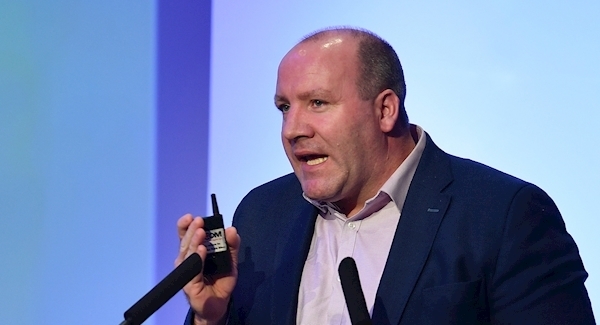
Former Cork senior football manager Brian Cuthbert has called for the underage development squad model to be reexamined in Gaelic games.
The Bishopstown clubman recently finished his PhD with the Department of Sports Studies and Physical Education, focusing on the development of young GAA players between the ages of 14 and 17.
“In terms of learning, there were a lot of surprises, but to be honest the competition structure within the development squads is something to be looked at,” said Cuthbert.
“There’s a competitive element in all of us, and if there’s a competition at the end, invariably the coach and the kids and the parents all want to win that. I hear coaches talk about those as All-Irelands, and I think that’s not correct. It takes away from the developmental approach that’s necessary.
“If you graph the training and contact time that’s done, there’s a steep curve coming up to July, and then it drops off. Obviously there’s a preparation phase for the competition, then it drops off as kids go back to school or whatever. But the coaching should be the same no matter what time of the year it is.
“I’m not saying you get rid of competitions, but I think there’s an overemphasis on them.”
Cuthbert added that the raison d’etre of the development squad needs to be re-examined.
“The question that has to be asked is, what are we developing? Are we developing a team to win a competition or are we developing players? You learn as you go along, and I’d have been 100% someone who wanted to win competitions as I went along, but the learning now — and fellas might smile at this — is that it’s completely around the player.
“Look at the best coaches in sport all over the world. Why are they great? They relate to players, and it might be nothing to do with the sport, even though inevitably they develop as players too. My study wanted to see how these boys developed holistically in these squads, but the focus is very narrow.
“A lot of counties are doing their best to broaden that focus, but the structure doesn’t allow them the opportunity and contact time for that. There’s a need to think outside the box and bringing contact time into a tighter relationship between club, school, and county, where some of the development work can be done at school level, some at club level and more of it at county level. But that’s only when everyone is on the hymn sheet.
“That’s very complex. The club coach might feel he hasn’t a relationship with the county coach; how many times would a senior inter-county coach — myself included — pick up the phone to the club coach and ask about player X or player Y?
“And it’s different again at senior level because you have the players all the time, whereas at U14, U15, the county coach might have them 25 times a year. Most of the time they’re with the club or school but we don’t build bridges between those.
Until the GAA aligns those three areas and gets parents speaking the same language as what’s in the development curriculum, we’re in trouble.
His thesis looks at the environment around players as they develop between the ages of 14 and 17: “I looked at the development of these players in terms of the synergies between clubs, schools, the academies and I also interviewed parents and U16 players.
“Even without doing the study we can appreciate what makes Gaelic football different, in that players play for their club, their school, and their county if they’re good enough. Getting the balance right is difficult at adult level but at a developmental level, at 14, 15, 16 a child is changing in terms of his social outlets, his own being, and then he’s deemed talented, so there are conditions put on him.
“He’s good enough for the county, so he’s good enough for the club and the school, and getting that balance right can be very difficult.
“And because of that, getting development right... if the structure isn’t right it’s next to impossible to get development right. So despite the idiosyncrasies of different counties, the same wants exist in those counties.”
Cuthbert found that research in the field doesn’t favour specialising in a particular sport: “One issue, going by the science, is the notion children should just play Gaelic games and they’ll get better at hurling and football.
“The science suggests that specialisation for the sport we play isn’t the way to go, but the opposite. That we need to offer children a diverse approach where they play as much as they can up to the age of 15 or 16.
“Now that’s almost impossible with Gaelic games because we can hardly get the balance right between club, school, and county, so how will we fit in more sports? But when I went around the country looking at these guys, they’re fitting them in.
“Some of them are playing rugby, some are playing soccer, tennis, whatever it is — some of them have nine or 10 weekly activities.
“But one of the recommendations coming out of the work is that there’d be an understanding among all the coaches within our games and organisation of what they’re (kids) doing with the other coaches, so that there can be dovetailing and development individualised as much as possible.
“We can extract a lot from models all over the world, but because GAA is becoming more professionalised and commercialised, we have a habit of borrowing practices from other sports and throwing them into Gaelic games. But that doesn’t work because they’re out of context, and when you go out of context, you create more harm than good.
“You need to go around the world to see what they’re doing in Holland or Belgium, but also to work out what that looks like in our context, particularly the club-school-county challenge.
In a nutshell, if you think we need a Cork U13 team because there are elite soccer teams at 13, it doesn’t fit for us. It shouldn’t be brought in.
CONNECT WITH US TODAY



Be the first to know the latest news and updates