Cream of the crop: How the humble 99 played a role in landing Liam MacCarthy


In the hours after their finest day, it was one of the more refreshing stories to leak into the public sphere, an antidote to the mania of marginal gains.
Shane Dowling revealed in a matter of fact manner that the Limerick hurlers had shattered the conventions of what inter-county players can — and can’t do. He recounted: ‘The ice cream van would pull into training at the Gaelic Grounds, and everyone was just chilling out on the field, having a 99. That would not have been heard of five or six years ago.
Ten years ago, you wouldn’t touch a drop of liquor from January ’til nearly the end of the season. None. Now, after every Championship game, we all go and enjoy ourselves, management included.”
It seemed a throwback to an extinct era, long before this amateur game became shackled by the chains of professionalism.
But for fitness trainer Joe O’Connor this was all part of the plan, with method in the perceived madness.
Before any aspiring stars go reaching for the bottle, though, it’s important to see the full picture.
“Obviously we don’t allow these guys to go on the piss for two weeks, they know themselves what to do,” says O’Connor.
“But when you’re trying to tell a guy of 21 or 22 that he can’t go out and enjoy himself, that can be counter-productive to performance.”
O’Connor has been Limerick’s fitness and nutrition coach since 2016, and having initially tried the dictatorship approach he’s since learned the value of leeway. He cites the work of Mihaly Csikszentmihaly, a Hungarian psychologist who is best known for his seminal paper, Flow: The Psychology of Optimal Experience.
Csikszentmihaly believed that in order for the mind to be on when it matters, it has to be able to switch off.
“You can’t be on all the time or you just get burnt out,” says O’Connor.

“When these guys are on, they’re fully on and when we say go and enjoy yourselves, we mean it. Because when they come back to us they’re fully committed and there’s no resentfulness that they could have gone out with their friends on a great occasion. It’s all within reason, it’s not losing the plot.
“They might party hard but they appreciate that if they’re going on a big night out, they’ll have their Dioralyte [a rehydration supplement], their bottle of water and banana in the bedside locker for the following morning.”
Over the years O’Connor has worked with enough inter-county sides to know what works, from the Waterford hurlers in 2010 to the All-Ireland-winning Clare hurlers of 2013 to his more recent work with the Kerry footballers and Limerick hurlers.
“If you hit your targets on one side of the house you’ll be rewarded on the other,” he says.
“Over the last 12 or 13 years that I’ve done this, I’ve found balance is the most important skill above all when coaching, to know when to push the button and when to back off, to find that sweet spot.”
With Clare he worked alongside coach Paul Kinnerk, and when they both wound up at Limerick they were swiftly on the same wavelength with how to prepare a team for a run into high summer. And just as O’Connor and Kinnerk empower players, manager John Kiely trusts them implicitly.
“John is a great leader and he steps back and lets us do our thing,” says O’Connor. “It’s a high- powered backroom team and they’re all coming with different skill-sets.”
O’Connor’s specialty is exercise and nutrition science, how to condition the body to withstand the demands placed on top players.
His grown-up job, as he calls it, is as a lecturer in exercise physiology at IT Tralee, and there’s a favourite line he tells his incoming students at this time of year.
“The best coaches are good at the two Cs – they know how to put things into the right context and they know what they can compromise on.
“In a limited time budget of an inter-county player you have to make sure you have the most effective stuff in your system.”
Planning the training and diet of a team like Limerick is a process of elimination; laying out all the things they could be doing then discarding all but the most effective. O’Connor may have a master’s degree in nutrition but when dealing with amateur athletes, the pursuit of an unrealistic ideal would only be counter-productive.
“I want the nutrition to be good enough, but it doesn’t have to be perfect.
“I find so many people have a negative relationship with nutrition science when they try to be perfect and a lot of the bullshit that goes on social media about nutrition can have a counter-effect with players trying to be as good as that.”
“A good healthy breakfast is the starting point, then it’s about working out players’ nutritional volume based on their training: on training days you eat a bit more, on non-training day you eat a bit less.”
The week after the All-Ireland, he could only laugh when he was approached by people amazed at what they’d heard, that sometimes they used to swing open the gates of the Gaelic Grounds after training and allow the ice cream van make the rounds.
“I don’t give the players ice cream every day, but for a psychological release we’ll allow the ice cream van to come in,” he says.
“It’s about getting a group of 20-something-year-olds hanging out and having fun and it’s nothing to do with ice cream. People react to that too much, but good experienced coaches can sit back and look at what needs to be done. Recovery is psychological as well as physiological.”
It’s why, as training and nutrition fads change like the seasons, O’Connor commits to consistent fundamentals of human performance, preaching the common-sense approach once taught to him by the likes of Liam Hennessy and Pat Flanagan.
“We bounce too much in extremes,” he says.
“You hear people say ‘feck strength and conditioning,’ they throw the baby out with the bathwater, and you hear that with sports psychology and nutrition too but I put an awful lot of faith in my underage coaches in athletics and [their belief] was: do what needs to be done and you don’t need a whole pile more.” Which brings us to that divisive term, strength and conditioning, written off by some as the scourge of the modern player, promoted by others as a saviour.
“I feel a lot of GAA, soccer and rugby teams are trying to make pin-up athletes rather than looking at demands of the games,” says O’Connor.
“One of the principles is specificity. I’m a firm believer in chronic exposure so from very early in the season I’m looking at the demands of hurling and trying to get their body to adapt over a period rather than trying to do things acutely.
“The gym emphasis is on preparing the bodies to withstand the training, not necessarily to make them bigger, faster, stronger — the training on the pitch will do that specifically related to hurling. But if they’re breaking down every session they do, the gym hasn’t done its job.”
But how to keep players healthy? For O’Connor it comes down to monitoring — and if needs be, restricting — the overall workload.
“I’ll have certain GPS and intensity metrics we look at that are important but most of that data is irrelevant, it’s about striking the balance.
“Get your training right, get your sleep right and get your nutrition right — they’re the big rocks and there’s a multitude of small things that contribute to them but if you’re not concerned about the big rocks, you’re going wrong.
“We have players that play Fitzgibbon Cup, Munster League, Munster Championship, club championships and I don’t think any of them would complain about burnout.
“We look at the full person. During exam times we like to back off and not push them because if they’re coming to us absolutely shattered, there’s no benefit and if we’re passing them to their clubs shattered, there’s no benefit either.
“You’re never going to be 100% right but you need to be as right as possible for the biggest days. If you’re as fresh as a daisy for every game you’re probably not doing it right.”
On that point O’Connor notes a lot of the job is not so much orchestrating drills or teaching technique in the gym — though he does that too — but sitting players down, helping to arrange their lifestyle and being at the other end of the phone when needed.
“A lot of the time a player would come to me with an idea and I’d say that’s rubbish!” he says.
“But we have a great mutual respect. I find too many coaches don’t respect the players they’re working with and a dictatorship doesn’t work.”
With Limerick he oversees the full spectrum of inter-county players: students and teachers with all the time in the world to recover during the summer months; office workers, farmers, all with different demands on their time and energy.
“You can’t treat everybody the same,” he says. “It goes back to my athletics background: you could have 10 different runners in a training group and they might have 10 different training programmes.”
As a child O’Connor played football, hurling, soccer and tennis, but after breaking his back in three places during a horse-riding accident at the age of 12, his career in field sports was often limited. It was as a runner that he made a name for himself, a passion he still indulges today at his home in Tralee, where he operates his own business, Nisus Fitness.
Having stepped away from the Clare hurlers in 2014 following the birth of his second child, O’Connor believed his days of training inter-county teams were at an end, but then the phone rang in 2016, Limerick hurling manager TJ Ryan at the other end.
“I just couldn’t say no,” he says. “I thought I’d never see the day where I would be working with Limerick.
“I’m not going to say winning the All Ireland with Limerick as a fitness coach was a childhood dream, but to see them winning and to be involved is so special with your own — it’s on a different level.”
A little over a fortnight ago, when Tom Condon burst out of defence with that ball at full-time, O’Connor felt he was “taking every step with him.”
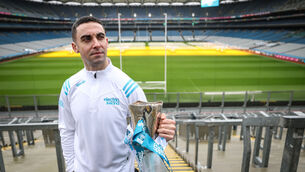
And when he walked up the steps of the Hogan Stand, raising the Liam MacCarthy Cup alongside Paul Kinnerk, it was a conclusion of sorts, validation of his methods.
But perhaps the morning after provided the real proof of how well he’d got through to this team.
After a late night of celebrating, O’Connor dragged himself out of bed at the Citywest Hotel to go for an early dip in the pool, and though nothing had been arranged or expected, he was stunned to find more than half the team already there, kick-starting the recovery process on their own.
It’s that mentality which makes him think they’ll get better, even if O’Connor believes their youth has been overplayed.
“When you look at all the other teams there aren’t too many teams of geriatrics out there.
“The profile of hurling is getting younger every year but for me, age is only a number. At this level it’s attitude that makes the difference.”
In that sense few teams can rival Limerick, and if O’Connor’s work has one trait it’s that of the facilitator, a guiding hand helping young men towards their physical peak.
“It has to be a player-first approach because they’re the good guys, the ones that decide to this,” he says.
“They’re the ones that should get the praise.”
CONNECT WITH US TODAY



Be the first to know the latest news and updates