TOMAS QUINN: By treating every game the same, Dublin are always pushing themselves to improve
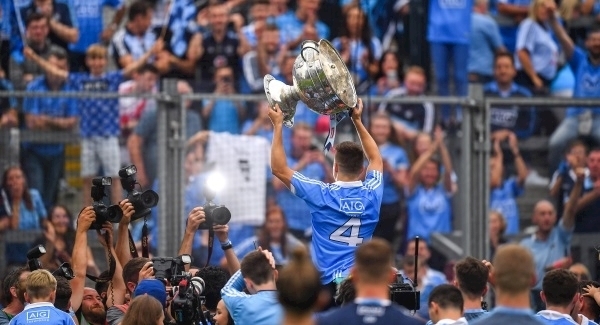
Before the majority of people had left Croke Park yesterday, the talk had turned to another All-Ireland final: The 2019 edition and if Dublin can land the elusive five in a row of senior titles.
In the next breath, fans wondered: Who out there might be able to stop them?
It feels like three-in-a-row is one milestone, and then it jumps to the quintet, particularly in the GAA world, with the failed bids of Kerry for five in a row in football and Kilkenny, more recently, in hurling.
Four in a row is more a step in the road, but it really is much more than that. We should not be too quick to skip over this season and
yesterday’s final. Much of the commentary will also centre around the state of football and where the game is going, but there was so much good in what was on offer over the 77 minutes and in what this Dublin squad continues to produce.
Across all sports these days you hear words like ‘culture’, ‘process’ ‘intensity’. I’m sure some people are tempted to roll their eyes and wonder if these are just buzz words used by coaches or sports
psychologists. The reality is that really successful teams have these characteristics and live and trust in them.
It can be easy to talk the talk about good culture within a team, but a much bigger challenge is to back up every aspect of it. Starting point: Everyone should be a team-first player; it’s easy to say the right things in public or in a team meeting, but do your actions back it up? Do you take a shot on when there is a man in a better position? Do you stay with your own man, even though you know he’s not the danger, or get over and help a fellow defender when he is in trouble?
Look at this Dublin squad over the last number of years, who is the star man? McCaffrey? Cluxton? Kilkenny? Fenton?
There are others you could make a case for, but not one player on the squad acts the star man.
Over the course of the four All-Ireland wins, they have won championship matches even when key names stepped away for periods: Jack McCaffrey and Paul Mannion both missed out for a season through travel with college, while there was no Diarmuid Connolly this year. Three elite players down, yet the squad rolled on without missing a beat. That is testament to the coaching and message coming from the management down.
Obviously, to win four championships in a row means you have a ridiculous level of consistency but how do you create and maintain that? The process of taking each game at a time is key. Again, this is easy to say, but do you really prepare the same for a first round as you would a final? This Dublin management team and players do.
Their form and results in the National League over the last four years back up that statement and have seen them claim three of those four crowns over the same period.
By treating every game the same, they are always pushing themselves to improve. One of the things that struck me watching the closing stages of Dublin’s first-round Leinster Championship victory over Wicklow was the manner in which the players continued to do the right thing and play the team game.
That day in the final quarter, Brian Fenton kicked an exceptional point on his left foot from 40 yards after spinning out of a heavy hit. To some, it was just a nice score at the end of a game.
Dublin were never going to lose, but to Fenton and other Dubs it was an opportunity to add to his skill set and ensure that when a moment like that was needed in a closer game he would be ready to deliver.
Dublin have also evolved tactically and are now such a high percentage team across the board. Compared to their all-out attack approach of Jim Gavin’s early years, it means they are often more methodical in their build-up and willing to hold the ball for long periods.
Brian Fenton’s second-half point after Dublin had held possession for nearly two minutes is a perfect example of this.
While skill, game intelligence, and tactics are integral, no team functions without intensity and hunger.
Again, these are two words that can have broad meaning across a team and ones that are often misused in my opinion. How could Dublin possibly have more hunger than Tyrone in their first All-Ireland in 10 years? What does hunger or intensity look like?
To me, it looked like Paul Mannion in the minutes after burying the critical penalty, making a goal-saving interception in his own full-back line.
It also looks like Con O’Callaghan making a crucial dispossession of Colm Cavanagh on his own 45 moments after putting Dublin’s second goal on a plate for Niall Scully.
These two instances perfectly highlighted all that is great about this team, two forwards, who could easily have taken a few minutes to enjoy a moment or ease up after making pivotal attacking plays, making equally as important plays in their own half. These types of plays lift every player on the pitch.
Willingness to work like that is infectious and keeps energy levels high throughout the team.
The players and management will enjoy the next few months, you have to take some time and reflect on what you have achieved.
Once they have, then they will properly turn their heads towards next year.