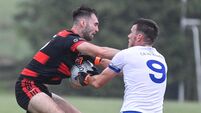
Gemma O'Connor: You’re not treating the girls with the same respect, which is very disappointing
Sixteen years after her senior debut Gemma O’Connor is still a mainstay of the Cork Camogie side seeking to defend their All-Ireland title.

Gemma O'Connor: You’re not treating the girls with the same respect, which is very disappointing

The Daragh Ó Conchúir Interview

Sixteen years after her senior debut Gemma O’Connor is still a mainstay of the Cork Camogie side seeking to defend their All-Ireland title.

She’s seen huge progress in how the game has evolved in terms of preparation and tactics, but she fears the recognition of the country’s top female players, and of women’s sport in general, still has a long road to travel.

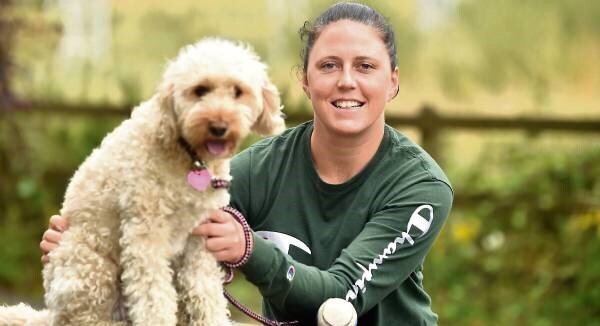
Cork camogie star Gemma O'Connor relaxes with her dog Molly on the Clogheenmilcon walkway near Blarney.Pic: Eddie O’Hare

Gemma O’Connor got away for a few days last week to Heir Island. It wasn’t a total switch off.

She still made the four-hour round trip to training but as a member of the Defence Forces, and with Cork also training on Saturdays and Sundays, when they don’t have games, there aren’t too many windows.

Her partner Aoife is a teacher but fortunately she enjoys sport and attending games because the holidays are of little benefit otherwise, with O’Connor an ever-present for Cork since her debut season in 2002, when a hat-trick of goals from Fiona O’Driscoll got the Rebels over fierce rivals Tipperary.

That gave the St Finbarr’s tyro the first of eight All-Ireland medals, the most recent arriving last September, when she played with a knee injury.

The build-up to that game was of the will-she-or-won’t-she variety. In the end, she didn’t just line out, she excelled.

O’Connor went on to nudge past Wexford legend Kate Kelly when winning a record 10th All-Star. If you had planned the circumstances of your retirement, there wouldn’t be many better.

Yet she didn’t ride off into the sunset.

“I must be a glutton for punishment,” comes the immediate reply, delivered with a grin.

“I had a big discussion with my family, my partner, my brother who plays senior hurling with the ’Barr’s. Anything I discuss about the games on a personal level would be with him.

"I think he was egging me to quit, after winning the All-Ireland and the way we won it, it would probably be a good way to finish up in a high. If I did go back, I’d have to be that committed again.

When I took time off with the injury, I had time to think about it. I said to myself it would be very easy to finish up, maybe a great way to finish. But I said ‘I’m 33. Can I still play at the top level? Can I set myself a new challenge?’

"So I decided I would and if I fail, I fail. It’s about not fearing that either. Fear of failure is a big thing in sport when you get older. Is it the right time or not?

"It could have been a great time to finish but I said I’d give it one more go and see can I still do it.

“I love playing. I played it all my life. Like anyone in GAA, it means so much to you and the family. There are so many different reasons you do it.

"It’s what it represents and who you’re doing it for. You don’t just do it for yourself. You do it for your family and your loved ones.”

You wonder if her late mother Geraldine, who was diagnosed with terminal cancer just days before the 2014 All-Ireland final, and died not long after the 2015 decider, is still part of that.

“Oh yeah. My mam was the main person that got me playing. She was extremely passionate about the game. She was involved in Glen Rovers growing up.

"Then she married my dad (Dónal) and when we got involved with the ’Barr’s she’d be up there morning, noon and night.

"She trained my school team, was involved in the club teams growing up and was there for every trial or session with Cork growing up.

“When she became sick in 2014 – I actually found out a week and a half before the All-Ireland final that she was sick and then the following year she passed away. It was a massive blow.

"I play now and I suppose coming back, that was probably one of the main reasons. She’d have been the person to say: ‘Don’t be afraid to give it another go.’”

Having moved to Dónal’s side of the city, the family rowed in with his club but Geraldine managed to get a Blackpool imprint on the clan when it came to naming their son, who is more a best friend to Gemma than a sibling.

“My mam named him Glenn after the Glen won the county in 1989. There’s fierce banter about that still.”

The Liberty Insurance All-Ireland senior quarter-finals are taking place today in Páirc Uí Chaoimh and the champions will be able to keep an eye on proceedings, having smoothly progressed through the round-robin stages and secured a place in the last four as group winners.

O’Connor spent more time around midfield as they road-tested a number of different game plans.

What has been very noticeable is the astonishing increase in scoring rate and the spread of contributors.

In all, 15 players have been on the board in clocking up a mind-boggling aggregate tally of 15-100 from five games. That’s an average of 3-20.

But there is always room for improvement.

It’s in keeping with the culture of seeking a little bit more that O’Connor possesses as second nature from her 14 years in the Army, and is imperative to surviving in the Cork camp under Paudie Murray’s stewardship, that the concession of six goals and — particularly three in the last tie against Offaly— sticks in the craw.

You always got the impression that O’Connor would have welcomed Murray’s obsession with detail and standards, and with bringing camogie more in line with Gaelic football and hurling in terms of skill, execution, temperament, fitness, and tactical evolution, when he took over for the 2012 campaign.

They were beaten by Galway in that year’s All-Ireland final. The following year, she went on her third Tour of Duty to Lebanon.

Previous tours took her to Liberia and Chad but they were winter trips and she never missed a championship.

She still managed to fit in the All-Ireland semi-final during a three-week break and came on in the second half but could not help Cork get the better of Kilkenny.

In 2014, Murray ignored the white noise surrounding his insistence on making his team defensively solid. He had O’Connor back now to orchestrate matters and the O’Duffy Cup returned Leeside for the first time in five years.

In 2015, Cork completed the two-in-a-row and O’Connor was player of the year, 10 years after she had won the accolade for the first time.

So yeah, she loves evolution, though she likes to keep it simple.

At one stage, O’Connor is talking about how little there is between Cork and Kilkenny, and how the last two scores in the All-Ireland were as a result of work done on the training pitch with Murray’s brother Kevin, the former All-Ireland-winning hurler who has taken on primary coaching responsibilities.

In particular, her score was all about rotation, being smart and composed, not putting the head down, not only looking forward. It was about waiting for the opportunity.

“We’re just trying to think of new things the whole time because teams create a standard and other teams want to go above that.

"So what worked last year won’t necessarily work this year because people will know what your plan is. Each manager and each team is trying to outsmart the others.

“You’re trying to get rid of that old mentality of getting the ball and driving it aimlessly up the pitch, or if someone has the ball there’s only one person running out and there’s no-one running off their shoulder.

"The game has just evolved so much. You’re trying to create something different the whole time. That composure and decision-making has become a lot more vital than 10 years ago.”

You don’t reach Everest by aiming for Croagh Patrick, but it is no straightforward task to create a new instinct.

“It’s a mentality thing. When you’re younger, you’d put on your boots and socks and your helmet, and get your hurley and go out and play. As you get older, your body changes and you start to think differently about it.

"And then you say ‘What used to be my strengths aren’t my strength anymore. How do I adapt to that?’ You need to think differently.

"Kevin puts us through certain situations where we have to think a lot. So as I said, the days of getting the ball and hitting it aimlessly down the pitch or gone. If we did that in training we’d be absolutely mangled.”

There is no hiding place now. Niall Collins is a conscientious games analyst and the players wear GPS and heart monitors.

In truth, that information is used proactively rather than as a stick to beat players, informing decisions on whether a session should be light or heavy depending on previous workloads.

What about the sweeper role though? Kilkenny adopted the tactic subsequently, and like Cork, gave the job to a brilliant ball striker and someone who thinks deeply about the game in Anne Dalton.

It was crucial to them getting over the line for the first time in 22 years and dethroning Cork in the process in 2016.

“It’s actually a very simple gameplan when it’s done right,” explains O’Connor.

“It’s just that everybody needs to understand it, everybody needs to understand that everyone has a job and a role that’s important. If one person doesn’t do their job then the whole thing breaks down.

“It was kind of interesting in that people became negative with it. I played centre-back — I didn’t necessarily play a sweeper role. But if a centre-forward goes out to midfield, they’re actually creating the sweeper.

We played Galway in the All-Ireland final in 2015. Their centre-forward went out the field and it played right into our hands. There are a few variations to it but it is simple and when well executed, it’s very effective.

Intercepting the ball is only one part of the job. Once she has it, she must make the right decision about how best to get an attack under way.

“You’re not there to fill a hole. You’re there to stop the attack, stop the runs and make the forward unsure about what they’re going to do.

"When we get the ball you’re trying to create options, go on the offensive straight away. Every team is trying to do that and it’s about who can do it the best.

“The wheel is constantly trying to be reinvented, it’s constantly trying to be adjusted and tweaked. Now it’s not about having a game plan, it’s about having two or three of them and covering all eventualities.

"Sometimes you have the best game plan in the world but things go out the door and you don’t know why. Now, you’re trying to pre-empt everything that’s going to happen on the pitch.

“Where camogie is now compared to three or four years ago, it has changed dramatically. Players are a lot stronger, a lot faster, a lot more physical.

"What players can rake up on a GPS now is frightening. It’s interesting, you talk about the number of possessions, turnovers, those critical runs – and it’s not about being on the ball either, it’s about what you’re doing off the ball. It’s all about workrate.”

Another area camogie has improved in is in terms of profile. The coverage has increased and is welcome but O’Connor knows the road ahead is still long.

“Camogie’s definitely going in the right direction and it has got better. I’m playing senior camogie since 2002 and where it is now, it’s a massive jump.

But female sport is still a long way off in terms of recognition and being on par (with men). And let’s call a spade a spade – I don’t think it will never be on par with men’s sport.

"You can name one or two sports that is on par – tennis is one, athletics maybe during the Olympics, the equestrian sports – but if you look at all the other sports, we’re always struggling to get that level of recognition and respect. It has gotten better but you have to do it the right time in the right way.

“Is having female pundits a box-ticking exercise rather than a genuine one..? I’m not saying female pundits shouldn’t be on but it doesn’t seem to be at the right time and it doesn’t seem to be genuine enough.

"It’s a gender balance thing, that you have to do it, as opposed to that they want to do it.”

Patronising analysis and questioning madden the players. The analysis during the Women’s Rugby World Cup was refreshing in that regard.

It doesn’t have to be vitriolic, but it should match what will occur when players and management congregate to look at the video. The ‘poor girl’ and ‘good girl’ approach is one which infuriates her.

“You’re not treating the girls with the same respect which is very disappointing. Even speaking from experience, you might be invited to things and there’d be lads there, a Q & A thing, and sometimes the questions you could be asked, compared to the lads, and you’re thinking ‘Are you serious?’

"That needs to change. It has got better and we appreciate the profile.

“When things go wrong we call out exactly how it is and what it is. You don’t take things personally. You just have to pull up your socks and drive on.

"If one of the management said to you ‘poor girl’ you’d probably hit him a box!

“It just comes down to having the same preparation made as when you’re going out to interview or commentate on the lads’ games. About reading up on the players, their past, their capabilities.

"That’s what it’s about, it’s about taking it that bit more seriously. Hopefully, that will come.”

This will be the next step and as someone who has always looked to better herself, she would like to think it will come because the coverage is essential.

Young girls need strong role models now more than ever, at a time when they are bombarded with superficiality.

O’Connor is part of a campaign being run by Liberty Insurance, who are not just ploughing money into camogie, but have committed to supporting female sport to the tune of €2.5m through to the end of 2020.

The ‘Camogie Made Me Ready for the Real World’ campaign aims to showcase how skills required to flourish on the pitch can be used in other aspects of life.

“Sport and the Defence Forces tend to go hand in hand and what I’ve learned from the Defence Forces I’ve brought onto the pitch. And vice versa. You’re dealing with people all the time.

"You’re instructing people all the time. You learn to be confident, to be vocal, to show loyalty, commitment. Show that bit of integrity and compassion.

“It was like earlier when you were asking about how you react when things go bad or wrong, it’s about recognising certain things and responding.

"And it’s not just me, there are other people on the team that have those sort of leadership qualities, or confidence or mentality to think outside the box.

The campaign is a good campaign in that the end product is trying to influence young females in sport and show, number one, it’s very healthy for them and a good way of life, but it’s actually character building, setting people up for their life outside of camogie, be it in jobs or relationships.

"Obviously we’re not all perfect but it does help you in life.”

O’Connor is deadly serious on the pitch and in work but is actually tremendously laidback when it comes to downtime. She isn’t into pontificating about the ills of the world. But.

“I take everything with a pinch of salt but these days, you see everything on social media, everything, especially for women, is about the look and the image and how people are portrayed.

"You have things like Love Island… I actually watched it out of curiosity two weeks ago just to see what it’s like and you think of young girls watching it, how much of a bad influence it can be.

“Having female icons in different walks of life, not just in sport, like Fiona Coghlan, Mags D’Arcy, Natalya Coyle, Annalise Murphy, Katie Taylor — there’s so many Irish sporting icons out there. Mine was Sonia O’Sullivan growing up.

“It’s important to recognise that everything is not about image and that side of things.

"It’s very important for young females to recognise there’s potential for female sporting athletes to thrive out there.”

x

More in this section

Cookie Policy Privacy Policy Brand Safety FAQ Help Contact Us Terms and Conditions

© Examiner Echo Group Limited