Barry Nolan Q&A: ‘Most of the day is spent on the skyline at Croke Park’
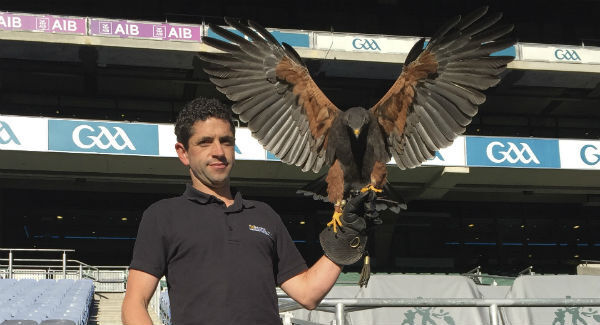
The Harris’s hawk nests in social units that vary from an adult pair, to as many as seven individuals, including both adults and immatures. Co-operatively hunting groups of Harris’s Hawks are more successful at capturing prey than individuals hunting alone. Electrocution from power poles is a danger to the hawks, but other members of the group sometimes come to the aid of injured individuals, providing them with food.
There are certain situations where wildlife and people come into conflict situations, like herring gulls and pigeons at Croke Park, urban foxes in gardens and schools, and other situations like that. We try to change whatever the environmental attractions are in a stadium, garden, school or pharmaceutical plant, find out why the animals are being attracted there and deal with that. Usually, it’s enough for the animals go to away but it’s important to stress that what we do is legal and humane. We’re in our 12th year of business.
It’s all birds. We have five at the moment, mainly Harris’s hawks, but falcons as well.
They’re exercised on a daily basis, especially the falcons, and fed on highly- nutritious feeds. The meat they eat is sourced from people who also supply zoos and reptile centres.
The standard day at Croke Park involves keeping pigeons away from the pitch, the feral pigeons in the city love the seeds on the pitch. It’s very different on match days, with 80,000 people there eating burgers and sandwiches. A lot of that food gets thrown on the ground and as it’s clearing out, the gulls have worked out that there’s an abundance of food there, for a two-hour period while the cleaners are working. It’s a large-scale cleaning operation and while that’s in progress, we get in there and use our birds to stop any gulls coming into the stadium.
We have them trained and the idea is that the gulls see our birds as a natural predator, and stay away from the area. There’s an in-built fear of any wild animal, and raptors (falcons and hawks) are the natural predators for seagulls, pigeons and crows. We’re trying to teach them that it’s a hostile area for them to visit, but our birds only eat meat and they will return to us when we call them. They don’t attack the seagulls either. It’s simply a case of teaching the seagulls that there’s a predator in the air.
It takes a little bit of time and can be a long process. One of our birds is in training at the moment, while there’s an older one flying a good while. It takes time to teach them to come back to you. The bird is not tame when you get it first, pretty much wild, but once you have them feeding off your glove and they begin trusting you, you’ll let them fly 40 or 50 metres and then you’re sure that they’re good to fly free.
With a piece of meat and a whistle, which is their signal to come back for something to eat. It’s all down to their body weight — we have the birds at a certain weight every day and they’ll respond to it. One of our birds is 2.4lbs, optimum weight, and she’ll respond. When we start flying, you might still have 20,000 people in the stadium as it’s clearing out and you need your birds to respond quickly.
I always had a love of nature — that’s what our whole business is based on. We’re not a pest control company as such, we try to do things in the most natural way. We don’t use any poisons or deal with rats, mice or anything like that.
We have to be up there for 1 o’clock, before the roads close, and that’s another very important point because we have to park in a shaded area. You don’t want the birds in the jeep for a long period where they would be getting warmer, and they’re safe close to the ground. We’ll fly them early in the day, to spread their wings, and then most of the day is spent on the skyline of the stadium. It’s pretty cool up there, but not when it’s raining. We also use other systems — acoustic and laser — to keep the gulls at bay.
The acoustic system plays the sound of a seagull in distress and it just adds to the idea of building a hostile environment in the stadium. The laser is shined at them and scares them off. So it’s not just flying the hawks, but there are only so many things that you can do because the herring gulls are a highly-protected species. We’re not there to damage them or catch them with the hawks, just to trick them into thinking that this is not a good place to be and that they should think about getting food elsewhere.
Myself and one other full-time guy, and we’ll have some part-time staff as well. We’ll be pitch side before and after the match, but on the skyline for most of it.
We don’t do any other stadia but we do lots of pharmaceutical plants and different places. We’ve been working at Croke Park for nine years, on and off doing bird control. Like everything, there’s another side to it because an awful lot of wildlife is attracted to the stadium. We had ravens hatched in the stadium and had them ringed and there are bird boxes too. It’s not just about keeping animals away, plenty is done to attract them too, but the seagulls and feral pigeons are the problem.
Harris’s hawks. Generally, falcons fly very high in the air and if that was the case, they wouldn’t be dealing with the problems in the stadium. The hawk stays close, never too far away. They might go as far as level 7 but they’ll never leave the stadium.
Temporarily, but we get them back. They have transmitters on their tails and if they do a runner, we can relocate them.
- To find out more about Barry Nolan’s business, Wildlife Management Services, visit: www.wildlifemanagement.ie