Jack O’Connor: Here’s what happens when young lads get overplayed...
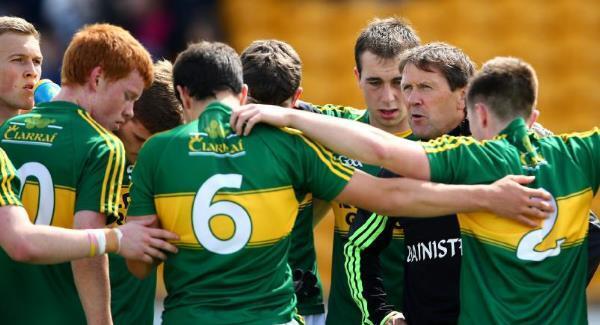
Absent for this evening’s Munster Championship clash with provincial champions Tipperary are 2015 minor captain Marc O’Connor, Conor Keane — the provider of 1-7 in last year’s semi-final defeat to Cork — and five members of the 2014 All-Ireland minor winning side — Matthew Flaherty, Shane Ryan, Liam Carey, Cormac Coffey, and Liam Kearney.
O’Connor has cited the lack of a closed season, coupled with the number of fixtures from last year’s programme which spilled into 2016, as the chief contributing factor to the extensive injury list ravaging his squad.
The three-time All-Ireland winning senior manager also claims that the only players enjoying sufficient time off from the game are those out injured.
“We’d a panel in the high 30s at the start of the year and the first night we came in there were half of them injured, which was just unbelievable,” remarked the Kerry U21 boss. “You’d be talking about a closed season; this was a 13-month club season in Kerry, 2015 ran into 2016. The length of the season has really affected our preparations.
“Even after the minor All-Ireland last year, some of the lads played seven or eight weeks in a row. Unfortunately, the only way they seem to be getting a rest is if they’re injured.
“Shane Ryan has had injury problems going back a few months and his injury seems to be long-term. Mark O’Connor has on-going issues, it’s a pretty long-term injury. Cormac Coffey is recovering from groin surgery. Matthew Flaherty picked up a knee injury. Barry O’Sullivan is trying to recover from a knock picked up at Sigerson. Conor Keane has been plagued by injuries. Liam Carey has a back injury. Rob Ó Sé has disc problems. Liam Kearney has a stress fracture in his foot. You’re looking at a lot of important players there, so we’ll be down men, no doubt about it.”
Having managed at minor and senior inter-county level, O’Connor has described his latest brief as the toughest.
“At minor level, it is much more structured and streamlined. Whereas [at U21], there’s fellas coming from all angles. You’ve colleges and clubs and bits and pieces of everything, it’s a tough assignment. We’d the minors for two years and we felt that the next challenge was to try and develop that group because a lot of them can fall off after minor. That’s a critical age, fellas can fall off for one reason or another. They’re away from home, they’re going to college, their lifestyle changes. It’s a very challenging age group.”
Against this light and in a bid to end the pulling and dragging of players at U21 level, Congress recently passed a motion to lower the age bracket to U20 and move the competition away from the already congested spring schedule.
“With the new proposal, they’re talking about June, July and August, which definitely makes more sense because we had a huge problem with the weather the way it was and trying to get pitches. The change to summer football is going to be a major benefit, certainly.”
Until then, O’Connor’s main focus is improving the county’s dire run of results in recent years — Kerry have not won an U21 championship game since 2012, a Munster title since 2008.
“Kerry have nothing much to write home about at this age group for the last few years. One of the problems over the last couple of years — and part of the reason U21s haven’t made the breakthrough to the Kerry senior panel — is they haven’t had a run at U21 level. They need a run at their own level to give them confidence. I keep going back to the mid-90s, I was involved myself, when we won five Munster titles in a row and three All-Ireland titles, and unlucky not to win a fourth. That bound the Kerry [senior] team for 10 years.
“It’s a hugely important age group for developing players. They have to get their belief and confidence from somewhere and you can’t pluck it out of the sky. It’s a huge jump from minor to senior.”