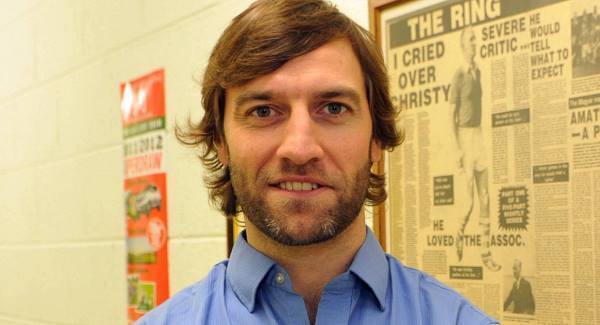
‘We are trying to make the GAA a healthier place’ says Colin Regan
In the days and weeks before Congress 2013, barely a single mention was given to the motion of the Strabane Sigersons club calling on each county executive to establish a health and well-being sub-committee.
The term ‘health and wellbeing’, at the time, didn’t register with the vast majority of the GAA community and yet on that spring afternoon in Derry, Congress recognised the simple truth that the GAA is a microcosm of Irish society and the issues that impact Irish life are invariably reflected through the GAA in one way or another.
Heading into 2016, health and wellbeing committees have been established in 30 of the 32 counties, while almost half this figure organised a county health and wellbeing seminar over the past 12 months.
At each seminar was a past or present inter-county player whose story provided real life evidence that gambling, depression and even suicide are slowly shedding their taboo status within the Association.
GAA community and health manager Colin Regan — a Leitrim footballer in his day — says the first significant steps in growing the health and well-being model within the GAA were taken little over a year prior to the Sigersons motion being passed at Congress.
“In January of 2012, Páraic Duffy and I sat down with Tony Holohan, then chief medical officer at the Department of Health, and Billy O’Neill of the HSE,” Regan recalled.
“A lot of the feedback coming from grassroots was that clubs were keen to go broader than just drugs and alcohol.
“The clubs that were interested in this journey were those who would have had some sort of experience within the club that would have prompted them to try and incorporate health and well-being into their practices.
"It could have been anything as broad as a club member suffering some form of a mental health issue, some incident involving suicide.”
It was at this meeting that the Healthy Club Project (HCP) model was born; its primary aim being to explore the potential of the GAA club as a setting in which to promote the health and well-being of club members and the wider community.
Drafted onto the steering committee were DCU’s Dr Noel McCaffrey, IT Carlow’s Dr Noel Richardson and national schools health coordinator Joan Ita Murphy.
Expressions of interest were opened up to all clubs and of the 64 applications received, four from each province were selected in January of 2013.
The results of phase one were published earlier this month and the countless case studies cited in the 36-page report would suggest the Healthy Club Project has been a pretty decent success.
Take St Colmcille’s in the Bettystown/Laytown area of County Meath.
In the past 10 years, the population has jumped from 3,000 to 10,000.
However, the infrastructure needed to accommodate such a growth in population has lagged behind and the community, as a result, has become disjointed with no ‘central point’.
Essentially, the GAA club wasn’t as strong a presence in the community as it once was.
With the help of Genio Trust, the club developed their ‘how are you feeling today’ programme to return a focal point to the area, while at the same time providing personal development skills through mindfulness classes, health and nutrition classes, dance classes, card games and facilitating a men’s shed on their grounds.
Down south, two Cork clubs involved in the Healthy Club Project, Midleton and St Finbarr’s, joined forces to establish ‘Cork Beats Stress’ — a six-week workshop facilitated by a qualified HSE psychologist which sought to equip participants with the skills required to cope with stress.
The average attendance at the Wednesday meetings was 161, with one HCP committee member commenting: “There were so many stories afterwards of club members and local people who benefited.
“The clubs were seen to be taking an interest in the community as a whole and showcasing that health promotion was an important part of the club’s culture.”
Regan added: “I cannot praise the clubs enough for the work they went through in phase one because they were a guinea pig.
“They really broke new territory in this space for all sports clubs in Ireland. We are delighted with it because we believe the model we have developed is a suitable model for the delivery of health in a GAA club setting.”
Also instrumental to the wide acceptance of the health and well-being branch of the GAA are the personal testimonies of past and present county players.
Oisín McConville (2009) and Niall McNamee (2012) broke new ground when opening up on their respective battles with gambling.
“While those personal testimonies are encouraging individuals to seek the help they might need and are helping in breaking down the barrier that still does exist around mental health, GAA clubs and counties are moving into the proactive phase in a very organic way. We are no longer reacting. We have taken the lead,” says Regan.
So, where next?
“The national health and wellbeing committee has just launched a three-year plan (2015-18). One of the goals is to integrate health and wellbeing into the daily activities of all aspects of the Association.
"It is ambitious, but it is achievable. We are trying to make the GAA a healthier place for everyone to enjoy.”