Seán Boylan: Football rules must be simplified
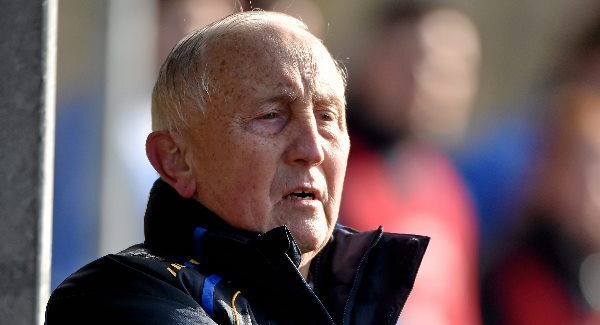
In his role on the standing playing rules committee chaired by former Armagh captain Jarlath Burns, Boylan intends contributing to a series of proposals to improve the game before the group dissolves at the end of 2017.
A number of recommendations have been sent by the group to the GAA’s management committee for consideration on the Clár of Congress next year. Among those that have been touted are the mark, substitutions being designated stoppages and feigning becoming a black card offence.
However, it is Boylan’s hope that more extensive work will be done next year and in 2017 to make Gaelic football easier to understand in terms of playing as well as watching. As of now, he believes the confusion contributes to foul play.
“What can you do to not profit the negative because at this point in time that’s what we seem to be doing. A lot of people have done tremendous work on the rules but life and the game have moved on from the static positions to the movement and athleticism in it.
“You’ve 90 or so rules of the game and how few players understand the game. How complicated have we made it for referees? Instead of more certainty coming into the area of rules, there is more uncertainty. It’s a question of looking at that and rewarding the positive which is distinct from rewarding the negative.
“In other words, ‘we might get a man sent off but sure pull him down, it’s a black card and we’ll put in somebody else’. That’s the way unfortunately gamesmanship has come into sport. If there’s a way around the rule, it’ll be found.
“I always remember Mick Lyons telling me about his eldest son Alan and there would be 18 or 20 lads in the front garden and they would play soccer for half an hour and Gaelic football for half an hour. They had to know five rules in soccer; they had to know 25 in Gaelic.”
Boylan, who was asked by GAA president Aogán Ó Fearghail to replace the late Dave Billings on the committee, argues that playing rules decisions were taken years ago that had unforeseen ramifications on the game.
“One of the big things that changed the game was the ball being allowed to be kicked from the hand for a free or a sideline ball. It took an awful lot of the tackling out of the game and it meant it was difficult for backs to get tight on forwards so you find the blanket defence being introduced.
“Now it’s so difficult to define a free. They talk about a hand in, they talk about the body but what part of the body are you talking about? The hand is still part of the body. It’s become all nonsensical.”
The Dunboyne man would like to make life easier for refs and repositioning their judges would be a first step. “Assessors generally tend to be in the middle of the stand. The one place you should be if you want to truthfully assess the referee is at the back of the goals or down at that level because that’s where the referee sees it.”
CONNECT WITH US TODAY



Be the first to know the latest news and updates