Everybody fair game as ‘controversialists’ get roaming role
I recently read an article in The Guardian in which the columnist was bemoaning the closure of the fabled Sports Illustrated library in New York. A sure sign of how the changing demands of readers is dictating how mainstream media now operates.

Everybody fair game as ‘controversialists’ get roaming role

Nowadays we don’t have ten minutes to sit and read one feature column; instead we want to read ten headlines in one minute. All via the flick of a thumb.

Nowadays the reader has become an integral part of shaping real time news. Online platforms and social media are rapidly taking over from the traditional broadsheets in setting the tone for what we read and hear.

The ‘Most Read’ or ‘Most Shared’ columns dominate the online foreground, regardless of the content. Unsurprisingly controversy and intrigue are the typical tones of those at the top of these lists. Pick up any paper, and the bold print predominantly aims to prime the reader for a scandal or controversy. Why? Because we crave it. Whilst we might not like to admit, we all are drawn to the eye catching headlines of shock, scandal and intrigue.

Media editors know this, so they give us what we want. Sadly the GAA is not insulated from this reality.

From chatting to some GAA journalists recently, the common tone is that their job is becoming increasingly demanding and indeed unenjoyable for some. It’s fair to say that GAA manager’s and players are a very conservative bunch when it comes to dealing with the media. Any slip of the tongue may leave you at a motivational disadvantage, sound-bites are kept to clichéd banalities. A nightmare for any credible sports writer.

To survive in the cutthroat media game these days, editors need to drive viewers and readers towards their advert adorned content. Advertising revenue pays the bills at the end of the day.

As a result media editors encourage and chase controversy, knowing it will engage more viewers and hence increase profit. A simple case of supply and demand.

Key to this strategy it the relatively new phenomenon of the ‘controversialist’ in mainstream media.

Feeding on our voyeuristic obsession with controversy and scandal, such commentators are securing prominent positions for themselves in mainstream media.

Whether it is Katie Hopkins, Perez Hilton or our own Joe Brolly, the same principles apply. Being controversial is unquestionably the quickest route to notoriety these days.

You don’t even have to believe what you say or even follow it up with a consistent argument. All everyone wants is the snappy sound bite.

I’ve no doubt that when Katie Hopkins claimed she wouldn’t employ fat people because it gave an impression of being lazy, underneath it all she was genuinely just trying to address the current obesity crisis facing society. Similarly when Joe Brolly ridicules Pádraig Hughes, Seán Cavanagh or whoever else is deemed fair game of a Sunday afternoon, he is simply trying to maintain the dignity of our games.

But here is the rub. Our guilty obsession with controversy and scandal goes directly against our innate value systems. So long as it is about somebody else we are happy to indulge ourselves in the banter.

But once we, or anyone belonging to us become the focus of the controversy, an entirely different approach is taken. Good old Paddy wears rose tinted glasses better than anyone.

It is no surprise then that the unorthodox GAA, built on its conservative foundations is struggling with these modern media trends.

Presently RTÉ are coming under fire, accused of allowing an overriding tone of criticism and controversy blight our national sports. Everyone has an opinion on the matter. Viewers want the same glamour and showbiz that they have become accustomed to with professional sports.

But as we have seen so often over the last few years, controversial criticism and amateurism go together like petrol and an open flame. Sunday couch voyeurs love it as it gives them something to chortle about in the pubs that night or around the canteen on a Monday mornings. Those who genuinely care about the integrity of our games, are left frustrated and saddened by the constant air of negativity that ‘hangs around like a bad smell’.

Those directly affected, Tyrone being the team du jour, are vexed and feel persecuted and victimised.

In the same way the GAA need the media to publicise its games, the media needs this cash cow for generating advertising revenue.

Compromise on that at any price and your days are numbered.

Recent comments from Aogán Ó Fearghail regarding his dissatisfaction about the standard of The Sunday Game coverage should be of concern to those in Montrose.

If his comments reflect those of the wider GAA management structure, such image damaging controversy will only be tolerated for so long. Nobody wants to see a stand-off between two of the country’s great institutions.

At the end of the day, we will, as we have always done, tune in to The Sunday Game regardless of the commentary. In this instance it is and always will be the product we care about.

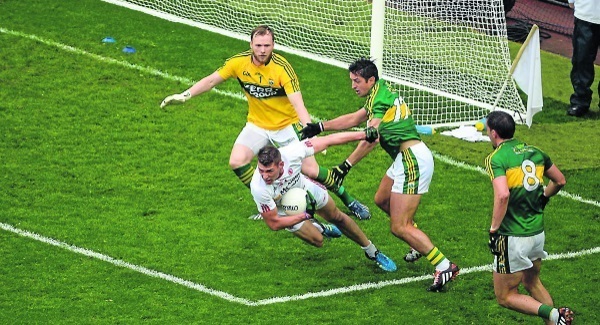
When do you cross the line between being the cute hoer who buys a free, and the cheat who dives? No doubt about it ‘Simulation’ as it is technically known, is the latest hot topic of debate in Gaelic football. In the dying minutes of this year’s Ulster final, Martin Carney swooned over my ability to ‘buy a free’ following a tackle by Leo McLoone. Eating up precious time as Donegal came at us in seek of an equaliser.

Did I dive? Well I put it to you like this, I was definitely fouled, so I just made sure that David Coldrick was left in no doubt.

But if we commend, and in many cases encourage players to buy frees at the appropriate time, we can hardly stand back aghast when they occasionally step over the line.

Feigning injury to get another player sent off is a different matter however, and can’t be tolerated. Yet the lines here are equally blurred. We have all stayed down on the ground following a dirty strike, for longer than necessary knowing full well we could get up if we had to. We also know that referees and their support staff will very often not take the appropriate action against a perpetrator if we stay on our feet.

Maybe mild forms of simulation are a necessary evil to help both players protect themselves and referees make the right decisions.

Food for thought!

x

More in this section

Cookie Policy Privacy Policy Brand Safety FAQ Help Contact Us Terms and Conditions

© Examiner Echo Group Limited