Five solutions to the GAA’s timing stuggles
It was at a post-Congress press briefing in February that GAA director general Páraic Duffy admitted time-keeping was an issue for the organisation.

Five solutions to the GAA’s timing stuggles

Just hours earlier, the death knell, excuse the pun, for the clock/hooter had been rung but from Duffy there was recognition something had to be done about the amount of additional time afforded by referees.

He said: “The CCCC (Central Competitions Control Committee) will look at that in terms of guidelines to referees, in terms of the time we play at the end of the game, that is their intention. There was no point doing that until today (the motion) was out of the way first so it can be addressed on that basis.”

What the CCCC proposed to referees is difficult to fathom and a championship weekend has not yet passed by without some sort of time-keeping concern. Human error seemed to be the reason behind the confusion at the end of the Limerick-Clare game last Sunday week. But could the row at half-time in that game as well as the one in the Donegal-Tyrone match the previous weekend been avoided were the end of the first half blown up differently?

Might Padraig Hughes have been considerate and just if he informed Cavan’s Martin Dunne that his free was likely to be the penultimate action of their one-point defeat to Monaghan?

Could James McGrath have allowed for some more time in Croke Park on Sunday? It certainly seemed he could have as there were hold-ups which merited an extension but Dublin manager Ger Cunningham knew better: “He was always going to give a draw at that stage once we went into the second minute.”

Time so far this summer hasn’t exactly been on the GAA’s side. So what could they do to remedy the situation? Here are five possible solutions, which when combined, could help:

Stop for substitutes

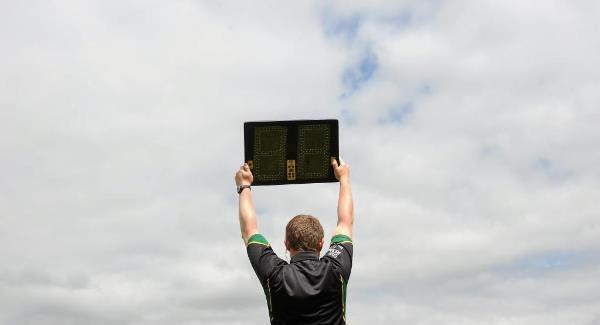
By staggering a replacement in the dying stages of the U21 All-Ireland final last month, Tyrone succeeded in killing the clock but then so many teams have whittled down the clock by bringing on replacements for the sake of using up the remaining minutes. It’s a considerable oversight that substitutes have yet to be considered stoppages. Like injuries, they too can be exaggerated but at least the watch is halted for such instances. Crowds are becoming more cognisant of how teams are abusing the substitute rule to halt the momentum of the chasing side. They know it stinks too but nothing has yet been done about it.

Ball out, game over

Trialled before only to be rejected, it was seen as an attempt to stop killing the clock while providing a definitive end of each half. For the most part, it seemed to work but there were teething problems and so it was shelved again. However, had the ball needed to go out of play in Thurles or Ballybofey we might have been spared the ugly scenes that were, let’s be honest, precipitated by fouls on the half-time whistle.

Black card time-wasting

Look back on the Cavan-Monaghan game and how Kieran Hughes cleverly kept talking to his namesake Padraig as Dunne stood over that injury-time free. The longer he spoke the more likely it was that he was going to blow for full-time as soon as he had played the announced number of minutes of additional time. There have been grosser attempts to waste time than Hughes’ but it is one of the most recent examples of what methods players have of distracting officials. If the black card truly is an answer to cynicism, then time-wasting must come under its umbrella. Of course, the clock would have to be stopped at the next break in play for the replacement to enter the pitch.

Better communication

We brought this up last week. It seems wrong that spectators and viewers at home are more aware of the time remaining than the players themselves. Colm O’Neill and Cillian O’Connor are just two who have been confused by the information they’ve received from referees. There should be no room for confusion. Referees have to be clear and concise in communication. Just as additional time is announced over the PA, so too should it be relayed to the men on the field. If a player is standing over a free and it’s likely to be his team’s last attack then he, his team and the opposition should be informed. It would really only be effective with the ball going dead confirming full-time.

Clock/hooter

It hasn’t gone away, you know. Certainly not when the principal ground in almost every county has been fitted with the technology. Croke Park’s reasons against the system were enough to convince delegates, even those from Wexford who initially proposed it, but some of their reasoning was stretched. History may turn out to be a lot kinder to the GAA’s version of the e-voting machines.

x

More in this section

Cookie Policy Privacy Policy Brand Safety FAQ Help Contact Us Terms and Conditions

© Examiner Echo Group Limited