Think Tank: 3 top coaches debate the proposals to "fix Gaelic football"
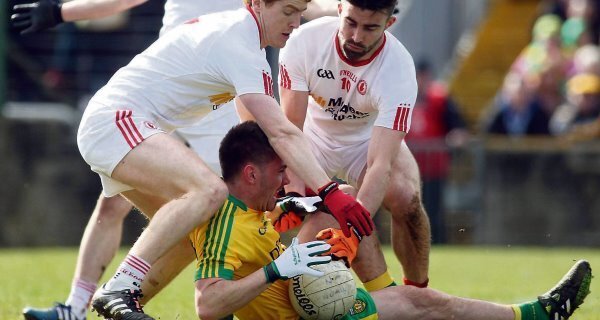
Liam Sammon ventured into a well-known GAA pub in Killarney on Saturday evening to catch the Dublin-Derry league encounter.

Think Tank: 3 top coaches debate the proposals to "fix Gaelic football"

Before half-time had even been reached at Croke Park, the game was no longer being shown in Killarney, patrons so disgusted by what was materialising that the Golf Channel was preferred.

“I was half-watching it and getting annoyed at the carry on,” said the former All-Ireland winning Galway footballer. “I don’t think anyone was interested in the golf, but nobody was interested in looking at that football game any longer.

“When you think that I was in Kerry, where they are so passionate about the game, it is sad to think they were so turned off.”

Kerry stalwart John O’Keeffe doesn’t believe the panic button needs to be hit just yet, but is concerned by the approach adopted by Derry boss Brian McIver — possessor of the most favoured managerial philosophy in the game at present.

“The big problem is that when a manager is weighing up a game and realises his team are not good enough to beat the opposition, he realises the best chance they have is to implement the blanket defence, get bodies behind the ball, try to keep the scoring as low as possible and hope to get a few scores on the break. Unfortunately, such an approach is becoming far too common,” he said.

“We are neglecting the basic skills. How many inter-county players can kick a 25-metre pass accurately off both feet? Not many. Underage, we are not spending enough time on developing the basic skills and, if we did, we would have by far a better game. Coaches will eventually wake up to this fact. We have a fantastic game but are not doing it justice.”

The seven-time All-Ireland winning Kerry footballer believes the introduction of the mark would significantly improve matters.

“When the player fields the ball at midfield, nowadays, he is immediately surrounded by three or four players. The player in possession should be rewarded straightaway with a free.”

Two-time All-Ireland winning Cork footballer John Cleary, meanwhile, favours 13-a-side.

Several other ideas have been offered this week to aid the game. Sammon (LS), O’Keeffe (JO’K) and Cleary (JC) run the rule over the most practical solutions offered.

Solution 1: Four players must remain in the opposition half at all times.

LS: I definitely would be in favour of trying it and, while it is workable, it would be difficult to police. You’d probably require an extra official to monitor the numbers funnelling back. I am not sure this will cure football’s problems.

JO’K: The rationale behind this makes so much sense. You need two men in the half-forward line and two in the full-forward line at all times. You need a receiver from the outlet pass, from the kick from defence. There has to be options up front. Good coaches will see the advantages of keeping four players in the opposition half.

JC: You’d need to tweak it so their four opposite numbers have to stay there as well. You couldn’t have a back tearing up, his marker chasing him but having to stop dead on halfway, because he is precluded from going back into his own half. Looking at 15 men defending is not attractive. People are crying out for something to be done because, sooner rather than later, the crowds will start to fall.

Solution 2: Limit the number of consecutive hand-passes to four.

LS: Still far too many. I suggest a maximum of two hand-passes and then kick. In your own half of the field, I would limit it to one hand-pass. We need to speed up the game so teams don’t get the opportunity to flood 15 men behind the ball.

Added onto this, I propose that, if you take off soloing, the only way you can get rid of possession is by foot. You would get rid of about 50% of all hand-passes this way.

JO’K: I don’t think there should be a need for this, for the team that is over-doing the hand-passing is a losing team.

The biggest problem here is stats, a player is being told at half-time he gave the ball away six times. That player is now afraid to kick the ball, because he is afraid he will be singled out for giving the ball away. The hand-pass is the safe option. Teams and coaches need to realise for themselves that the way forward is a mixture of kicking and hand-passing.

JC: There is something similar in place in rugby league and they don’t have a problem keeping count. This is something you could introduce into the lesser competitions, see how it goes and make a call from there.

Good hand-passing that creates forward momentum is very good to look at. The problem is that the hand-passing nowadays is mundane, takes places in your own half of the field and is either lateral of backward, because players are so afraid to lose possession. At the Kilmacud 7s, you can’t hand-pass backwards in your own half of the field. It works.

Solution 3: Two-points for splitting the posts from the outside the 45 metre line.

LS: This would encourage long-range kicking, an art that has gone missing from the game. I don’t know, however, would this proposal do anything to solve what we saw in Croke Park on Saturday evening. Looking at the bigger picture, this isn’t necessary and it would be difficult to ensure all grounds had the arc to correctly measure kicks from outside 45 metres.

JO’K: Obvious merit here. Accuracy from the hands is generally diabolical in our game. It is so bad because we are not practising it. How many games do we see where a team kicks close to 20 wides? That is outrageous. We are not developing this art from underage. Kildare are the prime example of a team who lack accuracy.

JC: Drastic, but carries potential. T here is nothing like watching long-range kicking. This is another dying art. Guys are afraid to shoot and are told not to shoot, because it increases the risk of giving away possession. Possession is everything and such a mindset is disadvantaging the individual who has the potential to kick from distance. It is turning these individuals into robots.

Solution 4: All sideline kicks and frees in own half of the field must go forward.

LS: This awful habit of kicking back to the goalkeeper is depressing to watch. If you kicked backwards in my time you’d be taken off, that is a fact. There would be an outcry from the sideline.

JO’K: I agree totally with the flexibility of being allowed kick the ball wherever there is an option. I like the fluidity that is there at present. This proposal is too regimental.

JC: This would bring an end to the practice of playing around with the ball in your own half. Forward movement is great to watch; unfortunately, we see so little of it these days.

Solution 5: Kick-outs must travel beyond the 45-metre line.

LS: Absolutely. This will ensure kick-outs are sailing over these packed defences and there is an opportunity to contest and field the ball. This will return the art of high-fielding. With these short kick-outs, midfielders are rendered useless and you get this succession of hand-passes from the team trying to work the ball out from their own 20-metre line.

JO’K: No. Look at how Kerry closed down Stephen Cluxton’s kick-outs in the 2013 semi-final and forced him to kick long. Every team has a different strategy and not every team kicks short. I wouldn’t have it as obligatory as a rule.

JC: I don’t believe this will solve anything. What you’ll get instead is players funnelling back before the kick-out is even taken in expectation of having to defend. Maybe, for kick-outs, we should look at six forwards having to remain inside the 45-metre line of the opposition half.

More in this section

Cookie Policy Privacy Policy Brand Safety FAQ Help Contact Us Terms and Conditions

© Examiner Echo Group Limited