Donegal far from spent force
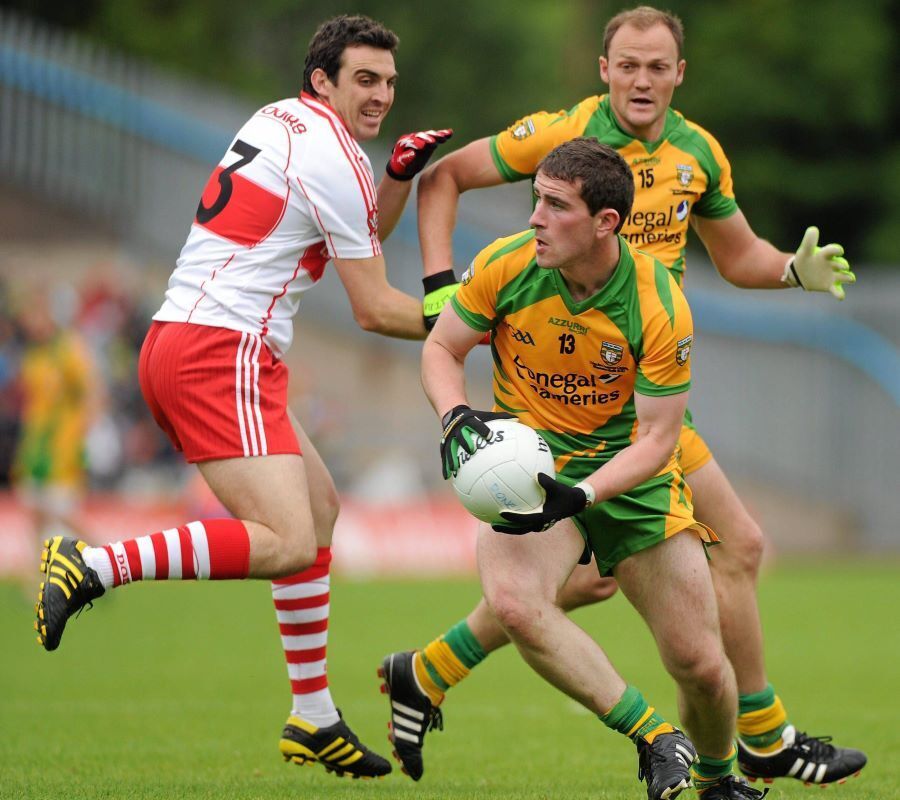
I’m not entirely sure that the Tír Chonaill men showed enough in the third-quarter blitz against Derry last Saturday to reassure their supporters that they have no intention of going gently into the night, but they certainly showed that they still have the muscle memory to dig out a win when needs be.
We may be a little wiser after their tussle with Dublin this evening.
On the face of it, the signs are encouraging for Donegal folk. Apart from Rory Kavanagh’s retirement, Dermot Brick Molloy’s departure and Leo McLoone’s unwillingness, or inability, to join the panel, there hasn’t been a whole pile of upheaval.
Watching the players turn the screw on Derry at the start of the second half last Saturday showed us that all the basic components are in place and it reminded us just how compelling Donegal can be when they are tuned in.
If and when Anthony Thompson returns from Essex, when Neil McGee, David Walsh and Colm McFadden return from injury and when Eoin McHugh overcomes his virus, the gaps that appeared in Donegal’s first-half showing against Derry will gradually be plugged.
But it is still hard to escape the sense that this is a Donegal team raging against the dying of the light, as opposed to a team on the cusp of something truly special.
To paraphrase Leonard Cohen, their time has gone, their hair is grey, they ache in places they used to play.
It seems from reading Karl Lacey’s comments recently that much of their attention since getting together for 2015 has focused on learning how to play teams that mirror their own style of play.
Armagh, in last year’s quarter-final, were the first to show Donegal that such a learning process might be necessary to survive against the more tactically aware teams, but can you imagine any of Jim McGuinness’s teams being just about mere survival?
As McGuinness himself was wont to say, “that’s not us”.
Just what vision Rory Gallagher has for this group of players remains to be seen, and it is far too early to ascertain whether he has the nerve to follow through on that vision to the extent that McGuinness did in the infamous 2011 semi-final against tonight’s opponents.
Based on the evidence of last Saturday night’s game against Derry, Donegal under Gallagher will roll with much of the same approach as they had under the previous regime. Their goal, scored by Odhrán Mac Niallais, could have come straight from the McGuinness playbook. Emmet McGuckin hesitated with the ball in hand and was dispossessed by Mark McHugh and Karl Lacey just yards out from their own goalmouth. Quick as a flash, Marty O’Reilly and Christy Toye rampage forward and Mac Niallais, in that wonderfully fluent style of his, made the finish look routine.
Gallagher may have inherited the likes of Mac Niallais, Ryan McHugh and Darach O’Connor from last year’s team but if Donegal are to stay at the top, these players are going to be required to lay down markers right throughout the spring campaign. Two years ago Mark McHugh was being touted as the prototype modern wing-forward and having him back in the fold gives extra impetus. He may take some time to cope with the changed landscape, however, as most teams now have developed the fitness and the tactics to counteract that kind of player.
Perhaps the biggest change of all for this group of Donegal players is the possible emergence of Patrick McBrearty as a leader of the attack to take some of the pressure off Michael Murphy. Sometimes players respond to managers and based on the evidence of last Saturday evening in Ballybofey, McBrearty appears to be playing for more than just a permanent place on the team. He seems to be playing for Gallagher too. Michael Murphy was always McGuinness’s on-field general and I have a sense that McBrearty could become the same for the man who guided his club, Cill Chártha, last season.
Between them, the full-forward line of McBrearty, Murphy and Marty Reilly contributed 0-12 of Donegal’s total of 1-15 against Derry and there are very few full back lines will fancy their chances of containing them from here to the end of the league. The trouble will begin for Donegal when the inside trio are contained to the extent that Kerry contained them in last year’s final.
Have the players further out the field the wherewithal to hurt teams on the scoreboard? Much was made ahead of last September’s showdown of how Donegal had shifted the scoring responsibility away from McBrearty, Murphy and McFadden to the extent that the key trio had gone from contributing 73% of their championship scores in 2013 to just 43% last season. If the inside line was held, the score would come from another source.
Misgivings about Mark McHugh’s absence were countered with the fact that the midfield and half-forward line had never been scoring as much.
Yet when it came down to it, one of the many reasons proffered for Donegal’s below par showing in the final was the fact that McFadden hadn’t delivered, Aidan O’Mahony had held Murphy relatively quiet and McBrearty didn’t even start the game.
For the record, Donegal’s starting six forwards scored 0-2 from play between them (Murphy 0-1 and Mac Niallais 0-1) — the same as their starting six backs. It was very evident where the remedial work was needed.
In fairness to Gallagher, he has gone about addressing the issue by giving Marty Reilly more game time, placing Murphy much closer to goal and asking McBrearty to become the player he’s been threatening to become for a while.
With two home games against Cork and Monaghan coming up in phase two of the league in March, Donegal wont lose much sleep if they leave the points after them in Croke Park tonight.
But what a boost it would be to rattle the Dubs on their home patch for the second time in six months! I wouldn’t bet against them.

CONNECT WITH US TODAY



Be the first to know the latest news and updates