Dermot Earley — more than just a footballer
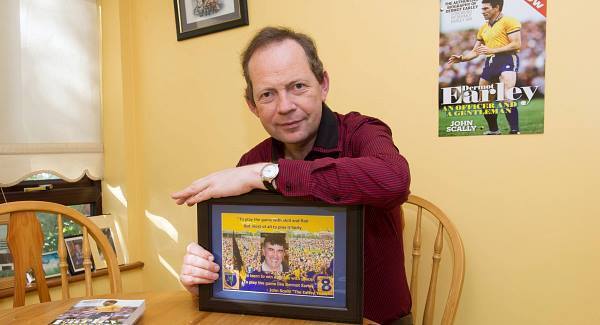
The Roscommon native has written the official Dermot Earley biography: An Officer and a Gentleman and shares his memories of the man he knew and admired so much
December, 1973 — Dr Hyde Park, Roscommon
I remember the first time I saw Dermot like it was yesterday. It was a lovely clear, crisp day and it was warm for that time of year. Roscommon were playing Cork, who were All-Ireland champions at the time. I can still see the Cork team walking out on to the field — Billy Morgan, Jimmy Barry-Murphy, Ray Cummins. I was 10-years-old and it was my first National League game.
I still see him in my head, leaping in the air with that big distinctive black head and grabbing the ball. I had imagined him exactly as he was — the clean-cut hero, the Clark Gable of Roscommon with a bit of dash.
Roscommon built up a big lead in the first half but Cork rallied in the second half. It was 1-11 to 1-10 and Cork had a 50. When the 50 came in, there were hands going up everywhere and then Dermot soared, caught the ball and kicked it out over the sideline and the final whistle went.
Roscommon had beaten the All-Ireland champions.
Afterwards, as Dermot was walking off the pitch, I found myself walking beside him — there was no fence around the Hyde then. I couldn’t believe it. I didn’t say anything, I didn’t ask for an autograph. I was walking beside this giant. I absolutely idolised the man and to be just beside him, in the presence of greatness, was like a moment of grace. If I had died and gone to heaven, there couldn’t have been a better moment. It was a perfect day.
My top 100 sporting moments, 50 of them would involve Dermot Earley. He was more than just a footballer. After he died, it wasn’t that he was Roscommon’s greatest footballer, he was Roscommon.
The most impressive thing about him was the effect he had on people when he met them. I spent a week with him in 1997 in the Lebanon. It was scorching hot, I could hardly stand up. Dermot saw a guy cleaning the toilets and he went over and spoke to him and to see the transformation in that guy just from getting a few words from Dermot Earley — Dermot seemed to have an ability to touch the right buttons and say the right things.
I think what made him special was his emotional intelligence. He was very secure in himself. He knew who he was, he didn’t need to impress people. He went out of his way to be the ordinary guy, which he wasn’t. He just wanted to be accessible.
One day Dermot was walking home with his father, Peadar, and he said to him: “You and me, we’re not like father and son, we’re more like brothers.” Men didn’t talk that way to their sons in rural Ireland the way Dermot’s father talked to him. He was comfortable in his own skin because of that.
The big disappointments in his life was not that he didn’t win an All-Ireland with Roscommon but that he let himself down, that he didn’t behave in the right way. In 1975 he was sent off when he struck Bobby Doyle from Dublin. He would rather lose with honour than win without it. Once, after a defeat, he refused to shake his opponent’s hand. He was disappointed about that. You had to do things the right way. He always wanted to walk the walk — 99% of the time he did but there was the odd time that he didn’t and that’s what stayed with him.
He was very traditional but also very modern. When he was first offered the Roscommon job in 1992, he turned it down because he thought it would be too much of a sacrifice in terms of his family. It was the children who turned him around. They held a family meeting to decide whether he would take the job. And everyone had a say, even Noelle, who was the youngest. All of the children wanted him to do it, it was a very democratic organisation.
The argument in Roscommon, when he took over as manager in 1992, was that he was too nice. I think there’s possibly an element of truth in that but he would have felt you don’t have to be ruthless to be a winner.
Napoleon always wanted his generals to be lucky. Dermot took over a Roscommon side that was on the way down. They lost the Connacht final in 1993 by a point and they lost to Leitrim, who went on to win Connacht, by a point in 1994. I think timing is a big thing in life. He was in the right place at the wrong time.
One of the great blessings in my life was to have been Dermot’s biographer but the greatest blessing in my life was to have been his friend for 20 years. I first met him in 1987. We had a lot of things in common, values and ideas. We were comfortable in each other’s company and could talk easily.
He would have told me stuff that maybe he wouldn’t have told anyone else. The 10-year-old boy in me still remembers the sporting hero but the man remembers the man. To me, his greatness as a footballer is completely eclipsed by his greatness as a man.
He had a great intellectual curiosity about all kinds of things. I teach philosophy and theology in Trinity and he could mix it with anyone in Trinity on that level. I remember talking to him about Michael Jackson one time. He was a fan and he loved the song, Black or White. He was in America, working with the UN, when it came out. He liked the energy of the song. Dermot was a happy man, he liked catchy, upbeat songs. Another favourite would be Dire Straits, the Walk of Life. You could imagine him humming it in the car when he was on his own.
His father was his hero. Peadar had a huge impact on him. Dermot got his values and his philosophy from him. Peadar’s father, Dermot’s grandfather, died when Peadar was very young so he was taken in by another family. They reared him and he eventually went on to become a teacher.
For Dermot’s father to get to third level back then was phenomenal. Peadar was always conscious of the debt he owed the family that took him in so when he got his first job as a teacher, he sent his first cheque to his adopted father. When Dermot joined the army, he cashed his first cheque and got four pounds, which he sent on to his father. When Peadar died, they were going through his possessions and they found that money in his wallet — four single-pound notes.
When people look at the cover of the book, they can’t get over what a physique Dermot had. He was an incredible physical specimen. One of the memories in the book is Dermot walking off the Hyde one day and two farmers are looking at him: “I have bullocks at home on silage and none of them have legs like that.”
He was a very devout Catholic and took that side of life very seriously. He was steeped in the land too — he loved the bog, nature, working the land. And he loved talking to farmers about the price of cattle and how good the turf was. He never left Roscommon.
Dermot got sick in 2009 — his family started to notice things. He was making mistakes, putting the milk in the press rather than fridge. He had a lot of stress at the time. He was Chief of Staff of the Defence Forces and sometimes when you have a lot of stress, your memory slips.
The first clue his mother had was when she rang up and heard that Dermot wasn’t at work. Her first comment was: “Dermot never gets sick.” Intuitively she knew this was huge and possibly, there was no going back. Cancer is one thing but when it’s a neurological illness, there’s no treatment.
Two things that always struck you about Dermot — the handshake and the smile. Part of the Earley tradition, after mass on Christmas morning, they’d come back to the house and Dermot would give out the presents. That first Christmas, when he got sick initially, he still did that and the smile was there. But as his condition developed, the smile went. It was obvious that he was no longer Dermot when the smile left. I didn’t see him right at the end because I wouldn’t have been able for it. I couldn’t imagine him not being Dermot.
Dermot thought the time had come for the GAA to enter a new era, to take a leadership role in society especially when it came to things like rural isolation, alcohol abuse and suicide prevention.
He had a lot of things he wanted to do to enrich the community. He had a huge agenda and there were a lot of things in the army that he wanted to change as well. He had strong views about where he wanted to take it. The army was hugely important to him.
He had ambitions for family too. Two grandchildren have been born this year that he never got to see. Two of his daughters have been married since his death. It was very poignant to see his mother at his own funeral.
When he got sick, part of the frustration for Dermot was that he knew all his great plans weren’t going to be carried through. It wasn’t self-pity for the fact that he wasn’t going to get better — it was that he wasn’t going to get to do all the things he wanted to do.
As Dermot’s coffin was lowered, Gay Sheeran, the former Roscommon footballer, shouted out: ‘COME ON ROSCOMMON.’ On one level, it was a completely inappropriate comment but in a way it was very appropriate. It summed up who he was and what he meant to his county.
The first person I see in the morning when I get up is Dermot and he’s the last person I see at night before I go to bed. I have a picture of him in my hall, at the bottom of the stairs. It’s four years now since he passed but I still think of him every day.
It was the most enriching experience I’ve ever had to have been his friend on a whole lot of levels. He is an enduring inspiration — the chapter isn’t completely shut for me. The story is continuing in a different way. His spirit is still with me.
My own father died when I was five and I never got to say anything to him. Dermot is the one person, more so than any of my family, that I got to say everything to. There was nothing left unsaid. He was everything I expected and so much more.
* John Scally, author of Earley — An Officer and a Gentleman in conversation with Brendan Coffey

CONNECT WITH US TODAY



Be the first to know the latest news and updates