McGuinness hoping Ferguson formula works for Donegal
The answer is readily available in Alex Ferguson’s first autobiography, Managing My Life. A second hand copy can be purchased via Amazon for the aforementioned price.
Reading all 480 pages of Alex’s tome is unnecessary. You just have to read one. It’s all laid out at the start of chapter nine. Page 137. For any ambitious coach, this page should read like a treasure map.
At the time of publication, Ferguson had been in footballmanagement for 25 years. And after a quarter of a century of sustained success, Fergie had developed an unshakeable conviction that “good coaching relies on repetition”.
Have you ever encountered those forward-thinking managers who are constantly introducing new drills, because they don’t want their sessions to become predictable?
Ferguson can barely conceal his contempt for that type of philosophy. He tells us: “Forget all that nonsense about altering training programmes to keep players happy.
“The argument that they must be stimulated by constant variety may come across as progressive and enlightened but it is a dangerous evasion of priorities.”
According to Ferguson, there are no short cuts. Mastery of a skill comes at a price. He believes football is no different to golf, therefore “effective practice requires repeated execution of the skill involved”.
To support his argument, Fergie pointed to one of his players. “David Beckham,” he claimed, “is Britain’s finest striker of a football, not because of a God-given talent but because he practises with a relentless application that the vast majority of less-gifted players wouldn’t contemplate”.
The reason I firmly believe Donegal will beat Kerry in Sunday’s All-Ireland final goes back to page 137, and that golden word — repetition.
Few would claim that Jim McGuinness’s players are technically superior to their Kerry counterparts. But Donegal have one massive advantage. They have a system of play practised over and over and over again.
Think about the various training camps which Donegal have been on this year. There was the week in Portugal during the National League. Five weeks later, they were in Johnston House before they played Derry in the first round of the Ulster Championship. We know they returned to the five-star resort ahead of the All-Ireland semi-final against Dublin. Last week, they were in the Lough Erne Golf Resort. More recently, it has emerged that they spent a weekend in Mullingar before the All-Ireland quarter-final against Armagh. These are only the camps which we know about.
To appreciate the benefits of these marathon training sessions, you have to understand the doctrine which underpins McGuinness’s belief system. He believes with every fibre of his being that the team with the best game plan wins. His players share that opinion.
So, if the best game plan wins, what constitutes a successful blueprint? Look at the most successful teams. They have one thing in common.
Their game plan is suitable for all seasons. It never changes. The best teams stick to their plan. Barcelona. Crossmaglen. Donegal. Regardless of the opposition, they rely on the same formation.
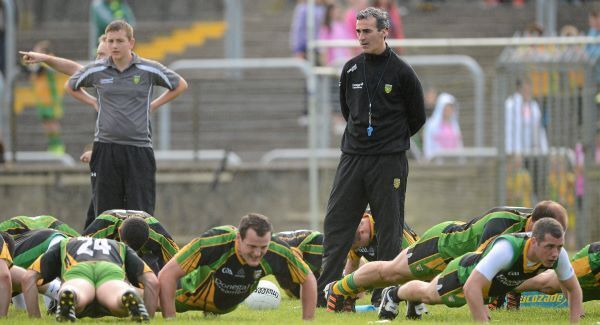
McGuinness has openly referred to ‘physical’ training sessions and ‘tactical’ sessions.
The former involves endless running. The latter, which can last three hours, will focus on coaching the game plan until it becomes second nature.
When a standard team comes under severe pressure, they revert to type. Players divert from the plan. They act as individuals and the power of the collective is radically diminished. When a well-managed team faces a crisis, they stick rigidly to the system engrained into their DNA. When Dublin coasted into a five-point lead, Donegal stuck to the plan.
The key thing to remember is that Donegal have been playing to the same system since 2011. There have been tweaks and adjustments, but the broad strategy is largely the same.
Think now about Kerry. Outlining the scenario leading to a Kerry victory, most people will conjure the picture of Kieran Donaghy, James O’Donoghue and Paul Geaney causing havoc in Donegal’s defence. Maybe that will happen. But consider what happened to every other full-forward line that entered Donegal’s den. They were swallowed up, spat out. Derry, Antrim and Monaghan were destroyed. Dublin were no different.
Armagh enjoyed the most success because they didn’t really play with a full-forward line. Jamie Clarke was a sacrificial lamb. Armagh played a possession game. When they attacked, the moved up the field and players like Aaron Kernan ran into positions which pulled Donegal out of their formation.
Therein lies the rub. If Eamon Fitzmaurice is bold and adventurous, he will keep O’Donoghue and Donaghy in his full-forward line. But Kerry have been playing this system for one game. With regard to the challenge which will be posed by Donegal, it’s neither tried nor tested.
Whatever strategy Fitzmaurice dreams up, it will be a departure from the way Kerry have been playing all year. Kerry beat Mayo on August 30. Fitzmaurice has had 22 days to refine and perfect his plan.
In contrast, McGuinness will have spent last week practising the kick-outs, moves and plays which his players have been working on since Portugal, since Johnston House, since Mullingar. Repetition, repetition, repetition.
Let’s say the best game plan does actually win. Donegal have been practising theirs since the start of year. Kerry have been working on theirs since the start of the month.
I fancy Donegal. I reckon Alex Ferguson would too.

CONNECT WITH US TODAY



Be the first to know the latest news and updates