Professionalism in an amateur context is a broken model
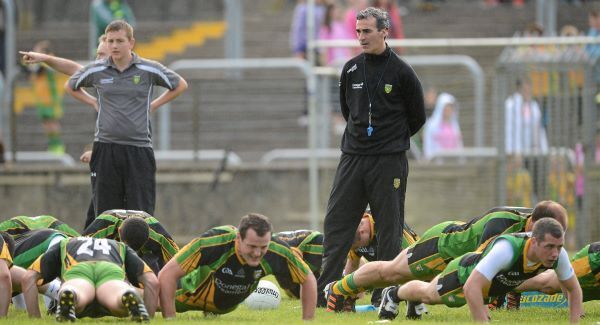
The level of attention that a top-flight footballer pays to mundane things such as practise, hydration, rest and nutrition is extremely important if you are to maintain any success in the game.

Professionalism in an amateur context is a broken model

“But it is also incredibly frustrating because it accounts for a lot of time that could be spent stimulating the mind. After a while, the things that made me a great footballer hampered my life progress and I came to resent every one of them. This, in turn, led me down a very dark path.”

— The Secret Footballer.

The corresponding document was revealed on Twitter recently and purports to be the current training regime of an inter-county GAA panel. Having seen a few of these, three main things stick out in this plan.

Firstly, the volume. It’s obviously quite significant. The schedule provides an overview of the current commitment levels expected and required of inter-county athletes. Without being flippant, the reality is that the expectations outlined and time involved are not really that severe, relative to what most teams are doing. It looks pretty par for the course and this has been the case for several years now. In fact, it is similar to the schedule of even a few club teams although it is notable that the mid-January version of this weekly schedule changes tack and ramps up to include five group field sessions (including two early morning weekday sessions), two gym sessions, two recovery sessions and a game all in one week.

The volume issue is muddied, however, when you throw in the fact that this regime assumes a commitment level for one team in isolation whereas the reality is an uncoordinated and loaded GAA fixture schedule for many players, especially the young player where every colleges, club, U21, hurling and football team all want access.

Strict linear expectations versus an unrelenting reality.

Do it all and you’ll be flying in March but finished by July. For the last few years, and last season in particular, notable performances by the younger stars of both inter-county hurling and football in the summer were tainted by a trail-off in performance by August and September. No one in the GAA is employed to manage oversight and the player must juggle demands and manage expectations on his own. It’s a sickening feeling arriving at any training session knowing you have to tell the manager you’re injured, but it’s worse when you’re arriving with the intention of asking for down time. The gear is put in the boot (just in case) and the conversation often never happens. Some forbearance might come at training but how likely is any club coach or college manager to turn around to most likely one of their best players and say, “No, you’re not playing this league game with us today because I’ve seen your schedule and think you would benefit more by sitting the game out.”

A head in the sand for their club or college manager allows the best team to run out in advance of championship and can win valuable league points. In the Irish Examiner on January 9, Professor Niall Moyna of DCU went further and claimed that elite GAA players now face the risk of kidney failure and long-term health issues due to the growing demands being placed on them.

It’s a broken model.

The second thing that jumps off the page on this training plan is just how prescriptive and rigid it is. As one would expect, it details the activity levels for the week but then it drills down to a level of detail in regards to what the player should be eating on a given day, for example. For less experienced guys, new to inter-county football and not yet that knowledgeable in terms of diet and training, this overly prescriptive approach can turn out to be nothing short of a disaster. Take your average 21-year-old, new to the scene who gets this document handed down to him. He takes it home and then breaks hell and high water to ensure he gets the prescribed swordfish into him at dinnertime on 30/12, the baked cod on New Year’s Day and then the steamed salmon on Friday 03/01. Addressing this minute level of detail in an amateur context where all the responsibility is pushed back on the player is very different to expecting the same from a professional athlete who will have much of this laid on for him and even if not, would have the afternoon to stroll through the shops and the evening to cook dinners. For the amateur player, this strict level of expectation can lead to diminishing returns rather than inches gained. The misplacement of effort will result in the sacrificing of time and money and will stress out that player who thinks he is being as professional as possible. A solid training plan, a base knowledge in terms of diet, hydration and rest such that a player can establish his own pattern of living, evolve and improve from there, has to be better than such exact directives.

On the point of nutrition, the plan appears to aim for a high quality protein meal that is also rich in omega and a variety of vegetables (for carbohydrate rather than the traditional pastas). All good, cutting edge stuff, but any combination of foods that make up such a meal would surely be acceptable if the choices were explained. The stereotypical eager young player who has been told inches matter more than life itself does not have time for this education which accumulates over seasons. Prescribing exact meals and the effective force-feeding of protein in volume may therefore suit the situation. Getting GAA players to intuitively understand what the requirements are so that their own schedules can be balanced, tailored and amended bespoke to their own needs has to be the goal. Robots are not needed.

This point goes deeper. Individual decision-making and big players taking responsibility for changing games is what makes good sport great. If robots are produced from an athletic point of view, then the games, the game plans and the spectacle will also become robotic. It’s happening already. Its unfortunate any player with a football and a 14 yard free should have to look slack-jawed to the line for instruction in the dying minutes when two points down. The ref’s feedback and the situation should be enough to empower the player to make his own informed decision. Or will we get to the stage where players on the field are mic’d up to the line? It is alleged this is already happening in some inter-county training sessions.

In Legacy, a fantastic book about the All Blacks and their cultural transformation from 2003 to 2011, James Kerr describes how the New Zealand rugby team went from consistent under achievers to world champions. What was notable in this transformation is that the All Blacks, and Graham Henry in particular, realised that the best chance of success was to equip the players and then push the responsibility back onto these players. Graham Henry is quoted as saying that getting the players to take charge of their own environments is, of all his achievements in rugby, the thing of which he is most proud. Essentially, this involved providing the players with a framework within which they could be successful, but the leadership and execution had to be undertaken by players themselves. Kerr quotes General Gordon R. Sullivan, former chief of staff in the US army: “The completive advantage is nullified when you try to run decisions up and down the chain of command. All platoons and tank crews have real time information on what is going on around them. Once the commander’s intent is understood, decisions must be devolved to the lowest possible level to exploit the opportunities that develop”. Or as Mike Tyson would more plainly say: “Everyone has a plan until they are hit in the face.”

The final aspect of the training plan that stands out is the level of expectation with regard to “gym”. The fact that it is listed three times a week is telling. If a player is going to devote around 40% of his weekly activity to the gym, the hope would be that he understands fully everything he undertakes in that session and why it is required so that he can get the most out of it.

While the exercises are not outlined in this schedule, in the majority of inter-county football gym programmes you will see activities like dead-lifting, cleaning, lunging and squatting. Significant benefits in power and strength are possible if these are done correctly. Ideally, the technique has to be demonstrated, coached and practised consistently without any weight before any credible strength and conditioning coach will allow players to load up and undertake the exercises with weights thereafter.

In the action-oriented sphere of inter-county GAA, however, loading up as quickly as possible becomes almost a race and is everyone’s priority. I would hazard a guess that no inter-county panel would have adequate supervision with regard to their players’ gym programmes. In an amateur context, where players squeeze in the gym at lunch, and the majority of time on their own, how can they? Getting the activity done and down on paper log is arguably more important than instruction and technique. “Task Priority Blindness” as it’s know in the US>.

The unfortunate reality is that there can often be a short-term gain after the initial stages of any such strength and conditioning programme no matter how badly executed. Sure, there is a strength stimulus involved lifting any weight and “a bounce” will be experienced but form compromised in such programmes will lead to dysfunctional, over-extended body mechanics in training and in games. Sooner or later, a player will break down and never devote themselves so wholly to the exercises if they recognised the consequences of their actions. This is why college players at 22 years of age with sufficient time devoted to professional-type training programmes are out-running 28 year-old-players whose bodies are now revealing the dysfunction and whose five years of life as a working stiff are catching up with them. The satnav may be better but this is pointless if the chassis is collapsing.

It’s happening already. Inter-county regimes are transforming good young players into inter-county athletes in the space of six months. The foundations that are laid in the process are inevitably weak. With a realistic two to four-year horizon for any inter county manager, who could blame them.

A broken model?

There have been worthwhile initiatives such as the volume monitoring app that has been devised by UCC and provided for development squad players in Rebel Óg but the challenge to change lies at the top table and not with the counties themselves, who are clearly conflicted. The path required is not likely to be popular in the short term. Any means of amendment or reining in will likely be side-stepped and abused if not meaningful and actionable. Take the winter training ban imposed a few years ago which merely saw the majority of inter-county panels becoming part-time boxers and basketball players, while retaining a collective unity. Strong leadership, visionary leadership is never universally popular, however, and unless these steps are taken, the trend will continue where the strongest 22-year-old body survives and yet is finished by 28.

Supply isn’t a problem — there is always someone new, always someone younger volunteering as the next five-year project. If, however, a culture is created whereby more time is devoted to developing the 22-year-old both from a knowledge and skill point of view, rather than maximising and exploiting his warranty, then perhaps his body at 28 would be more game appropriate. Perhaps even the game itself may be less of an exclusive athletic battle and more of a balanced spectacle.

The alternative? Well we could always revamp and go the professional route. But that’s a whole other broken model.

More in this section

Cookie Policy Privacy Policy Brand Safety FAQ Help Contact Us Terms and Conditions

© Examiner Echo Group Limited