Black card debate goes down to the wire
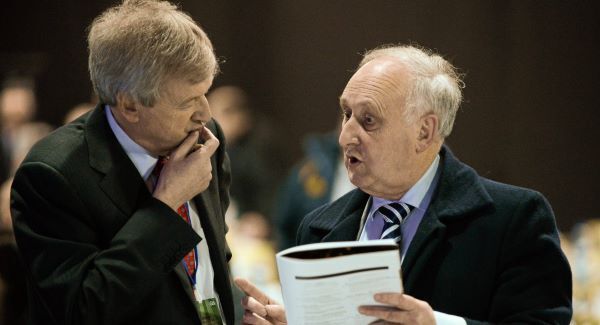
A combination of five Munster counties and six in Ulster along with three in Leinster appear to have formed enough opposition to ensure motion four on the Clár fails to receive the required two-thirds majority to be passed into rule.
However, there was good news for the FRC on Thursday night with Mayo and Derry electing to back the black card, meaning 16 counties are expected to vote in favour of it, with Louth and Leitrim likely endorsing it as well.
Speaking in Derry last night, McGee was remaining positive and looking towards the 80 or so non-county votes for support.
We’re not dead in the water yet. There was a lot of talk during the week about all the counties that have said ‘yes’ and ‘no’. Eighteen have said ‘yes’. But that is not the point. There is the guts of a 100 votes that aren’t attached to camp. There are foreign boards, Central Council, Management Committee, former Presidents and various miscellaneous people. There is probably 100 votes to play for. What happens on Friday night or a Saturday morning can have a big role in all of that. Above all the debate is crucial. We are confident that we can present a very strong case. We are putting on two speakers, Paul Earley and Tim Healy. We feel that every single vote has to be fought for at this stage.”
At yesterday evening’s FRC workshop in Derry, Connacht Council secretary John Prenty spoke passionately in support of the motion.
He also revealed his disgruntlement with his own county Mayo’s cynical tactics in defending their lead against Sligo in last year’s Connacht final.
“Is there anybody in this room who can put up their hand now and say it’s a skill to pull and drag an opponent, to trip him, to run into him and stop him moving on?
“I’m a Mayo man and I was disgusted in the Connacht final last year in the last five minutes when Mayo shouldn’t ever be afraid of Sligo.
“And what did they (Mayo) do in those last five minutes — every chance they got they pulled a Sligo man down to kill the game.
“That’s not a skill, that’s just a means to an end. Is that was we want?
“We’ve got to vote for motion four and after that we can decide (in the next motions) what is cynical behaviour. Cynical behaviour is disgusting and it will kill our game. Absolutely.
“This is one of the biggest days for football in the Association since it was founded. We have an opportunity in our hands and I think we should take it.”
During the workshop, several examples of the three “black card” fouls — deliberate pulling/dragging down, trip and body-check — were highlighted in video clips.
FRC member and former Derry player Tony Scullion said “some of the tackling would make you sick” although he admitted he disagreed with the idea there is systematic fouling in Gaelic football.
“I don’t agree that rugby tackling and cynical fouling is being coached but players know when to take the yellow card and when not to take the yellow card. There’s talk about this unmanly fouling going on in the last five to 10 minutes of games but it happens at many stages. The dragging down and tripping of players is despicable.
“I believe if the black card is voted for, players will think twice before they do it again.”
Of the FRC’s other motions, McGee told delegates of the necessity in introducing the mark to Gaelic football and enshrining high-fielding.
Another FRC member, Connacht games manager John Tobin, said the committee’s direct pick-up motion was “adding a skill” to the game.
Paul Earley pointed out 13% of all frees occur around the current toe-tap pick-up in Gaelic football.
Earley also highlighted there is no leniency allowed in the rulebook for an accidental trip and pointed out making a distinction between it and a deliberate one would make referees’ duties easier.
GAA director general Páraic Duffy believes match bans should be introduced at all levels in the Association.
A motion is on today’s Congress Clár to make them permanent at senior inter-county level after they were brought in on a trial basis last year.
The proposal is expected to pass and Duffy acknowledged that if it does the natural step is to bring an end to time-based suspensions at club, college and underage levels.
“I’d love to see us moving it into club level,” he said in response to remarks on his annual report. “It’s a big challenge but it shouldn’t put us off.
“There is a motion to make match bans permanent at inter-county level and if that is passed, I agree we should look at the possibility of introducing match bans across the Association, although it will take time.”
Duffy told counties they shouldn’t be looking to Croke Park to do all the promotion of games.
In regards to increasing exposure of the All-Ireland senior championships, Duffy said the onus is on county boards to make players available to the media.
“The real ground to be made this year is by individual counties with making players available for interviews. The real challenge lies with the counties.”
Former Derry player and RTÉ GAA pundit Joe Brolly last night spoke at Congress after being invited by president Liam O’Neill.
He called on delegates to back his “opt out” campaign to increase the number of organ donors across the island.
President of Ireland Michael D Higgins will address Congress this morning before O’Neill gives his inaugural full Congress speech as Uachtarán Cumann Luthchleas Gael.
All 73 motions will be voted on today among which it is anticipated the GAA will make stadiums available for the 2023 or 2027 Rugby World Cup should it be staged in Ireland.

CONNECT WITH US TODAY



Be the first to know the latest news and updates