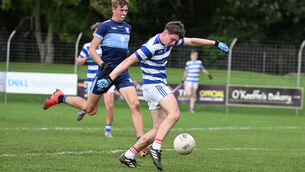
‘This isn’t a test of how hard you are’
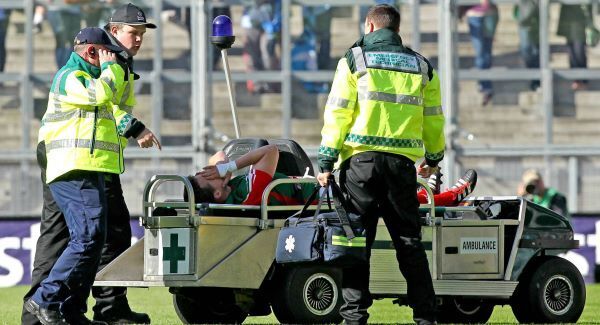
“When you put your foot on the ground and you twist or sidestep, that’s when you use your cruciate, to prevent excessive movement in your knee — anteroposterior, front to back movement, or rotational movement.
“The cruciate is made up of a number of bundles, and two functional bundles control front to back movement and rotation. When you tear it, in a small percentage of cases the damage is just to the anteroposterior bundle and there’s no rotational instability.
“Those are the fellas who can put their foot down and cut or step despite having no cruciate. They’re called ‘copers’.
“The other 80% or 90%, though, have rotational instability. The standard test for that is the pivot-shift test, and if that is positive, you’ll rest after the injury and the pain will get better, you can build up your quads and rehab but the first time you go back and cut or twist, you’ll go down again.
“I always say to the athlete, ‘this isn’t a test of how hard you are, it’s just nature saying to you that you’re not playing today’.”
The philosophy behind the operation to repair the cruciate has changed over time, he says.
“The doctrine has always been the cruciate is repaired to give the knee stability so you don’t develop arthritis down the line. The thinking now is that it may not make a difference. We don’t know if it definitely does.
“Now there’s even more research suggesting repairing someone’s cruciate allows them get back playing sport and being active on a part of the knee that has been damaged at the time of initial injury and shouldn’t be active. You have an injury there and you may be making it worse, so maybe we shouldn’t be encouraging those people to get back into that sport.
“Now that’s a whole different debate, because our job, after all, is to encourage people to be fit and active and healthy, but is there a price to be paid down the line for that?”
In the here and now Falvey sees no sudden spate of cruciate injuries.
“No, it’s just a lot of the victims are high-profile and in the media eye.
“If you go to any GAA club in Ireland, in a squad of forty you’ll have three or four – at least – who’ve had cruciate ruptures repaired.
“The big sports for cruciate injury are those with cutting and twisting – soccer, Gaelic football, Aussie Rules. It’s different in American football, for instance, because cruciate injuries there come about when someone runs in at fifty miles an hour to hit your knee with his helmet.
“It’s a different injury, while typically, in soccer, GAA and Aussie Rules there’s nobody near you when it happens – you put your foot down and your leg goes.”
Falvey points out that accurate and up-to-date injury records would help the GAA: “It’s difficult to gauge the amount of cruciate injuries in an amateur sport where you don’t have a central database of records.
“In Australian Rules they have very good injury records going back 15 years and we extrapolate our injury rates from those, the sport and injury risk factors are very similar.
“Where there is a spate of cruciate injuries is in ladies’ football, by the way. Women are six times more likely than men to tear the cruciate ligament during field sport, which doesn’t get any headlines — women’s predisposition is thought to be largely due to neuromuscular control — how the stabilising muscles work.”
He gives a quick demo: he shows how a man lands after a jump, with the knees bending slightly forward, and then demonstrates a ‘woman’ landing, with the knees bending slightly towards each other.
“When you land after jumping,” says Falvey, “there are a number of things which make the movement safer. Bending the knees to 10-30 degrees flexion, Hamstrings help, so having the hamstrings contract first on landing is helpful. Women respond to ‘tibial translation’ by contracting quads first — the opposite to what is helpful, and they also tend to land with less knee and hip flexion.”
It’s not an insurmountable problem, though. Falvey refers to a preventative measure developed in Scandinavia.
“A study there looked at injury prevention and cut cruciate injury rates by a third in three seasons by teaching a sport-specific warm-up – how to jump and land.
“That’s backed up by a lot of US research: a half-hour of the sport-specific warm-up two or three times a week in pre season, and incorporated into each session for 10 minutes in the season is a huge help. The glutes, hamstrings and correctly timed quads are protective.
“There was even an editorial in the British Journal of Sports Medicine stating that anyone coaching women who didn’t use this [sport-specific warm-up] had the blood of their players’ cruciate injuries on their hands.
“What’s disappointing is that there hasn’t been a carryover into men. There isn’t the same preponderance but there are still lessons to be learned there.”
Falvey widens the context on protecting the knee.
“Prevention of an injury isn’t a matter of one thing. When a guy does his cruciate, was the ground harder or softer? How long were his studs? Was he tired? Did he sleep the night before or do a weights session the previous day? Was his mind elsewhere? Did he have an argument with his better half?
“These are all potential factors in whether you tear your cruciate or not and there’s some quality research on this being done on this in America — this is where the database works.
“You study the injuries, you document them – but you also gather information about them so you can do regression analysis to see why it happened.”
The results of that research has produced some surprising results.
“In the States they can tell you that a man who’s torn his cruciate is five times more likely to tear that again than someone who hasn’t; a woman who’s torn her cruciate is more likely to tear the cruciate in the other knee.
“They don’t know why but they can tell you that because there’s a database. Where is it? In the US Military, because all the recruits play soccer as part of their training, so the information is all there.”
Even when reasons for injury are found, the remedies don’t always take. Ask the Aussies.
“At the Australian sports medicine conference in 2003 there was a study mentioned where the grass for Aussie Rules was changed to make it slippier – that would mean players falling over rather than twisting and tearing their cruciates.
“What happened? The players wore longer studs. They were looking to increase their ground reaction force, where you can stop faster and twist, which obviously makes a cruciate injury more likely.
“That’s sport, though – you want someone who can stop and start and twist inside a guy.”
*Tomorrow: What happens when you have to go under the knife for a cruciate op?


CONNECT WITH US TODAY



Be the first to know the latest news and updates