GAA needs to do more to promote its marquee names

SAN FRANCISCO can be a weird and wonderful place. It’s a city where the unusual is the norm.

GAA needs to do more to promote its marquee names

In less than a week, you are pretty much conditioned to it.

Take the All Star exhibition match on Sunday. Two rows of bleachers and a table acted as both the press box and the substitutes’ bench. The Liam MacCarthy Cup was perched on the table.

As the game drifted on, one journalist picked up the Cup. He felt the weight of the silver chalice and carried out a brief inspection. Then holding the handle with one hand, he gave in, and dreamed the dream. The Hogan Stand and the Cup punched into the air. What would it be like? Soon, curiosity got the better of most of us and the Cup was being passed from one journalist to the next so that each man could experience holding the trophy aloft.

Then John Mullane, the only substitute, issued a request. “Throw it over there to us lads,” he said.

“I may as well get used to the feel of it before next September.”

And we laughed at Mullane’s good humour. It all seemed so normal. A pitch, a game and the recording of scores. The standard routine. Yet, it took a moment to register that this wasn’t another Sunday. Sitting in a press box with a four-time All Star winner and the Liam MacCarthy Cup for company just doesn’t happen that often.

But like I said, this is San Francisco, this is America, and no-one does crazy quite like America.

The previous night, we were in a bar in Haight Street, the district of San Francisco where the hippy movement was centred in the 1960s. One journalist stepped outside for a smoke. He was gone slightly longer than usual. On his return, he explained the delay. A fellow smoker had recited a poem to him. It was a long poem. A very, long poem. And, we were also reliably informed, a very bad poem. On a walk along the Embarcadero, the two-mile stretch of promenade that lies between the Bay Bridge and the Golden Gate Bridge, I met a man dressed as a dog. He was also walking a dog.

Coming from Ireland, it all seems slightly mad. Yet, there are things about us, and there are aspects about the hurling All Stars which Americans would find absolutely absurd.

Let me explain. Standing on the bus that was due to take us from our plane to the connecting terminal in Heathrow a fellow Irishman started talking to me. He was going to Cape Town to build houses. He was keen to tell me all about it. I, on the other hand, had no interest in anything he had to say. I looked out the window so he picked on the player standing beside me. The do-gooder got bogged into his spiel. The player chatted away to him, asked questions and was totally courteous. I couldn’t help being impressed by the player. The man was a bore, but the player indulged him.

Eventually, Mr Charity stopped talking about himself and asked the player who he was. “J J Delaney,” came the response. JJ Delaney. Kilkenny hurler. Winner of seven All-Ireland medals and an All Star on five occasions. His manager, Brian Cody, a man not given to making effusive statements, has described Delaney as: “one of the greatest hurlers of all time”. Yet, somehow this living legend, can stand unrecognised in a public place.

There are more people than the house-builder who would fail to identify J J Delaney.

If Jackie Tyrell (four All Stars), Michael ‘Brick’ Walsh (three All Stars) Noel McGrath (two All Stars) and Richie Power (two All Stars) were walking down your street, would you be able to name them? Probably not. It’s not necessarily the fault of GAA fans that so many top hurlers are virtually anonymous outside their own counties.

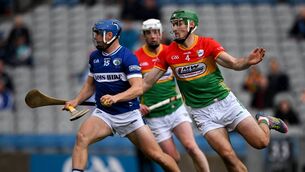
The compulsory wearing of helmets has essentially removed players from the public’s view.

It wouldn’t happen in America. This is a country that knows how to celebrate its sports stars. They also wear helmets in American football, but if the equivalent of J J Delaney existed in the NFL, it goes without saying that footballer would be known in every one of the 52 states.

This is a problem that the GAA needs to tackle. Photographs of the players could be shown on the big screen when the teams are announced in Croke Park. RTE should be encouraged to do something similar. Players should be asked not to wear their helmets during the pre-match parade. Other ideas should be generated.

Every sport needs its heroes. They promote the game. Children want to be like them, men want to play like them.

The GAA is fortunate in that the majority of the players are exemplary ambassadors.

On this tour the conduct of the players has been impeccable. Given that they are here to carouse and have a good time, it’s actually remarkable how civilised they are. Unlike other sports that can’t trust their players to behave themselves even when they are representing their country, the GAA is lucky to have so many genuine role models.

But there is something seriously amiss when the super heroes of hurling aren’t known outside their own domain.

Even by San Franciscan standards, that’s pretty crazy.

* p.heaney@irishnews.com

More in this section

Cookie Policy Privacy Policy Brand Safety FAQ Help Contact Us Terms and Conditions

© Examiner Echo Group Limited