If at first you don’t succeed...
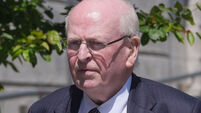
THE accepted wisdom is that Laois teacher Liam O’Neill has the distinction of being the first to assume the highest office in the GAA without having to fight an election.
It’s certainly never happened in modern times and it has come about this year because the three other nominated candidates withdrew over a period of 18 days.
O’Neill was runner-up to Christy Cooney in 2008, when former Munster chairman Sean Fogarty also contested the election. Other than the historic nature of his appointment (he won’t take over from Christy Cooney until next year), he becomes the ninth president to be chosen at the second attempt since 1978.
The ‘exceptions’ have been Paddy Buggy (1981), Sean Kelly (2002) and Nickey Brennan (2005), each successful first time out.
At official level, the private view would appear to be that it’s not satisfactory to have the presidency uncontested. But this should not be seen as a personal reflection on Liam O’Neill. For the obvious reason the situation was brought about by the joint decisions of Con Hogan(Tipperary), Tom Daly (Donegal) and Sheamus Howlin (Wexford) not to go forward. However, Howlin had indicated he would have stood had he known in time that ex-Ulster chairman Tom Daly was going to withdraw from the race.
Con Hogan announced on February 8 that he was not standing. His reasoning was that the other candidates “had a stronger provincial and geographic support base” and doubted if the membership would be favourably disposed to electing a second successive Munster man.
Tom Daly waited until February 24 to announce his decision saying he had to balance both personal and professional commitments against the three-year, full-time and intense level of commitment the presidency entails.
When asked earlier in the year if he was running, Sheamus Howlin said he would wait until the end of his term as Leinster chairman before responding. And while he did that, on February 26, he informed Liam O’Neill a week earlier that he would not stand against him. Additionally, he had conveyed that news to representatives of the counties in the province.
In his formal address to convention, he said while he had the commitment and the experience to take on the presidency, he was conscious that O’Neill, as his predecessor in Leinster, had been the runner-up the last time and “deserved the opportunity” to run again.
“My loyalty to Leinster is unconditional and I was resolved not to divide the Leinster support,’’ he said. “Consequently, I met and spoke with Liam. I undertook to stand aside on this occasion and to attempt to unite the province behind his candidature.’’
In advance of convention, he confided to friends that he would have stayed in the race had he known in time of Tom Daly’s intentions. And, he alluded to this in his formal address when he said: “the withdrawal of other candidates may have changed the landscape in some people’s minds, but for me my word is my bond.”
Against this backdrop, it’s interesting to note that when Paddy Buggy was elected in 1981, there had been 12 candidates and nine stood for election.
Sean Kelly was one of four candidates in 2002 and notably his vote of 195 exceeded the combined total of the other three (Seamus Aldridge, Albert Fallon and PJ McGrath) by 66.
Fallon, another former Leinster chairman, had the dubious distinction of failing at the second attempt. In 1999, he finished second behind Sean McCague (173/85), but three years later he was third behind Sean and former referee Seamus Aldridge.
Unusually, Nickey Brennan and Christy Cooney were the only candidates in 2005, when Brennan triumphed on a 171/154 vote. When Cooney was successful at the second attempt three years ago, he got a similar vote (172), with Liam O’Neill in second place with 112 and Sean Fogarty gaining 26 votes.
Cooney was the eighth President to be elected at the second attempt, the others being Paddy McFlynn (1978), Dr Mick Loftus (1984), John Dowling (1987), Peter Quinn (1990), Jack Boothman (1993), Joe McDonagh (1996) and Sean McCague (1999).
Paddy McFlynn was actually the first to be chosen as president-elect (two years after Con Murphy defeated him 175/123). He had also stood for election in 1973, when he finished in third position between Dr Donal Keenan and then Leinster chairman Tom Loftus. A Derry native, McFlynn served as County Secretary before moving to Down.
He was their Central Council delegate for 15 years and was a member at the time of the decision to play the 1947 All-Ireland football final in Gaelic Park.
The idea of choosing a president 12 months in advance was that it would assist in gaining experience in administration and management procedures at the top level before assuming office.
It had been decided to follow this course at the 1975 congress, when delegates were concerned with the easing of the presidential work-load. They were influenced by the fact that the then holder, Donal Keenan, suffered a minor heart attack in the middle of his term. He took over at the 1973 congress in Waterford, when he gained the distinction of being the first president in 20 years to be elected on first count.
CONNECT WITH US TODAY



Be the first to know the latest news and updates