Stuck in the mud on field of dreams
IF you drive through the gates of the wonderfully appointed University of Limerick it won’t be long before you come across the internationally renowned UL Sports Arena.
Developed at a cost of €28m and opened in 2002, it houses, among countless other facilities, Ireland’s first 50m swimming pool to be built to Olympic standards. It caters annually for over a half a million customers, among whom often are international athletes and teams.
To those of us who attended the University over a decade and a half ago and to the Sigerson panels of that era, however, the 3,600 square metre sports arena and its tarmacadam car – park will always be the “mud-patch”.
To give a sense of the early 90’s football landscape, Down were the pre-eminent force in Ulster, Dublin were processing the accumulated pain of years of narrow failure, Kildare were getting used to Mick O’Dwyer and Cork were longtime overlords in Munster and we in Kerry, their underlings.
Terms like core stability, SAQ, plyometrics and periodisation had yet to make their way into the GAA lexicon and current mantras like centres of excellence, innovation, state of the art and smart economy were still some way off. But if you were a Gaelic footballer in UL back then, the mud-patch was the still point of your world on campus.
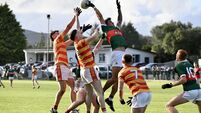
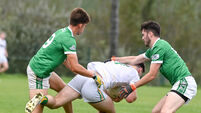
Training sessions were primitive and brutal. They were also frequent and frenzied. So dire were the conditions, one wonders at this remove how the whole thing didn’t just fall asunder. There was no real theory of evolution among UL Gaelic footballers – just a list of creatures the mud-patch allowed to survive. Holding the whole show together through sheer force of personality was that mad hoor from Moyvane in North Kerry, Paddy Mulvihill.
Paddy was and still is, CEO of Irish Wire Products on the Dock Road in Limerick, at that time a former Kerry footballer and future Limerick manager who was refreshingly unconventional.
While the university hurling team, containing emerging legends such as Brian Lohan and Seán McMahon, trained on well manicured pitches (or even indoors if the weather and good sense demanded) Paddy Mul maintained a steadfast line that the mud patch with its all year round glue-like traction was ideal for building stamina and team spirit.
Just in case that didn’t work, Paddy insisted on doing all runs in reverse. Flatmate and future Kerry goalkeeper, Diarmuid Murphy was often a piggy back partner reversing through the mud. No more than yours truly, Murph had a deep distaste for physical training and he also had the staying power of a jockey in the donkey derby at the Béal Bán Races. To add insult to possible injury, there was no adequate lighting system to illuminate our sessions and we depended on the light from the nearby, all-weather pitch, usually reserved for the university soccer team. Our orchestral manoeuvrings, while not entirely in the dark, were certainly not for the faint hearted or faint sighted.
The Shawshank Redemption, so beloved of so many Gaelic footballers if match programmes are to be believed, was the big film of our second year in UL. Shawshank’s Andy Dufresne only had to crawl to freedom through 500 yards of sh*t smelling foulness to come out clean on the other side of the prison walls. We endured more than Andy. After a few sessions my colleagues and I very quickly discovered that the mud-patch was built on the percolation area for an entire university sewerage system. We had our very own Venice of human excrement running right beneath our training ground.
When Venice became Vesuvius – as it frequently did with over 12,000 students feeding into the mix – it really was time to get busy living or get busy dying.
The mud-patch was hell but it was the best education I got in my seven years in Limerick. The UL Arena is a magnificent monument to sporting excellence but as an interpretive centre for a de-sacralised landscape, it doesn’t work. Commercial gyms and pools are built into the social fabric of communities now, as GAA clubs once were. Sometimes it seems that Tiger Ireland never fully evolved sporting forms for coping with affluence. In places such as the UL Arena, individual athletes (some maybe Gaelic footballers) come and they go, leading their own privatised existences in their pursuit of the Spartan ideal.
How did we come to this? Gaelic sport was never about a series of events emptied of serious human encounter. It was surely never about toned, perma-tanned athletes clad in designer labels paying good money to conform to all the images expected of them. The UL footballers I knew understood Einstein’s maxim that “what counts can’t always be counted and what can be counted doesn’t always count”. The mud-patch was about more than just a bunch of athletes hurrying from one private experience to another. It was as much Corinthian as it was Spartan and for a few years in the early 90s, Gaelic football was important in UL. Like many more former UL footballers, I am saddened to see that there has been no genuine progress on the Sigerson front since the UL Arena was built eight years ago. To paraphrase Boris Yeltsin: “We don’t appreciate what we have until it’s gone”.
Team spirit engendered, strangely, by adversity and a lack of resources is sometimes like that. It’s like air. When you have it, you don’t notice it.

CONNECT WITH US TODAY



Be the first to know the latest news and updates