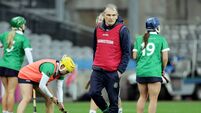
A woman for all seasons
They included a significant number from Pakistan and she described them as ‘natural camogie players’ because of the eye-to-stick co-ordination developed through their fathers’ obsession with cricket.
It’s not where she sees the future of the game. But the Tipperary woman with an intense interest in all sports and a passion for Gaelic games inculcated by her late father Garrett (an All-Ireland hurling medal-winner with Limerick in 1921, 1934 and 1936), recognises the importance of reaching out to non-nationals.
She agrees they will be judged on how successfully they nurture the interest being shown by girls in parts of the country which don’t have a camogie tradition and by consolidating their strength in the ‘traditional’ counties.
Handing over to Cork-born Joan O’Flynn at this weekend’s annual Congress in Nenagh, she takes understandable pride in the progress that has been achieved over the three years of her term. It has seen the number of clubs increase from 460 to 520.
“When I took over I worked in conjunction with our Strategic Plan, which was really the pathway for growing our sport. Obviously I had personal goals as well, but the most important aspects were to improve the standard of coaching and the quality of play.
“I think we have done that very effectively with a very good team of development co-ordinators headed by Mary O’Connor (the dual Cork All-Ireland medal-holder, who is National Director of Camogie).”
They have seven full-time development officers appointed, two of whom are working with secondary school students. Howard saw this as an area of concern because of ‘a big fall-off’ between primary and second level.
“We have developed the game hugely in places like Kerry, Mayo, Sligo, Tyrone, Cavan and Wicklow. You have to build from the ground up for the weaker counties as we call them, but then again you have to consolidate your strong counties as well. There is a lot of development work being done, not just by our co-ordinators but by the volunteers also.
“We have increased our number of players and our number of clubs. I would be very confident that I brought it to another level, but I inherited a healthy organisation from Miriam O’Callaghan because Centenary Year kick-started the association again.”
One of her personal goals was to play their All-Ireland finals with the U21 hurling championship final — what she likes to call ‘the whole family of hurling’ — and that was achieved over the last three years. Negotiations are taking place with a view to continuing the arrangement.
She also points to the association receiving increased funding from the Sports Council and a ‘particularly good relationship’ with John Treacy and Ossie Kilkenny.
“They have been impressed with the work we have done. Our Gala sponsorship has also been hugely important, both from a profile point of view and in financial terms.”
More than satisfied with the standard of camogie produced in the different grades, Liz also takes great encouragement from the development of the game overseas. Currently, they have six clubs in Australia and, in North America she has seen teams from cities like Indianapolis, Denver, Washington and Milwaukee built around girls who have no Irish connection whatsoever.
“Camogie is more than holding its own,” she states. “We are in a very healthy state.”
At the same time, the association is also very conscious of the need to be better structured and better organised. Howard brought in Atlantic Sports Management, a company whose leader, Morgan Buckley has experience of working with the IRFU, basketball and women’s golf, as well with sporting groups in Australia and New Zealand.
“I just wanted him to measure if our structures were effective enough for the modern association and to meet the needs of our volunteers as well,” she explained.
“The structures are there since the association began and possibly need a bit of tweaking or re-energising.”
Delegates attending Congress will hear a presentation from Buckley, based on his work to date.
The new president is from a well-known GAA family in East Cork, playing with Fr. O’Neill’s before moving to London and settling in Kildare.