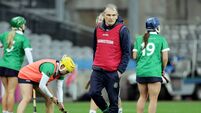
No retreat as Rebels rule with possession
Much though it pains me to say so, I’m in total agreement with all the criticisms thrown at the film by the more rabid elements of the English press: far-fetched, unrealistic, irrelevant, and entirely lacking in balance. A hurling championship match in Ballingeary at the start of the movie, for heaven’s sake?
On a more serious note, a current revolution is being televised, just as Gil Scott-Heron predicted. Cork’s possession game, as seen last Sunday in Thurles, is re-making the game of hurling in front of us. It’s like having a pitchside seat at the invention of catenaccio in Italy, or seeing the first forward pass in American football, but no-one seems interested in talking about it.
Hurling must be the last field game to take leave of tactical naiveté. For decades in Gaelic football we’ve had third midfielders, deep-lying half-forwards, two-man full-forward lines, blanket defences, yet hurling has always been resistant to strategy. The prevailing wisdom held that the bounce of a temperamental ridged sphere the size of a tennis ball was impervious to anything but the most rudimentary planning, so hurling was a game built on improvisation and inspiration, and nobody played that game better than Cork.
When Galway tried to hoodwink Cork by creating space in their full-forward line during the 80’s the men in red stood their ground and won by marking the ball and trusting to high skill levels. They had players to score goals in the full-forward line, so there was no point dawdling with the sliotar 60 yards out the field, and the basic tactics owed a lot to Nathan Bedford Forrest’s approach in the American Civil War. Asked for his plan for battle, Forrest said: “Git thar firstest with the mostest.”
However, playing the current Cork style demands, arguably, higher skill levels: each short pass has the potential to go astray, and the default position of most hurlers, with space to wind up, is to put the ball into the red zone. Cork’s adoption of the support game means sublimating that instinct for a high-risk possession style, but the rewards are huge. Not so much goals like Ben O’Connor’s last Sunday, but because — as soccer, rugby, basketball, American football and other team sports discovered decades ago — when you have possession of the ball the other team can’t score. Cork’s ability to starve opposing attackers is linked to that ball retention.
The difference is marked when you watch film of the last Cork side to win the three-in-a-row, from 1976 to 1978, or even the last side to approach it, from 1984 to 1986. They seem to be playing a different sport at times, defenders banishing the ball as far as they can, half-forwards never looking to lay the ball off outside but going for their own scores, full-forwards going for goal first and thinking of points as a poor man’s alternative.
Where this gets interesting is the possession game/running game/Newtown’s style legacy. (Incidentally, if someone could come up with a decent agreed name for the style of play it’d be handy: something Italian like ‘stile nuova città’ would make us all feel sophisticated about ourselves).
This year isn’t just the anniversary of Cork’s three in-a-row; it’s the 30th anniversary of the publication of The Selfish Gene, by Richard Dawkins. Dawkins is the evolutionary biologist who first said genes were selfish because their only motivation is to survive and replicate themselves; later he refined the idea, identifying ‘memes’ – ideas, concepts or skills that survive not because they’re useful in themselves, like learning to drive, but because survival is their only motivation, just like the ‘selfish gene’.
The Cork possession game, for instance, is a meme within hurling. For the younger players on the side it’s the style they’ve played since coming onto the team, it’s successful and they’ll continue with it. There may be tweaks and refinements, but the learned behaviour is to look for a man with the ball, whether he’s ten yards away or 60, because they’ve won two All-Irelands using it.
What will be interesting is whether Cork persevere with the style when and if they lose. The Cork county set-up isn’t Ajax of Amsterdam, with the playing pattern replicated down to the U10’s, so it’s not as if new players are indoctrinated on arrival in the senior set-up.
What’s more interesting is whether or not other counties will adopt the basic tenet of possession rather than delivery. If so, you can wave goodbye to sky-high clearances and long bombs from the half-back line. Like the scoring wing-half or the Munster foot-rush in other sports, those will become memories and relics. The time may come when Cillian Murphy’s long deliveries from full-back in Ken Loach’s movie will seem as remote as the green and purple sashes worn by the players.