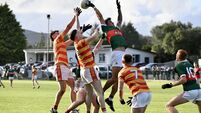
Fermanagh’s big day out
In a competition losing a little bit of significance with each manager quote making a priority of May and June, two counties have arrived to spice up its raison d’etre.
While most mouths are watering at the examination of Micko’s latest starring role as the midlands Messiah against the All-Ireland champions, the curtain-raiser will pique just as much interest in the dewy-eyed romantics among us.
Tyrone are the defending league champions, the team we are told to watch out for in the summer, a team who, despite their manager’s protestations, could have done without this tasty treat. Like Armagh, nobody is really too concerned with Tyrone’s part in all of this. We will be hearing about them, ad nauseum, in the summer.
It is Fermanagh all eyes will be on. Wee Fermanagh. The county with the barest cupboard in the land. The quiet and modest people hemmed in by the curlews and the Erne, locked to land by Donegal and Leitrim. It’s a little hackneyed to call Croker a field of dreams, but a quick gander at the history of Fermanagh football ... well just think about this: they are the only northern county never to win the Ulster title and as recently as seven years ago there were suggestions, taken seriously in some quarters, that the county should opt out of senior football. Dom Corrigan, as much of a messiah as Micko, grimaces for a second to think of similar days like Sunday in Fermanagh’s threadbare past.
“Well, there was an All-Ireland under-21 final against Cork in 1971, we lost that, there was a junior All-Ireland final, I think, in ‘59. And that’s it. The last league semi-final was in 1935. It is certainly the first time in living memory that a Fermanagh team will walk out onto Croke Park.”
The most surprising thing is the timing of this trip to headquarters. For the past five years, Fermanagh have made a gradual climb from the doldrums. First, under the honest and committed stewardship of Pat King, then under the harsher regime of John Maughan before Corrigan, battle-scarred from 12 years of whipping boy football in Ulster, took the reins.
Each year since King’s final season, there has been mumbled words of a breakthrough. King left on a high, a one-point defeat to Armagh in the Ulster semi-final, an unjust defeat for anyone in Clones.
Had Fermanagh’s immensely talented full-forward Stephen Maguire got any sort of protection from the referee, that could have been the year Fermanagh broke their barrier. Wasn’t to be.
And it was never to be in Fermanagh. It was just another hard luck story for the humble few that keep Fermanagh football going, a callow referee providing another excuse. Maughan came on a wave of hype and rumour of helicopters and draconian training sessions. Two barbed encounters with their nearest neighbours saw Fermanagh come through, but Tyrone annihilated them. Back to the drawing board, but there were encouraging signs.
Last year, Rory Gallagher re-wrote the record books against Monaghan and people were talking about a break-through again, in more faint tones. By the time, their summer ended with a total destruction by Paidí’s juggernaut in Portlaoise, eight players had called it a day.
And Rory Gallagher, their Micheal Donnellan, had taken a break.
“Our target was not to make the play-offs,” Justin Gilheany recalls.
“It was just to preserve our division one status. We lost eight players from last year, there wasn’t really a specific reason for losing them, most of them just felt after eight years or so in the panel, they put enough into it without getting anything back. It is tough to keep coming back to inter-county if you don’t have success to show for it.”
Dom Corrigan takes a different slant. He uses the same philosophy as he does to the 12-year-olds who enter his classroom for the first time in St Michael’s secondary school in Enniskillen.
“Well, it was hugely disappointing that Rory decided to opt out, he is a very talented footballer, and one that any team in the country could do with. But, there is a simple philosophy that I always use and I drill into my students from their first day in first year and that’s ‘never quit because quitter never wins anything’.
“The easy option for any player, particularly after a couple of disappointing seasons, is to quit but I tell my students and players that winners never quit and quitters never win.
“The easy option in a desperate situation is always to walk away, and it was easy to walk away after the Kerry game last year. But I am delighted for each and every one of the players that remained, this is the reward for their effort, for their honesty and for their commitment since we came back in October that they have a game in Croke Park.
“Now, it is my job to ensure they do themselves justice in Croke Park.
“It will be a great occasion in Croke Park, a great day for Fermanagh people, Easter Sunday in Croke Park, but I am not one for occasions. They have just to play their game and do themselves justice.”
Talking about Fermanagh football, Corrigan becomes animated. This is his life-work, the schoolboys he has led to three of the last four McRory Cups with St Michaels are the future of Gaelic in his county. He played with Fermanagh himself for 12 years, his first year, they made it to the county’s only Ulster final. The year was 1982, and Corrigan was an innocent championship greenhorn.
“I thought at that time that Fermanagh football was entering a golden period, but it went backwards, by the time I retired in 1994, we were playing Division three football.” The year Corrigan retired was the year Justin Gilheany, now his centre-back, began. Dark days in a green shirt.
“In my early days with Fermanagh, we were playing in Division 3, but we just weren’t playing in Division three, we were losing heavily there, to some of the smallest counties. I think the worst day was in 1996, we played Tyrone in the first round of the Ulster championship, and it was humiliating. It was like a junior club side against a county side,” Gilheany recalls. That match led some people (including those inside the Ulster council) to observe that maybe the county weren’t suited to senior football.
But, neither the players nor the management were about to give up on it. The same side rubbed themselves off and won the All-Ireland B Championship that same year, as if to prove a point. It was Fermanagh’s first senior success-of any kind.
Like many of his team-mates, Gilheany feels the mortar for this success was set by Pat King. Each Fermanagh player says the same thing. Without Pat King’s honest endeavour, Fermanagh wouldn’t be running out onto Croke Park on Sunday.
You can’t tell this story without mentioning size. Fermanagh is the most sparsely populated of the counties in the north. There’s 45,000 people scattered around its lakes, with Enniskellen the only reasonably-sized town. Half of the people are not what is euphemistically referred to in the north as Gaelic population.
Dom Corrigan is working off a smaller population base that the oft-mentioned example of near neighbours, Leitrim.
There are only 18 GAA clubs in Fermanagh, the smallest number in any of the 32 counties. Six of those are intermediate, two are junior. So, that’s only 10 senior football clubs. Now, you are getting the idea. As Gilheany points out, Tyrone, Sunday’s opponents, have 50 GAA clubs, the vast majority senior.
Corrigan bats away the size question. “Football is not a numbers game. Players can’t get bogged down comparing the size of the county with Tyrone. They have to concentrate on taking that extra step, bringing it to a further level in Croke Park.”
Although they lost their first two league games, Fermanagh have hit a scorching streak since then. They’re going well as they say in these parts. That they didn’t fold like cardboard against Mayo was the most encouraging thing for Corrigan, and a portent of things to come in the landscape of Fermanagh football.
“In the past, that little bit of steel was probably missing. Fermanagh teams would fold when the finishing line was in sight, they wouldn’t be able to cross it. That hasn’t happened with this team. There has been plenty of Fermanagh teams down the years with loads of talent. I have played with some extremely gifted players,” Corrigan says, somewhat wistfully.
“But, what was lacking in them all was that small bit of steel, a little resolve. And I think, looking back over this league campaign, that is what we have shown, a little character when it was needed.
“In years gone by, it is just when character was needed, that Fermanagh teams were found wanting.”
“There has always been loads of quality in Fermanagh teams, but quality players don’t always win you games or championships. I remember reading a quote from Sean Boylan once where he said it is better to have players who are 80% heart and only 20% quality rather than players who have 80% quality and 20% heart. I think that is where Fermanagh might have fallen down in the past. They didn’t have the character to go with the talent. There is a better mix now.
“I am delighted that players like Raymie (Gallagher), Justin, the Brewsters, Stephen (Maguire), top-class players who deserve to be playing at the highest level, I am delighted they have got the stage to show their skills. But the big challenge for us remains June 1 and Donegal,” Corrigan concedes.
Even in the most romantic story of this special Easter Sunday, eyes are pinned on the hard ground of the championship. But should Fermanagh win on Sunday, things might change.
A chance at a national title, a chance to finally notch one in the positive side of the honours list, a chance to prove that their county exists.
“Hopefully, Sunday will generate a lot of interest,” Gilheany says. “We have always had the die-hard core like any county, about 3,000 supporters, family and friends and that. But, the chance to go to headquarters, well it doesn’t happen every day for Fermanagh teams.”
While the bright lights might search out Micko on Sunday as they have done for 30 years, Fermanagh may have already gladdened the hearts of incurable romantics.
And started the party off on the right note.