How the Lakers became a poker chip for some of the most powerful men in America
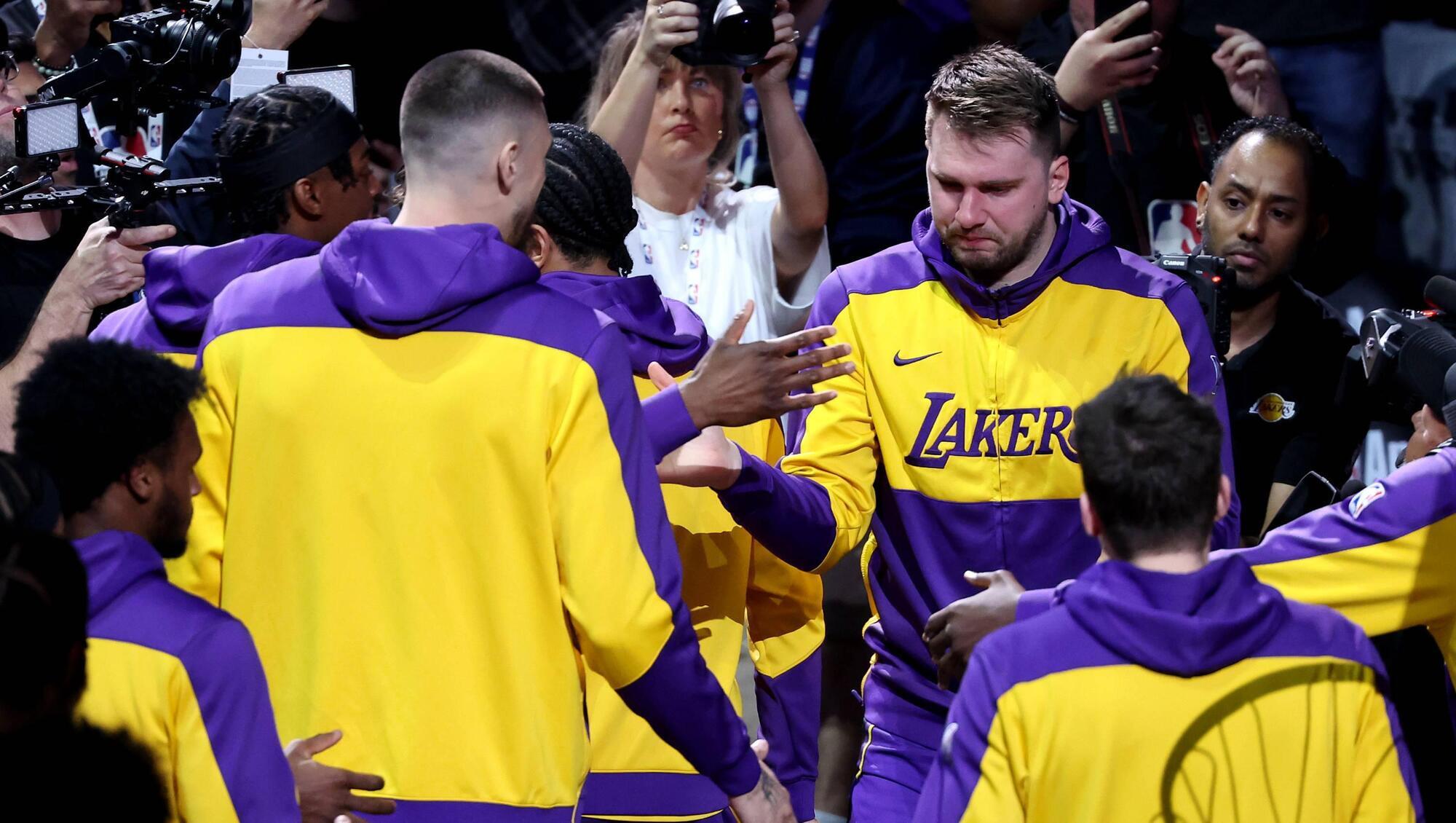
LA-LA LAND: Luka Doncic #77 of the Los Angeles Lakers is introduced before the game against the Dallas Mavericks at American Airlines Center. Pic: Sam Hodde/Getty Images
One of the most brutal lessons we must learn as fans is that the team we shed blood, sweat, and tears for is seen by those who own it as just one of many assets. That gap has never felt as wide as it does this week. On Wednesday, ESPN reported that the Los Angeles Lakers are set to change hands, again, for $12.5bn, a sum that would be a record for any American sports team (the deal must be approved by the NBA’s board of governors before it can go through). The buyers aren’t diehards who saved up every penny like the good Dr Jerry Buss in the 1970s. Those days are gone. If and when the deal is approved, the new owners will be venture capitalist Josh Kushner and his business partner, Bob Iger. Kushner is the younger brother of Jared Kushner, the titleless Wormtongue to Donald Trump’s Saruman. Iger used to run Disney. These men have connections across the political world and influence in every corner of the American empire. A franchise woven into a city’s identity should never become an asset vastly wealthy people move around like a chip around a poker table. But that is exactly what the Lakers are about to become. The way the deal came together should terrify anyone who still thinks sports belong to the fans.
Mark Walter took control of the team from the Buss family last October at a valuation of roughly $10bn. A mere 10 months later, he is set to cash out around $2bn richer. That’s not how this is supposed to work. The old guard, like Jerry Buss, used to guard their NBA teams like heirlooms and pass them down to their heirs. Walter is set to flip the team after less than a year.
He has other issues to deal with. Bloomberg reported in July that Manhattan prosecutors want to know whether two insurers that Walter controls, Delaware Life Insurance Co and Clear Spring Life and Annuity Co, concealed that their private-credit books were secretly propping up his other businesses. The SEC opened its own line of questioning, and the loans at issue reportedly run near $16bn (A spokesperson for Walter’s company, TWG Global, told the Wall Street Journal that “Mark Walter and TWG have always acted in good faith, and those who have done business with Mark know him as honest and straightforward”). Insurance made Walter rich long before basketball did, and TWG Global still owns slices of the Dodgers, the Sparks, Chelsea, the Professional Women’s Hockey League, and Cadillac’s Formula 1 team.
The Lakers’ buyers also know that sports can generate huge returns to add to their already vast wealth. Starting in 2009 at the age of 24, Kushner built Thrive Capital into a firm now worth more than $60bn. He shoved his way into Instagram’s 2012 round at a $500m valuation days before Facebook paid $1bn for it, then rode early bets on OpenAI, Stripe, Spotify, GitHub, and Skims. He owns a piece of the Miami Heat that league conflict rules will force him to shed before he can run the Lakers. And he founded Thrive Eternal to buy long-term positions in sports, media, and entertainment (its first big move was a stake in MLB’s San Francisco Giants).
Iger, the former Disney boss, took control of the NWSL’s Angel City FC in 2024 alongside his wife, Willow Bay, and he’s also a Thrive partner. Now, Kushner and Iger are set to add one of America’s most important cultural landmarks to their portfolio.
The timing of Kushner’s deal may not be random either. Fifa said in late July it would hive off its commercial arm into a new company, Fifa Forward Enterprises, and sell 20% to a Thrive Eternal-led group for $4.2bn. But Europe torched the plan. Uefa convened an emergency summit and threatened to have all 55 members boycott every Fifa competition until the deal died. Negotiations ended within a week. Then Jamie Raskin, the top Democrat on the House judiciary committee, proposed an inquiry into whether Fifa handing prized assets to a fund run by the president’s relative crossed an ethical line.
“Over the last few weeks, Fifa’s cozy relationship to Donald Trump has been floating to the top of the swamp of quid pro quo corruption in which the Trump Administration is swimming,” Raskin said in a statement to the Guardian. “But now we see where all the bribes, kickbacks and sweetheart deals have been leading.”
So Kushner pivoted to the NBA, where venture capital is more welcome. In fact, the other 29 owners have a direct financial stake in blessing the sale. The paper value of every team just surged with news that Kushner and Iger are willing to pay $12.5bn for an NBA franchise. Teams are no longer cherished possessions to grow and share with fans, they’re assets that can be snapped up by the ultra-wealthy – franchises are now too expensive for the merely very rich to buy – and sold on at a vast profit down the road.
But the proposed Lakers deal isn’t just about how wealth has changed sports. It’s also about how one family has moved into every part of American life. The Kushners keep ending up on the title of the most coveted assets on the planet, and the connective tissue is proximity to power. Trump campaigned on burning down exactly this kind of arrangement. Josh is the younger brother of Jared Kushner, Ivanka Trump’s husband, and a senior adviser during Donald Trump’s first term. Jared is now a Special Envoy for Peace and helped negotiate the recent ceasefire with Iran. Their father, Charles Kushner, pleaded guilty in 2005 to 18 counts – among them illegal campaign contributions, tax evasion, and witness tampering – and was sentenced to two years in prison. Trump pardoned him in 2020, and today he represents the United States as ambassador to France, a job he holds despite not speaking French.
Some seem to think Josh Kushner’s moves are more acceptable because he’s a registered Democrat who told Forbes in 2017 that liberal values shaped him. He didn’t vote for Trump, and after 2016, he reportedly went company by company through his portfolio, telling founders he couldn’t get them anything from the administration. His wife, Karlie Kloss, publicly split with her in-laws in 2021, writing that honoring a legitimate election is patriotic and inciting violence is not. All that may be true, but Josh Kushner’s views on climate change or gay marriage or foreign aid aren’t the point, it’s the concentration of power in the hands of a few that is the most troubling.
Politics, extreme wealth and sports are headed for a collision. Athletes and fans are the last line of defense against the owners. And they can fight back – look at how NFL players in 2020 forced league commissioner Roger Goodell into an apology over how he handled athlete protests; or how NBA players threatened to boycott the season the same year over the police shooting of Jacob Blake; or how the proposal for a European Super League in soccer was abandoned after backlash from fans in 2021. But those were actions against leagues and governing bodies. Whether athletes have the motivation to take on the billionaires who pay their wages is another question altogether.