World Cup decider outstrips All-Ireland final for TV viewers
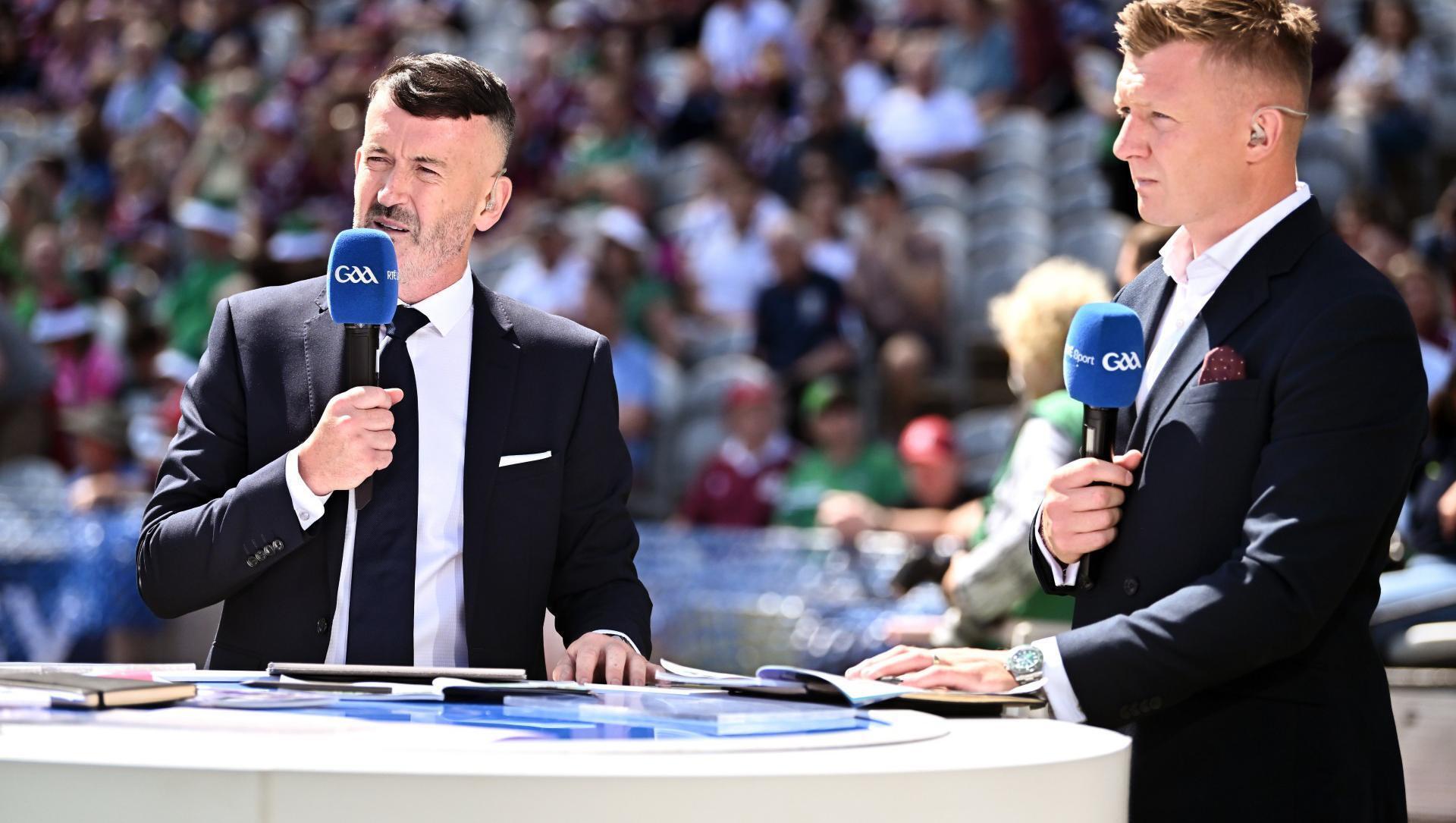
RTÉ Sport analysts Dónal Óg Cusack, left, and Joe Canning before the All-Ireland hurling final. Pic Piaras Ó Mídheach/Sportsfile
RTÉ's coverage of the World Cup final clocked up over one million television viewers on Sunday - nearly 250,000 more than the All-Ireland hurling final at Croke Park earlier the same day.
Montrose figures show the 8pm clash of Spain and Argentina registered an average viewership of 1.037m and a peak of 1.16m with a further 1.4m streaming views.
By comparison, the hurling decider between Limerick and Galway that afternoon reached an average viewership of 778,000, and a peak of 862,000. It reached around 350,000 stream views too.
The disparity between a national sporting showpiece and the climax to the global spectacular is explained, at least in part, by timing, a low key hurling championship and a higher than anticipated audience for the World Cup generally.
The semi final meeting of England and Argentina had a viewing on RTÉ 170,000 greater than the All-Ireland hurling final. GAA sources said Tuesday they were not hugely surprised at the numbers and conceded that the tv audience for the final was reflective of the game and the championship in a broader context.
The figures come amid a rank and file debate on the structure of the hurling championship. On Tuesday, Cork GAA chairman Pat Horgan proposed a radical new All-Ireland SHC format which will ensure that all Liam MacCarthy counties are still hurling in mid-June.
The lengthy spell of guaranteed warm weather also kept many GAA fans away from their armchairs on Sunday afternoon.
RTÉ confirmed that the 1m-plus viewers for the World Cup final was the second most popular tv programme of 2026 - and reckon it would have been around 250,000 greater had England overcome the Argentinians and faced Spain in the final.
RTE insiders say the one sided nature of the Limerick-Galway game had an obvious impact on the average viewership. The All-Ireland football final traditionally eclipses its hurling counterpart for audience share.
In Ireland, the World Cup final also generated over 1.4 million streams on RTÉ Player, making it the most-streamed single event in the platform's history. Across the tournament as a whole, audiences generated 23.4 million streams. This is an increase of almost 15 million streams and nearly three times the audience achieved during the 2022 FIFA World Cup, which recorded 8.5 million streams.
RTÉ's top-performing matches were Spain v Argentina (average audience of 1 million, 65% share on RTÉ2, and 1.4 million streams on RTÉ Player), England v Argentina (average audience 949k, 60% share on RTÉ2, and 1 million streams on RTÉ Player) and the France v Spain semi (average audience of 873k, 61% share on RTÉ2, and 1 million streams on RTÉ Player).
RTÉ had four commentators and analysts on location for the tournament, with Darragh Maoloney and Ray Houghton calling the final. The BBC’s main coverage of the final on Sunday, presented by Gabby Logan and featuring Alan Shearer, Micah Richards, Joe Hart and Wayne Rooney, peaked at 13.6 million viewers. Guy Mowbray took on commentary duties.
BBC was also celebrating its numbers on Tuesday as four times as many people turned to the BBC to watch Spain secure victory over a belligerent Argentina, very similar to its lead over ITV four years ago.
The BBC enjoyed an average audience of 9.7 million viewers, with ITV recording 2.4 million, according to the Digital i agency.
ITV’s coverage, presented by Mark Pougatch and including Gary Neville, Ian Wright and Roy Keane, peaked at 3.4 million viewers. Sam Matterface was its commentator, alongside expert summariser Lee Dixon.
It means ITV has not closed the gap with the BBC for the tournament’s conclusion. Four years ago in Qatar, the BBC had an overnight average audience of 9.2 million, with ITV recording 2.8 million, according to Digital i.
ITV has been praised by TV insiders for its shrewd move in bringing in pundits Neville and Keane, ensuring it would benefit from the viewers attracted by the pair’s hit podcast Stick to Football.
The BBC’s decision not to broadcast from the US is still a contentious one in the TV world, despite the popularity of its final coverage. “You have to show up for the World Cup,” said one senior figure in sports broadcasting. It will not be confronted with the same decision at Euro 2028 in two years’ time. The tournament is being hosted in the UK and Ireland.
All broadcasters have also been trying to adapt to the huge changes in consumption as audiences turn to phones and digital platforms for football content. On RTÉ Sport Online and on RTÉ Sport social channels, there were 91 million video views across all social platforms to date. This includes over 6.8 million views of highlights and analysis on the RTÉ Sport YouTube channel.
The BBC’s new football YouTube channel generated 100m views. Across social media, BBC clips, interviews and analysis attracted 2.55bn views.
Added Kevin Bakhurst, Director General, RTÉ: "We are delighted that RTÉ has been successful in securing rights to the 2030 World Cup for Irish audiences after what has been a very successful 2026 World Cup with record numbers of people enjoying (our) coverage."