Hakone Ekiden: The race that stops a nation
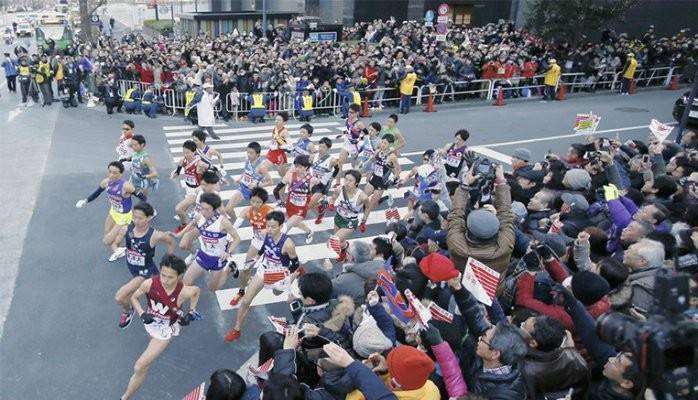
The Hakone Ekiden is an 11-hour, two-day relay race in Japan. Last week’s run was watched by approximately 64.7 million people.
Pop quiz: think of an annual sporting event that’s watched by half a nation’s population. Got any?
Before we go on, it’s worth noting that about one in three Americans watch the Superbowl, while between a fifth and a quarter of Irish people watch the All-Ireland finals. About one in eight Brits watch the FA Cup final; same for the Grand National.
In an age of instant gratification, where brevity is king, it may come as a surprise to learn of an event that fulfils the above criteria: the Hakone Ekiden, an 11-hour, two-day relay race in Japan.
This year’s event, on January 2-3, was watched by approximately 64.7 million people, according to Video Research Ltd, which means that at some point during the two-day broadcast, just over half the Japanese population tuned in.
What’s more, it’s not even a professional event, but a race gathering university teams from one region of Japan, Kanto, with 10 runners on each team logging roughly a half-marathon apiece.
Founded in 1920 by Japanese Olympian Shizo Kanakuri, the idea was to boost the nation’s half marathon standards at collegiate level to eventually elevate their performance in the Olympic marathon, but the event has long since taken on a life of its own.
“To compete in the Hakone is bigger than the Olympics for a (Japanese) runner,” says Adharanand Finn, a British author who spent six months in Japan in 2013 to write his superb book, .
“I had this idea the Japanese are really into marathon running but when you get in with the serious end, their whole year is built around Ekidens.”
It’s the race that stops the nation, by far the most watched sporting event each year, trailing behind only an annual New Year’s Eve concert in the overall TV ratings.
Crowds were limited at this year’s event for obvious reasons, but a typical year sees about a million fans lining the roads between Tokyo and Hakone, decked out in the colours of their favourite university team.
“I went to the start and finish and it was insane, people had camped out all morning,” says Finn. “There was no way I’d get to the front; it was seven or eight deep on each side. Everyone is reading the background stories, the histories, the timelines and that’s what gives sport its hook. There’s this soap opera connected to it.”
Brett Larner, an athlete representative and journalist who has lived in Japan for many years, says runners come back from the course with similar stories about the atmosphere.
“That it's like a blur,” he says. “They can't remember much due to the roar the entire way except for their ears hurting.”
The athletes themselves are typically 20 or 21, and possess a level of fame that would make an inter-county star seem anonymous. Finn got a taste of it when accompanying one such runner to a track race.
“It was like David Beckham,” he says. “It’s hard to get your head around; there’s young girls fainting at the sight of them and crying; it’s like pop stars.”
While Kenya and Ethiopia continue to dominate at global level, the emphasis on Ekidens in Japan has led to astonishing depth at half marathons: 78 Japanese men broke 62 minutes last year and 194 broke 63 minutes; the equivalent figures for Ireland are one and two.
The vast majority of them will not go on to run professionally, and many burn out their talent in a bid to make a mark in Ekidens.
This year’s race was won by Komazawa University, which bridged a one-kilometre deficit on the final leg to take victory. Whether anchor runner Takuma Ishikawa does anything as a professional is almost immaterial; among the millions of Japanese who tuned in, his feat will live forever.


CONNECT WITH US TODAY



Be the first to know the latest news and updates