Three men, two gloves and one powerful sporting moment
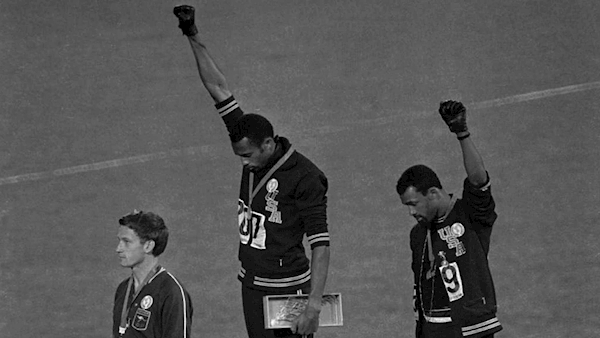
Fifty years ago today, on October 16, 1968, one of the most powerful political protests of modern times, and certainly the most famous using the vehicle of sport, took place at the Mexico City Olympics.

Three men, two gloves and one powerful sporting moment

Fifty years ago today, on October 16, 1968, one of the most powerful political protests of modern times, and certainly the most famous using the vehicle of sport, took place at the Mexico City Olympics.

It involved three men, though one of them is often ignored in the history books, and two black gloves, writes Kevin McCarthy

In the USA, 1968 was a year of particularly high tensions. The Vietnam War caused huge division and the country reeled from the assassinations of two of the great hopes for societal reform, Martin Luther King Jnr and Bobby Kennedy.

Among the African American population, the sense of despair in the aftermath of King’s assassination was palpable, accentuated by ongoing lack of power, opportunity and basic civil rights for black people.

Yet, there was also the irony that many of America’s top athletes, boxers, and baseball, basketball and football players were black; in many respects, the greatest potential influence that black people could have in the US in 1968 was through sport.

Early in 1968, John Carlos, Tommie Smith and a host of other black US athletes joined the Olympic Project for Human Rights, under the leadership of professor Harry Edwards. They demanded a number of sporting reforms, including the restoration of Muhammad Ali’s world heavyweight title, stripped from him for his refusal to go to Vietnam.

Many in the Project advocated a boycott of the upcoming Mexico City Olympics — among those who refused to join the US team in 1968 was the basketballer who would eventually be known as Kareem Abdul Jabbar, all-time great of the LA Lakers.

For athletes, such as Smith, Carlos, Lee Evans, the decision was different. They decided they would compete in Mexico, but would use the occasion to publicise the cause of black people. According to Smith, “very few people had the avenue to tell people how it really was or how we felt about a certain issue. You had to have a platform
 Because we were black athletes, what we were supposed to do was run fast, smile, and return home to be second-class citizens.”

John Carlos agreed: “It was the greatest platform in the world to expose the troubles and the ills of society to the world.

The outcome of the men’s 200 metres, in light of subsequent events, became virtually irrelevant. Smith won in a world record time of 19.7 seconds, with Carlos beaten into third place, somewhat surprisingly, by a young Australian named Peter Norman. The sprints, and the jumping events saw incredible performances in the rarefied air of Mexico City, particularly Bob Beamon’s 8.9m in the long jump, which has yet to be broken as an Olympic record.

The 200m victory ceremony was the opportunity that Smith and Carlos had been anticipating for their protest. What they had not anticipated was being split by the Australian Peter Norman, who had snatched the silver from Carlos on the line. Perhaps it was as great a surprise to the two Americans to discover, as they prepared for the ceremony, that Norman had huge empathy for their position.

He said: “I’ll stand with you” and he happily donned the badge of the Olympic Project for Human Rights that the other two wore. He even calmed the two Americans’ nerves when they realised that they had only one pair of black gloves between them.

It was Norman who suggested that they just wear one glove each; Smith wore the right glove and Carlos the left. So, it was that three men with two gloves and one intention emerged into the Mexican night for the victory ceremony.

The black-gloved fists that Smith and Carlos raised as the national anthem began were essentially symbols of the Black Power movement, emphasising pride in being black and the demand for equality and economic and political empowerment. The symbolism of the anthem protest went much further than that. Smith wore a black scarf around his neck, while Carlos wore beads. Both claimed these were reminders of the lynchings that many blacks had suffered.

Carlos explained afterwards that he had also decided to leave his tracksuit top unzipped — breaking Olympic protocol — to represent the attire of working class blacks more closely.

Both went to the podium in stockinged feet, to symbolise the poverty in which most of the black population lived in the USA and around the world. Afterwards, Carlos has an interesting explanation for what he did with his Puma runner. While Smith left his single runner behind him on the 1st place platform, Carlos put his in front, facing the cameras. Years later, he said he did so because Puma had always been very good to poor black kids, giving out free gear throughout the Harlem neighbourhoods where he had grown up.

As Norman stood to attention in front of the two Americans, perhaps the most powerful aspects of the demonstration were the bowed heads of Smith and Carlos. Other black athletes attempted similar protests, wearing black berets or chatting irreverently while the anthem played. The bowed heads, representing those who have suffered but endured, had far greater visual impact.

There are some popular misconceptions about what happened to Carlos and Smith after the protest. The American Olympic Committee did not, in fact, decide initially to send them home. That decision came following pressure from the International Olympic Committee, headed by the ageing and (among black Americans) despised Avery Brundage. The two were never stripped of their medals, but would spend years in the sporting wilderness and never ran for a US team again. Their actions split black America too, as key sporting figures from George Foreman to Jesse Owens publicly opposed their protest.

Both men found it very difficult to get regular employment and both suffered marriage breakdowns under the strains which ensued, with Carlos’s first wife committing suicide. Smith played professional American football for a time before becoming a college track coach, while Carlos became a Puma brand ambassador at the Munich Games in 1972. Carlos, in particular, remains active in the campaign for human rights in the US.

In Australia, Norman also experienced a huge amount of official odium for his endorsement of the protest.

It is untrue, though often suggested, that he was never selected for an Australian team again; he was, but was not selected for the Olympics again. There are varying reports of his non-invitation to ceremonies at the 2000 Sydney Olympics too, though he carried the torch briefly in his home city of Melbourne and was honoured by American athletes, such as Michael Johnson in Sydney. It was not until after his death from a heart attack in 2006 that he really received approval, including an Order of Merit and, in 2012, an apology from the Australian Parliament for its own “failure to fully recognise his inspirational role before his untimely death”.

Norman’s Mexico time of 20.06 seconds is still the Australian record time for 200m.

He never regretted supporting Smith and Carlos on the podium. He commented later in life: “If it hadn’t been for that demonstration on that day, it would have just been another silver medal that Australia picked up along the line. No-one would ever have heard of Peter Norman.”

The three Mexico City protesters were reunited at San Jose University, the alma mater of Carlos and Smith, in October 2005. There they saw a giant statue unveiled to commemorate their protest.

Norman’s place on the statue’s podium is empty, and there is a plaque in the empty spot inviting people to ‘Take a Stand’. Norman requested that his space be left empty so visitors could stand in his place and feel what he felt.

Today, people come and stand, as he had done, beside Smith and Carlos, and have their pictures taken.

When Norman died suddenly in Melbourne a year later, Smith and Carlos travelled to his funeral, both spoke at the ceremony and both acted as pallbearers to his coffin.

Carlos said on that occasion: “He was a lone soldier in Australia. Many people in Australia didn’t particularly understand. Why would that young white fella go over and stand with those black individuals? Peter never flinched, he never turned his eye or his head. When I looked into his eyes, I saw nothing but love.”

Some sporting moments transcend the realm of sport itself, and take on a significance in terms of the human spirit that no mere sporting victory ever could. October 16, 1968, in Mexico City saw such a moment.

More in this section

Cookie Policy Privacy Policy Brand Safety FAQ Help Contact Us Terms and Conditions

© Examiner Echo Group Limited