Sinead Kane: ‘With my disability, there is no finish line’
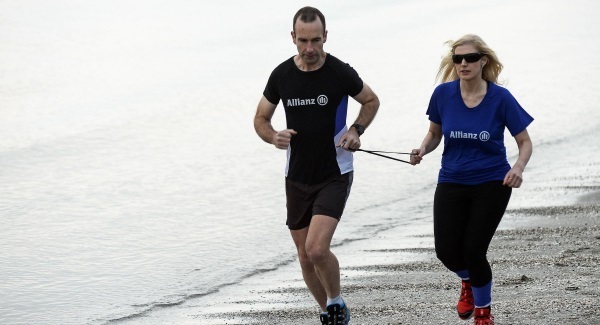
The marathon, which Sinead Kane is running in aid of Cliona’s Foundation, will be her eighth of 2017 and that’s not including the 172km she covered during a 24 hour race on an indoor track in Finland, writes Eoghan Cormican.

Sinead Kane: ‘With my disability, there is no finish line’

Sinead Kane missed her bus from Cork to Limerick on Friday of last week. She arrived at the station in plenty of time but positioned herself in the wrong queue and by the time she realised her mistake, the bus was gone.

It wasn’t the first time this had happened and probably won’t be the last. The Cork woman, though, had no frustration to vent. She’s long accepted the visual impairment which can, and does, make everyday life a challenge.

At the age of four, Kane was in the sitting room at home in Youghal watching television with her sister. Well, trying to watch television. She couldn’t make out what was on the box so moved closer and closer until her nose touched the screen. The friction lent itself to a static shock. The four-year-old fell backwards and began to cry. It was then her parents broke the news to her that she’d been born with Aniridia and consequently, had only 5% vision.

Kane will return to the bus station this weekend, again bound for Limerick. Come Sunday morning, she’ll be on the start line in People’s Park for the Great Limerick Run. The marathon, which she’s running in aid of Cliona’s Foundation, will be her eighth of 2017 and that’s not including the 172km she covered during a 24-hour race on an indoor track in Finland.

Her participation in Finland came three weeks after a seven-day stroll of the globe where the 34-year old became the first visually impaired athlete to complete the World Marathon Challenge. Her Twitter handle, @blindrunner777, neatly sums up what the challenge entailed. Seven marathons in seven continents over seven days.

This history-making feat has made Sinead Kane a household name in running circles. Where once she had to place an advert for a guide runner in the Evening Echo so she could participate in the Dublin marathon, she now has people knocking down her door. Each wants to hold her hand as she takes the next step of her journey.

“Before, when I was unknown, they didn’t want to know me or help me. People used to look at me in terms of what I couldn’t do. Now, they are asking what are you doing next,” says Kane, a qualified solicitor and certified mediator.

After Limerick, she’s not sure where her next challenge lies. Wherever it takes her, she’ll enjoy it. The pleasure she derives from running stems largely from the fact that there is a start line and a finish line. There can be no surprises in between.

“A lot of people have said to me that the World Marathon Challenge must have been extremely difficult. Some of the time, I feel I nearly need to make up a story about how difficult it was. For me, it wasn’t as difficult as I imagined. The reason I say that is because my biggest difficulty in life is my disability and getting through simple day-to-day activities that people take for granted.

“With the World Marathon Challenge, and with every race I do, there was a finish line. With my disability, there is no finish line.” She continues: “If I want to know if it is raining when I get up in the morning, I actually have to go outside, rather than simply looking out the window. When you’re making your first cup of tea to get you going for the day, you have to make sure you don’t pour boiling water over your hand rather than into the cup. These are the daily challenges I face. And therefore, I don’t see running as a challenge.

“I couldn’t choose how I was born. Every day, you are walking along the street and there are people with full sight so engrossed in their phones that they end up walking into me. They get annoyed at me and they are huffing and puffing. Yet, they are the ones with full sight and yet they are choosing not to look where they are going.”

It was because of her visual impairment that Kane wasn’t ushered into the world of sport as a child. She wasn’t physically active and neither was she expected to be. She was the sole student with a disability at a primary school of around 450. She was bullied, put down. Sidelined, in every sense.

After declaring to one secondary school teacher her intention to study law at third-level, she was told she wouldn’t be able.

“You’d have people asking you what course are you doing? They’d expect you to be doing a PLC course, underestimating your ability. The minute you tell them you are a full-time PhD researcher and a qualified solicitor, they’ll talk completely different to you. They get embarrassed.”

When asked by Child Vision, the National Education Centre for blind and visually impaired children, to run a 10km in April of 2012, she was determined to prove she was up to the task.

And despite never having previously been involved in as much as a park run, her goal was to complete the event in under an hour. She made it home in 55 minutes.

The following year, however, was a write-off. No guide runner meant no running.

I

n 2014, the target was to complete the Dublin marathon during the October Bank Holiday weekend.

“I put out an ad in the Evening Echo saying I needed a guide runner. I went on 96FM too. Now, do you think out of all the running clubs in Cork city and county, that one runner came forward? Nobody came forward. That will show you how much local people in Cork supported me. I am a very proud Cork girl but I was very disappointed with Cork people in 2014. I was a blind girl doing it for Childline and yet no fully sighted person in a Cork running club would be my guide runner.”

She turned to social media and penned the following the tweet; ‘No guide runner, no marathon for blind girl’.

It drew the necessary reaction. Having been out of long-distance training for so long, though, saw Kane fall foul of injury when she cranked up the miles that August. It was then she turned to decorated ultra-distance runner John O’Regan, who had previously soldiered alongside blind and paralysed adventurer Mark Pollock.

She sought advice regarding her “banjaxed” knee. O’Regan’s advice was to skip the marathon. Kane, to no great surprise, wasn’t having any of it. At the end of their first meeting, he asked her if she had any remaining questions.

“Will the race be cancelled if it is raining?” she replied. O’Regan was flummoxed.

“That’s how naïve I was at the time with regard to running,” she chuckles.

Dublin was conquered and the following February, John and herself completed the Donadea 50km in Kildare. There followed a 24-hour race in Brazil where she was the 23rd female home out of a field of 1,413. There was a 12-hour race in Belfast where she was the second female home, covering 109km. She returned to that track a year later and was again second, this time covering 112km.

Allianz supplied the €36,000 for entry into the World Marathon Challenge, with race organiser Richard Donovan giving O’Regan a free seat on the charter.

They began in Union Glacier in Antarctica, which she completed in five and a half hours, and went from there to Punta Arenas in Chile, followed by Miami, Madrid, Marrakech, Dubai and concluding in Sydney.

“Antarctica was difficult, not least because the weather was so bad towards the finish of the race that John could hardly see where he was going. There was snow blowing everywhere and because there was so much light, my eyes became really sore. If it had been like that from the start of the race, I wouldn’t have got through it.

“What was also difficult and upset me was that I couldn’t see the beautiful mountains. My guide runner was trying to describe their beauty. He was trying to give accurate descriptions. He took photos of the mountains and I was zooming in on the photos to try and see them. I’ll never be in Antartica again and you’d like to see it. That reminds you that you have a disability. That’s when it hits you.”

There was another unfortunate reminder in Dubai.

“We were running along a boardwalk beside a beach and because the weather was perfect, I was able to shine. Of the women competing, I was in joint-first with another girl. Towards the end of the race, people started clapping for the other girl. That upset me. I said it to them. They said they weren’t clapping for me as they didn’t think I was in joint first position. ‘We thought you were a couple of laps behind,’ they told me.

“It was a character-building experience. My definition of tiredness has certainly changed. You learn a lot about yourself when you are doing it. I feel I am constantly learning.”

More in this section

Cookie Policy Privacy Policy Brand Safety FAQ Help Contact Us Terms and Conditions

© Examiner Echo Group Limited