Five questions on Giro d’Italia you’re too afraid to ask…
The Giro d’Italia is one of cycling’s three Grand Tours and was first run in 1909. A Grand Tour is a three week race. This is only the 97th edition of the event as it was stopped during the War years.
This year’s Giro will see 22 teams of nine riders battle it out over 21 days (or stages) and there’ll be three rest days after days three, nine and 15. The sport’s other two Grand Tours take place in France (Tour de France) and Spain (Vuelta A Espana). The Giro is the first of the Grand Tours to be held in a season. Total distance this year is 3,449 kilometres.
A combination of luck and chance played their part in what is a masterpiece of quirky innovation by the race’s route designers. Darach McQuaid of Dublin-based marketing company Shadetree Sports is one man we can thank, however.
The brother of former UCI President Pat has been lobbying for it since 2009 when he approached the race organisers, RCS Sport. Then, a new Irish Government was elected in 2010 and they were open to the idea and when the Northern Ireland authorities were keen on it too, it started to snowball. It has also started in Denmark and the Netherlands.
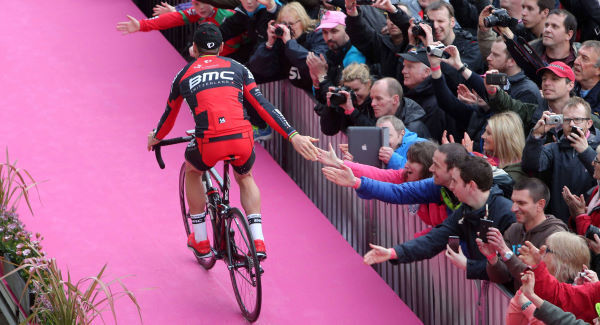
The Pink Leaders jersey, or Maglia Rosa, singles out the overall leader of the Giro d’ Italia from his other competitors. Although coloured jerseys are
commonplace in professional cycling, many take on the colour of yellow, made famous by the Tour de France. The Giro selected pink because the race’s sponsor, the Gazzetta was printed on pink newspaper.
Three Irish in the 200+ peloton, overall contender Dan Martin leading his Garmin Sharp team, his cousin Nicolas Roche the Tinkoff-Saxo unit while Philip Deignan will be amongst the nine-man Team Sky unit.
The peloton is the ‘bunch’, the ‘field’ or the ‘pack’ of cyclists that consists of the main group of riders in a race. The word is drawn from French literal translation ‘pack’ or ‘platoon’. Riders stay closely packed together to take shelter from the win and conserve as much energy as possible. It is estimated that riding directly in someone’s slipstream can save as much as 30% of one’s energy.
A break can be any number of riders – though smaller than the peloton - that forges clear of the main pack. A break of just one rider will find it extremely hard to stay away to the finish line alone. A break of two riders, where they will both take turns setting the pace at the front has a much better chance, while four riders have an even better chance again, assuming they all share the ‘workload’.