Putting sport first
Smiling and sharing a joke together were each of chief executives of the three biggest sporting organisations in the land — the FAI’s John Delaney, the GAA’s Paraic Duffy and the IRFU’s Philip Browne — as well as the Special Olympics’ Fergus Murphy.
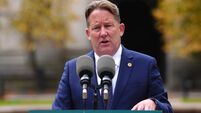
On the other side of the table, as a reminder that he’s not just the Minister for Transport and Tourism but also Sport, was Leo Varadkar, as well as junior minister Michael Ring and a couple of departmental advisors.
Amidst all the power and suits was a petite thirtysomething woman who probably was the most active in bringing all of them into the one room.
For nearly five years now Sarah O’Connor has been the executive director of the Federation of Irish Sports, a group founded in 2002 which now acts as an independent and unified voice for over 70 of the country’s national governing bodies, from basketball to baton twirling. While it’s the function of the Sports Council to allocate and supervise funding, it’s the federation’s job to lobby and campaign for that funding.
O’Connor’s appointment in 2007 as a full-time administrator was pivotal in the evolution of the fledgling organisation but she would point to another development that year that was even more monumental in its growth. Within weeks of her appointment, John Hayes had famously welled up during the national anthem, Shane Horgan had planted the ball over the English tryline and Stephen Ireland had put the ball in the Welsh net.
“It’s just a personal view but I think the sharing of Croke Park was huge for the overall wellbeing of Irish sport because it brought the big three [sports] together, and with it, all of Irish sport,” she says.
“Up to then, Irish sport was pretty fragmented. There would have been a perception among all the other sports that if the big three wanted to talk to the minister, they could just lift the phone and they’d be in immediately, whereas that wasn’t going to work for them. And certainly in the past, it was a case of the GAA did their thing, the IRFU did their thing, the FAI did their thing, and then there was everybody else. And I don’t think that helped sport as a whole or how we as a society looked at sport. There was no real cohesive policy towards sport because sport didn’t have one itself.
“But when Croke Park was opened up, the big three sports actually realised they had a lot more in common with each other than they had differences, while it also helped cement relationships on a personal level. The people within those organisations got to know each other in a way that would never have happened before.”
They definitely wouldn’t have been as convivial or as united as they were in Leinster House last Thursday. Traditionally the GAA would have been its own large republic, only concerned with its own sports; in many ways it saw itself as Irish sport. Not anymore. Duffy views Delaney and Browne as colleagues rather than just rivals, which was why he was so insistent they, along with Swim Ireland’s Sarah Keane, were all there to represent and support O’Connor and the federation.
“The way Paraic [Duffy] explained it to me,” says O’Connor, “was that he felt as the director general of probably the biggest sports body in the country, he and the GAA had a responsibility last Thursday to all the other sports to make the case for sport as a whole.”
What O’Connor and Duffy and the other four federation members were attempting to do last Thursday was impress upon Ministers Varadkar and Ring a different way of looking at sport than their predecessors.
For all the strides sport has made since Bernard Allen first pushed for the founding of the Sports Council in the mid-90s to the Government investing €141m in sport in 2008, Varadkar’s predecessors still tended to hold a narrow view of sport.
There was almost a Bertie-like mindset. Sport was Man U in Old Trafford on Saturday, Parnell Park on Sunday and the first place you’d look for in the papers on Monday, but at the end of the day, only circuses and bread really. It was frivolous fun, a diversion essentially, not something to take that seriously. Fianna Fáil-led governments throughout the Tiger years continuously poured more money into greyhound and horse racing than the rest of sport combined on the premise the dogs and horses were an industry that employed more than 18,000 Irish people.
Last Thursday, O’Connor and the federation outlined to Varadkar and Ring that the sport and leisure industry employs more than 38,000 people, underlying again the folly of excluding it at the recent global economic summit in Dublin Castle.
“When we first looked at the amount of money that the Sports Council was been handed to allocate to sport in comparison to what the Government was investing into the horse and greyhound racing industry, Government ministers and advisors would tell me, ‘Well, Sarah, horse and greyhounds is an industry; sport is sport’. They wouldn’t really have looked at the wider impact of sport, that it is an industry. What we’re trying to achieve and what Ministers Varadkar and Ring seem to be open to is to look at sport in a wider context.”
For one, it’s a sector which Government would get a return from its investment. A study showed that for every €100 the government puts into sport, it gets €149 back. Even when the Government forked out €191m in redeveloping the old Lansdowne Road it got €140m right back between VAT, PRSI and PAYE and the like.
“That’s not a bad investment for €50m,” says O’Connor, “especially when you think this year’s Ireland-England Six Nations game generated €51m for the Dublin economy.”
The other thing about sport is how it complements so well Varadkar’s other brief, tourism. The federation estimates that sport brings in €800m annually in tourism revenue, with golf alone generating over €110m. Last Thursday the federation touted the establishment of a joint venture body similar to Sports Event Denmark in which the Government and the country’s sports bodies target attracting more sporting events into the country. It doesn’t necessarily have to always be looking for something on the scale of the Ryder Cup or Rugby World Cup either, but smaller events like the world team racing sailing championships that enlivened and enriched morally and financially the small west Cork village of Schull last August.
Then there’s the public health function sport provides. In this country it’s estimated we spend about €400m on dealing with obesity. About 11% in total of our health budget is taken up with people not being physically active enough. Giving a little more to sport would save a lot. There’s also the lift it gives us, the hope and focus it offers, from seeing Robbie Keane smashing another one into the net to the eight-year-old trying to do the same in your local field. In all there are more than 270,000 adults who voluntarily help out in sporting clubs across the country. They can’t be taken for granted, says O’Connor, just as sport itself can’t.
“Sport isn’t just something that just happens. In the 60s we always thought the environment would be pristine, we took it for granted it would just be fine. Now we realise that sport is something that also needs to be looked after and invested in.”
O’Connor knows her own interest and vocation in sport didn’t just happen. It was something an older, visionary generation of elders invested in. As a kid she was a student at Mount Anville secondary school in Dublin where they had just built a new sports building that “looked a bit like spaceship that just landed”. That allowed her and classmates to play and try a plethora of sports: netball, gymnastics, badminton, tennis, squash, cricket, hockey, swimming, golf, sailing; you name it.
O’Connor took so much from that experience. There was some sport for everyone. Sport was for everyone. In every year the school had five or more hockey teams and five or more netball teams, yet if those sports weren’t for you, there was at least another 10 sports to choose from. O’Connor herself was the last player on the school’s tennis team and was a fringe player on the hockey team in her first two years at Trinity College but to this day raves about the friends she made rather than their unbeaten record in her time there.
It was through sport she met her husband, playing tag rugby. So when the opportunity came to work in sport, she gave up her job as a solicitor with Arthur Cox to become the federation’s first full-time executive director.
If it was sport that attracted her to the job, it was her legal background as much as her personable manner that attracted the federation to her. The federation oversees Just Sports Ireland, an arbitration and mediation service designed to keep sporting disputes out of the courts, along the lines of the GAA’s Dispute Resolution Authority. It is still not as widely utilised as it could be, with the service only being taken up 20 times in the last two years, but O’Connor is seeing at first-hand just how useful and efficient it can be.
Only last Friday week. the federation’s offices out in Park West on the southside of Dublin hosted a mediation. It involved a sports club in which there had already been a claim initiated at the equality tribunal and a complaint had been submitted to the Law Society. There were three rooms used in resolving the dispute, one for each of the warring parties, and a third in which they could all come together with the mediator. The day began with O’Connor dropping in some tea and some newspapers to each of the warring parties and the mood in both rooms was generally hostile.
“I remember thinking that the mediator really had his work cut out here,” says O’Connor, “yet by 5.30 that evening he had a written agreement signed by the two parties. The most expensive case we’ve had so far cost €3,500. So we have proof of concept that the system does work and reduce costs hugely. The challenge now is to build on that and raise awareness.”
Broadening the Government’s awareness of sport though is probably the biggest challenge. The federation appreciate that money is tight, that funding will be reduced, probably by 6% every year until 2015. The key now is that whatever money the Government does offer up is used in the best way. In the past, money was flung into building sports halls for a few votes more, rather than as part of some strategic vision. Now there’s an appreciation that money needs to be invested into programmes and people, not just pitches and pavilions.
Rewarding philanthropy would go along way too. Last Thursday, Ministers Varadkar and Ring were surprised to learn that whereas you can get a tax break for helping pay a theatre group go around the country, or in the UK, a benefactor can get a tax break for donating money towards helping inner-city kids get swimming lessons, donations to amateur sport in this country are offered no such incentives.
Similarly O’Connor and the federation brought it to the Government’s attention how current policy is seriously hampering the number of teachers willing to take sports teams as it doesn’t count as going towards fulfilling the extra-curricular hours they’re obliged to put in.
Largely though the job is about helping sport to help itself. A good chunk of O’Connor’s day can be spent advising and informing national governing bodies of good and best practice. There are plenty of examples around.
In 2007, Cricket Ireland realised it had to become a lot leaner and smarter to capitalise on the groundbreaking success of that year’s World Cup win over Pakistan. So, it reduced its board size to 11 members, co-opting leading practitioners in law, marketing and communications as well as a member of the sitting International Cricket Council, which came in particularly handy after Ireland was initially going to be frozen out of the 2015 World Cup. This year Cricket Ireland established a branch in Connacht for the first time. More than 15,000 people are playing the sport nationwide. They want to make that 25,000 by the time the next World Cup rolls around.
A range of other sports are going in the right direction. Swim Ireland, it goes without saying, was in a dark place 10 years ago. Now its child protection programme is, in O’Connor’s estimation, “the best in the class” and it is helping other sports in that area. This year the GAA could show it has 378,000 registered members. It runs over 130,000 fixtures for its male members every year. It’s a model how a professional approach matched with the zeal of the volunteer can work, but then the passion and the commitment of the sports volunteer in general continuously amazes her.
A while back, she sat in at a midweek meeting of the Irish Tug-of-War Association.
“It was in Tullamore. One officer had come all the way from Donegal, another had driven up from west Cork, another from Connemara.
“It would have been 11.30pm that night before the meeting would have wrapped up, four in the morning before some of them would have arrived back home, all with work to get up for a few hours later.”
Sport is more than a pay cheque to her too. She still plays hockey for Old Alex out in Milltown, while this summer she ran the Dublin city marathon, though she’ll self-deprecatingly joke whether she actually ran it; it took her just under five hours to complete the course.
“It was just an incredible experience,” she says, “to see the number of people who came out urging you on. It showed what sport can do for the community.”
She’ll continue to highlight it too. As the federation’s motto goes, Sport Matters, and for highlighting that, O’Connor’s job does too.