Tommy Martin: Despite a polarising week, Irish soccer uniquely remains the team of us
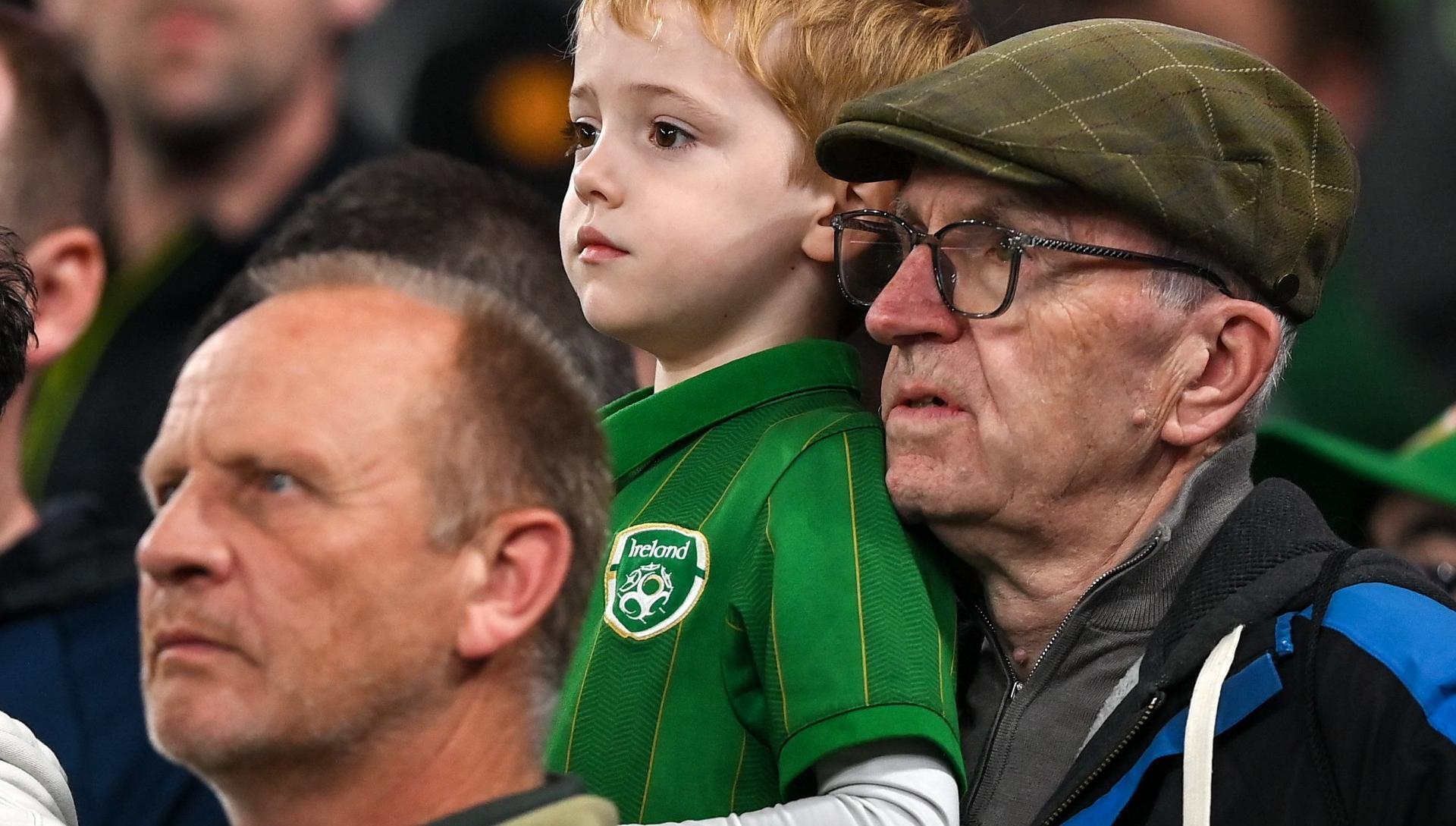
WHOSE TEAM IS IT ANYWAY? Republic of Ireland supporters during the UEFA Nations League B match between the Republic of Ireland and Austria at the Aviva Stadium in Dublin. Photo by Stephen McCarthy/Sportsfile
If a week is a long time in politics, then it’s a very long time in long-ass, politically charged Nations League windows.
The last seven days in the life of the Republic of Ireland football team seem scarcely believable as a narrative, as if a skilled event planner had put together a bespoke itinerary of chaos for some bored, super-rich client who takes a sadistic pleasure in watching European soccer nations torture themselves.
The post-Pristina gloom; the player meetings; Gavin Bazunu’s change of heart; more player meetings; votes and representations from various sides of the issue; the frenzied speculation from the embedded press pack; a tense press conference with the manager and various FAI heads.
Who spoke to the goalkeepers?
The Israelis pressing Heimir Hallgrimsson about playing Nazi Germany in the 1930s; telly talk of Bazunu’s ostracisation; the bowed heads for the Israeli anthem; alleged racist chants; Ireland, improbably, smashing Israel; an emboldened FAI president breaking his silence to attack the media; an Oireachtas hearing in the middle of it all.
Wait, did anyone speak to the goalkeepers?
A show of unity against Austria at home; Troy Parrott with a goal for the ages; some protests, some tennis balls and a pitch invader, but that’s it; a late Austrian rally and the sense of weary stagger towards another meeting with Israel.
If you can make sense of all that then you are a better person than me. There’s already a book in there, and it’s not even over yet. At this point – and, I stress, it’s not over yet – the prospect of a Saipan-level outbreak of national garment-rending seems to have subsided.
The second game against Israel is expected to go ahead and the FAI will take that as a win, even if last Saturday’s carry-on should temper any plans for an open-top bus parade.
Read More
Those who wanted Ireland to boycott the games have lost, but they may take the febrile hours in Debrecen when the team teetered on the brink as an achievement of sorts: a campaign that shouted loud enough about a humanitarian cause to penetrate the bubble of professional football. Those who think all that is mere lefty virtue signalling are currently triumphant, seeing in the generous support for the team at the Aviva on Thursday night a rejection of the idea of bringing namby-pamby, woke causes anywhere near sport.
What it all means for the stricken of Gaza, we’ll leave for the adjudication panel. Israeli conduct in the region has received plenty of coverage this week, but at the time of writing in this country at least, the pitchfork-wielding mob seem more interested in the tackling the scourge of self-righteous sports journalists.
While most of the immediate focus throughout this saga has been on the issue of whether the games would be played, an underlying question has been lurking. To some extent, all the parties involved were laying claim to the soul of the Republic of Ireland football team and all its works and pomps. This is no surprise. Last November reminded us that the team unites the country like nothing else. But Troy Parrott is something we can all get behind. Israel and Palestine, not so straightforward.
So, whose team is it anyway?
For the association whose role it is to run soccer in this country and field the team in competitions clad in appropriate apparel and with all the correct forms filled in, the Boys in Green are their bailiwick. Lock, stock and barrel. Where, when and whom they play is a matter of football administration, to be arranged with their betters in UEFA and FIFA. Supporters part with their cash but that only earns them the right to sing. The team operates in the interests of Irish football, and the FAI decides what those interests are. L'État, c'est moi.
Then there is the team itself, an identity distinct and often at odds with the association that runs it, even if things are a little more professional compared to the days of George the Greek, blazers in first class and lurid goings on during frequent Polish away trips. It’s all governance and five-year plans now, but last weekend was a reminder of how the needs of the team and its overseers can sometimes butt heads.
Some say sports teams function best in hermetically sealed environments, which allow a clear sense of internal unity and external threat to develop, plus it means you don’t have to follow the news. We might see the team as a symbolic source of occasional national pride and more regular national gloom, but for themselves it’s the lads, the gaffer and his band of cone-wielding consiglieres. On weeks like this, when the signal from outside penetrates the glass dome, it can be confusing. Why are all these people shouting at me? Whose team is it anyway?
And then there is the general mass outside of all that, ever increasing concentric circles starting with the die-hard away fans, working out through the Aviva-going home support, through the general, more-of-a-rugby/GAA-man-myself populace and, after that, the type of people who have no interest whatsoever in the team but are perfectly happy to have their say whenever success or scandal force it onto the wider news agenda.
It is on this perilous battlefield that the Israel Nations League debate has been fought. Most public debates feature small, strongly invested cohorts on either side and an amorphous, floating blob in the middle. These people are mostly decent and fair but and can be swayed towards any cause as long as it is not going to cost them in the pocket.
This one was no different. When the draw was made and the lines were drawn, most people were horrified about what Israel was doing in Gaza, heard the UN report describing it as genocide, took heed of the strong words from our government, campaigners and media commentators and felt generally supportive if things went the way of a boycott.
That position was fairly solid through the months that followed, even as the FAI made the case for the financial damage a boycott would cause (the amorphous blob being typically FAI-resistant). As the first game approached, a general sense of queasiness pervaded at the prospect of lining out against the Israelis, accompanied with discomfort that the ultimate decision was clearly going to fall on the players.
When word of a possible player revolt broke, people thought, jaysus, fair play lads. Then, when it went the other way, there was a period of gnashing of teeth and fear and loathing, a sense that maybe the whole thing was falling apart. Then people saw how the players carried themselves in the match and how they played and they thought, jaysus, fair play lads.
And then they saw how some of the more invested on one side started going in too heavy on the players, accusing them of betrayal and all, and they thought, ah here, enough of that. So, the blob drifted back to the middle where it felt comfortable, supporting the team and generally not going too far in either direction on anything.
At one point in the last week, it looked as if the question about whose team it was would be moot, that the Republic of Ireland team would be just another victim of the fractures and polarisations of our time. We’re all part of Jackie’s Army, we could once justifiably sing, but how could we say we are all part of anything now?
There will be those disappointed that an opportunity to make a real stand on Israel was lost and those dismayed at the conscientious actions of the players who did play and the one that didn’t. But at the end of the long week – not over yet – the Republic of Ireland team remains, incredibly, a uniquely unifying force, which, given the times we live in, is a win in itself.