Paul Rouse: The MacColl songbook stayed in tune with Irish sport
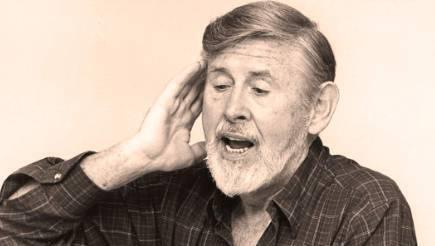
Ewan McColl.

Ewan MacColl’s most famous contribution to the GAA is that he wrote the song ‘Dirty Old Town’. There will be few Monday clubs where this great song is not murdered this autumn.
MacColl actually made another contribution to the music of the GAA – although it has been almost entirely forgotten – more of which later on.
MacColl (his stage name) was born James Henry Miller in the middle of World War One in a Scottish enclave in Salford, beside Manchester in the north of England.
Both his parents were Scottish, his father a leftist trade unionist and his mother a ballad singer.
He left school when he was barely a teenager and educated himself in the Manchester Public Library. He began singing on the streets of Manchester, started to act and wrote for a Communist newspaper in the 1930s. It says much the M15 kept a file on him, regarding him as a dangerous extremist.
He was one of the best protest singers in the English folk scene in the 1950s and 1960s.
Some of those songs haven’t aged well. The ballads in honour of Joseph Stalin and Ho-Chi Minh are not good.
But there are more than 300 songs that represent a serious body of work. Songs of his were recorded by some of the most celebrated artists of the twentieth century, including Elvis Presley, Paul Simon & Art Garfunkel, and Roberta Flack.
MacColl’s folk songs brought him into partnership with many of the best Irish folk artists of the 1960s and 1970s.
These included The Dubliners, the Clancy Brothers and Dominic Behan.
The songs that Ewan MacColl recorded about Irish sport were ones he either wrote himself or recorded with two other English folk singers, A.L. Lloyd and Roy Harris. They included songs on the Galway races and Irish boxers as well as songs about cockfighting and card-sharps and playing pool.
Basically, these are songs that celebrate the lives of ordinary people from these islands who loved sport and especially sport with a bit of subversion in it.
Songs from various albums recorded between 1958 and 1962 can be found in a collection called Bold Sportsmen All: Gamblers and Sporting Blades which is on most streaming services.
There is, for example, a brilliant song about a boxing match between an Irish-American boxer called Morrisey and a Russian sailor down in Terra del Fuego. This fight ended in the 38th round when the Russian sailor got a punch in the heart which saw him saved only when a doctor intervened to open a vein. He was never to fight again.
Boxing was a central part of the working-class culture that MacColl sang about. His best sporting song is about the famous boxing match in 1860 between the Irish-American champion John C. Heenan, who worked on the docks at Benicia, California and the English champion Tom Sayers, a bricklayer from Brighton.
They fought for two and a half hours in a field near Farnborough, a small village in Hampshire, about an hour from London. The fight was bareknuckled and illegal, yet 2,000 or 3,000 were reported to have made it to Farnborough for the start at 7.45am.
Rounds lasted until one fighter went down and the fight continued until one or other could no longer continue. The fighters were into a 42nd round of a savage, evenly-matched contest when the local police finally stormed the ring.
In the mythology of boxing, this fight is seen as one of the most famous of the 19th century. Among the wilder claims are that those who attended the fight, but evaded the police, were the 19-year-old Prince of Wales (the future King Edward VII) and the then prime minister of Britain, Lord Palmerston.
Lord Palmerston was later to defend the fight in the House of Commons in London, without admitting to being present: “Technically, a fight between two persons, though not fighting from any feeling of enmity, is a breach of the peace, and, being a breach of the peace, is clearly an act which is subject to prosecution. But the persons who go to those places, though they may be technically open to a charge of breach of the peace, are harmless and commit no breach of the peace; they stay looking at what passes, which are exhibitions of manly courage, characteristics of the character of the people of this country.”
Neither Heenan nor Sayers were arrested. They made something of a friendship afterwards and made some money touring on stage putting on a dramatised re-enactment of their famous fight. Both suffered from the rigours of their lives however and were dead by the age of 40.
Stories of the fight were passed through the generations, the names of the two men tied together in the ballad ‘Heenan and Sayers’, one version of which finishes:
MacColl sang the song brilliantly in memory of a lost world. Bareknuckle prize-fighting was nearly finished.
The newspapers had made such hay reporting the fight and all that happened around it that impetus was given to moves to clean up boxing, to bring it inside the law.
This was in keeping with the spirit of the times which was to take sports which had a certain wildness about them and put in place a standard set of rules.
This led to the writing in the late 1860s by the London Amateur Athletic Club of rules which set up 3-minute rounds with a minute's break in between, made gloves mandatory and brought in 10-second counts at any knockdown.
The 9th Marquess of Queensberry offered his support and the new format became known as the Queensberry Rules. And the history of boxing took a new turn.
The song on ‘Gaelic Football’ does not have the same gravitas as the boxing songs and has dated a little poorly but it’s got bits that are good fun and it demonstrates a fine insight into Irish culture, with its references to the Hogan Stand and various Irish nicknames.
The song can be heard on YouTube.
It is a song that seems no longer to be sung, but its presence in a collection of English sporting songs is a reminder of the sporting ties and passions that can live together between the covers of a song-book and in the folk traditions of people who come from very different cultures.